
Classical Music Album: Vox Clamantis’ “And I heard a voice…” — Music of Arvo Pärt
By Jonathan Blumhofer
The Arvo Pärt compositions here showcase a composer of remarkable stylistic coherence—but never dramatic complacency or creative stasis.
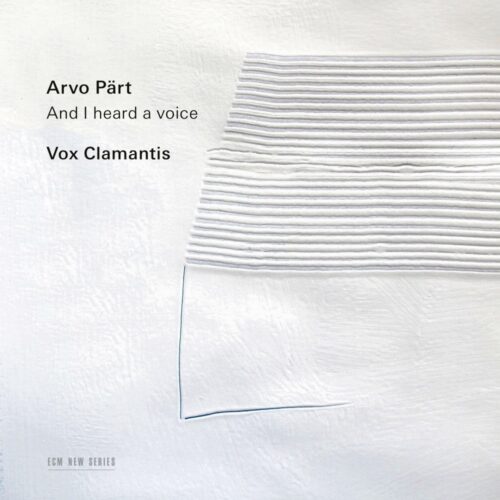 Few major composers have crafted a bigger or more important body of choral music over the last fifty years than Arvo Pärt. Now 90, the Estonian master appears to be winding things down, not just on account of his age but because of his health: reports emerging around his birthday in September indicated he was suffering from dementia and had ceased composing.
Be that as it may, there was a consistency of focus and quality that marked Pärt’s incredibly long creative life, as Vox Clamantis’ new album, And I heard a voice…, attests. Released earlier this year to mark the composer’s milestone, the recordings pairs four choral works written since 2015 with two of earlier vintage. Between the half dozen, they showcase a composer of remarkable stylistic coherence—but never dramatic complacency or creative stasis.
The disc’s single biggest item is also its most recent, Pärt’s 2021 setting of O Holy Father Nicholas. Comprised of a repeated series of short prayers drawn from the Orthodox Prayer Book, this nearly 11-minute-long effort offers an opportunity to focus on certain traditional musical elements: the beauty of sonority, plays of consonance and dissonance, and text painting among them.
At the same time, the score reveals that, in the right hands, there’s much yet to be done and said with these old devices. Pärt’s management of his texts is smartly paced, moving from an essentially homophonic (and homorhythmic) opening to textures of greater rhythmic activity and counterpoint over the score’s second half. At the end comes a somewhat unexpected statement of the “Gloria patri.”
Vox Clamantis, which is led by Jaan-Eik Tulve, delivers a reading of O Holy Father Nicholas that is both bright-toned and rich-textured. Diction, especially at the beginning, is precise, and the intensity of the ensemble’s devotion carries through several of the score’s charged pauses.
Coming from the opposite end of the chronological spectrum, Pärt’s Sieben Magnificat-Antiphonen of 1988 benefited from a similar sense of performative direction. As a result, the music’s occasionally stark illustrations—like the piercing pleas for deliverance in Nos. 2 and 3 and No. 7’s hopeful invocations for guidance—speak with special urgency.
Meanwhile, the resonant, atmospheric Nunc dimittis of 2001 unfolds with hypnotic purity and terrific ensemble blend. Particularly notable are its piercing dissonances and the ecstatic “lumen ad revelationem” section.

Arvo Pärt and Jaan-Eik Tulve. Photo: ECM
Pärt’s gifts as a miniaturist are on display in the album’s last three selections, all of which date from between 2015 and ’19. The oldest of those, the inward Kleine Litanei, thrives on the tension between major and minor sonorities.
In contrast, Für Jan van Eyck is marked by gentle, dance-like leaps and a noble, final verse. Here, everything sounds utterly unhurried—yet the music hardly feels like it’s dragging.
A similar aura of timelessness marks the title track, a setting of a brief passage from the book of Revelation (one also set, coincidentally, by Brahms in his Deutsches Requiem). Haunting and lovely, marked by a series of absolutely enchanting progressions across its second half, And I heard a voice… makes for a touching closer.
Perhaps, given the context, it can be heard, too, as an epitaph for Pärt. Either way, this is music that sketches a picture of simplicity that is anything but trite; rather, it’s a tapestry rich in subtlety, beauty, devotion, and meaning.
Jonathan Blumhofer is a composer and violist who has been active in the greater Boston area since 2004. His music has received numerous awards and been performed by various ensembles, including the American Composers Orchestra, Kiev Philharmonic, Camerata Chicago, Xanthos Ensemble, and Juventas New Music Group. Since receiving his doctorate from Boston University in 2010, Jon has taught at Clark University, Worcester Polytechnic Institute, and online for the University of Phoenix, in addition to writing music criticism for the Worcester Telegram & Gazette.
Tagged: -Arvo-Pärt, ECM New Series, Jaan-Eik Tulve