
Book Review: The “Night” Movies of Film Critic A.S. Hamrah
By Peter Keough
Once again, critic A.S. Hamrah sheds perceptive light on our cinematic malaise.
The Algorithm of the Night: Film Criticism 2019-2025 by A.S. Hamrah. n + 1. 554 pages. $23
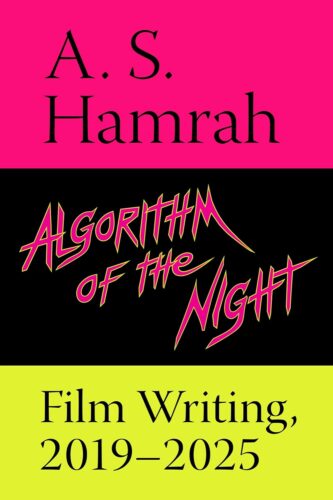 If film criticism – and film itself – survive the ongoing cultural, political, economic, and technological onslaughts they face, it will be due in part to writers like A. S. Hamrah. His latest collection (there are two, in fact; I have not yet read Last Week in End Times Cinema, but I am sure that it will also be the perfect holiday gift for the dystopic cinephile on your list) picks up where his previous book The Earth Dies Streaming left off, unleashing his savage indignation on today’s fatuous, lazy critical conversations and the vapid studio fodder that sustains it.
Not that it is all negativity. This inexhaustibly illuminating and entertaining assortment of reviews, essays, mordant Oscar roundups, and freewheeling, sui generis bagatelles first seen in such publications as n+1 (for which he is the film critic), The Baffler, the New York Review of Books, and the Criterion Collection is filled with numerous laudatory appreciations of films old and new — all of which you should watch or watch again. I was impressed with his eloquent, insightful praise for Debra Granik’s Leave No Trace (2018), his shrewd analysis of Abbas Kiarostami’s masterpiece A Taste of Cherry (1997) and its mixed critical reaction, and his reassessment of John Sayles’s neglected epic of class warfare Matewan (1987), among many others.
Also not to be missed are Hamrah’s absurdist ventures into his personal life, many in theaters (or not in theaters, as when Covid shut them down in 2020), such as the time he observed a menacing attendee at a screening of 2010’s Joker. “It would be best to see [Joker] in a theater with a potential psychopath for that added thrill of maybe not surviving it,” he concludes. One strikingly admirable characteristic of Hamrah’s criticism is that he consciously avoids writing anything that could be manipulated by a studio into a banal blurb. You will find no “White knuckle thrill ride” or “Your heart will melt” or “A monumental cinematic experience” here.
The book does boast a bounty of blurbable bits, but they are not the kind that any publicist will put in an ad. These are laugh-out-loud takedowns of bad movies, vain filmmakers, and vapid performers. Some of my favorites among these beautiful barbs include his description of The Banshees of Inisherin (2022) as “[S]horter than Wakanda Forever by a whopping 47 minutes but still too long,” his dismissal of Jojo Rabbit (2019) as “combining Quentin Tarantino and Wes Anderson in the worst, cop-out ways,” and his exasperated take on Edward Berger’s 2022 remake of All Quiet on the Western Front (“What happened to the German cinema?”).

Film critic A. S. Hamrah — another inexhaustibly illuminating and entertaining assortment of writings on film. Photo: n+1 benefit.
He also displays the rare critical ability to reassess a director and give him his due. In his review of Berger’s 2024 Conclave, he admits that “Berger directs [it] like he is a totally different filmmaker than the one who made the 2022 version All Quiet on the Western Front. Unlike that film, this one is highly burnished and tightly wound.” (Watch out – close to blurb material there!)
The book ends with an apotheosis of the listicle called “Movie Stars in Bathtubs: 48 Movies and Two Incidents” in which Hamrah summarizes nine decades of cinema. It ranges from Louis Feuillade’s 1916 silent crime serial Les Vampires (“‘It is in Les Vampires that one must look for the great reality of our century’ wrote the surrealists Aragon and Breton”) to Brian De Palma’s 2002 neo-noir Femme Fatale (“There is a picture book called Movie Stars in Bathtubs, but there aren’t enough movie stars in bathtubs. De Palma’s Femme Fatale, which stars Rebecca Romijn, does much to correct that.”)
Around the volume’s midpoint, Hamrah includes one of the two “incidents” of the title. In “1951: The first issue of Cahiers du Cinema” he celebrates the astonishing cadre of cinephiles, many of whom are depicted in Richard Linklater’s recent film Nouvelle Vague, who put out the publication that reinvented an art form. “Unlike critics today,” Hamrah points out, “these writers did not complain that they were powerless. They defended the movies they loved and excoriated the ones they hated. For them film criticism was a confrontation, its goal to change how films were viewed and how they were made.” It’s a tradition that Hamrah, who combines the personal point of view and cultural literacy of James Agee with the historical, contextualizing vision of J. Hoberman, triumphantly embraces.
Peter Keough writes about film and other topics and has contributed to numerous publications. He had been the film editor of the Boston Phoenix from 1989 to its demise in 2013 and has edited three books on film, including Kathryn Bigelow: Interviews (University Press of Mississippi, 2013) and For Kids of All Ages: The National Society of Film Critics on Children’s Movies (Rowman & Littlefield, 2019).
Tagged: "The Algorithm of the Night: Film Criticism 2019-2025", A.S. Hamrah, film criticism
“These writers did not complain that they were powerless. They defended the movies they loved and excoriated the ones they hated. For them film criticism was a confrontation, its goal to change how films were viewed and how they were made.”
Replace the word “film” with “theater” in Hamrah’s admirable toast to movie critics of yesteryear. His demand fits what critics of the stage are called to do, but don’t — most of our opionionators are mired (happily!?) in a sinkhole of publicity.
A very nice appreciation of the works of an excellent film critic.