
Theater Review: Wheelock Family Theatre’s “Annie” Radiates Hope but Misses an Opportunity
By Joan Lancourt
Conveying the value of hope and resilience are undoubtedly important, but positing social and civic responsibility is also essential, and Annie clearly offers that opportunity.
Annie Book by Thomas Meehan. Music by Charles Strouse. Lyrics by Martin Charnin. Directed by Nick Vargas. Choreographed by Joy Clark. Music Direction by Jon Goldberg. Staged by the Wheelock Family Theatre at the Boston University, Fenway Campus, 200 The Riverway, Boston, through December 21.
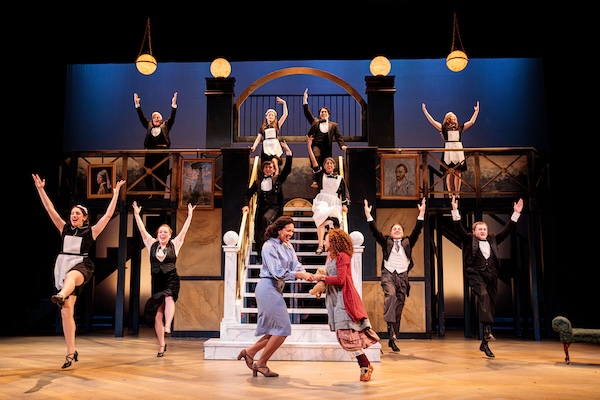
The cast of the Wheelock Family Theatre production of Annie. Photo: Benjamin Rose Photography
In a bit less than a month, our nation will mark its two hundred and fiftieth anniversary. Whether we will have cause for celebration is an open question. However, there’s another anniversary that is clearly cause for celebration. Wheelock Family Theatre (WFT) is forty-five years young and is celebrating with an optimism-infused production of a classical American musical, Annie. This Tony Award-winning play premiered on Broadway in 1971 and has been a staple in theaters large and small across the country ever since.
With wonderfully flexible sets by Ryan Bates, and a high-energy cast, director Nick Vargas (WFT’s Executive Director) has elicited engaging performances from a large cast of professional adults and aspiring young actors (and one well-trained dog). All assembled seamlessly represent on stage a racial and ethnic mix reflective of the kids and adults you would see in most urban settings. (Vargas also is rightly proud that WFT’s audience represents most of the greater Boston zip codes.)
In an interview, Vargas said that he chose the play because he felt it offers a much needed uplifting message about how perseverance can overcome adversity. Also, how one can achieve a sense of belonging and community through the creation of a ‘found family.’ Annie’s resilience and sense of hope provide an important role model for the theater’s young audience. In truth, given these difficult times, it’s a lesson even adults can benefit from. The ethos of the musical, its inspiring message embodied in the lyrics of one of its most popular songs, “Tomorrow,” supplies a welcome antidote to the fear and anxiety that infect our current national climate.
The story opens with Annie, performed admirably by a winsome and accomplished Sky Vaux Fuller, singing about the “hard-knock” life with a group of fellow orphans. The brisk and energetic choreography by Joy Clark gives lie to the sense of exhaustion or gloom that would typically accompany a real ‘hard-knock’ life. Similarly, the ensuing scenes depicting the Depression era lack a convincing sense of how that national catastrophe squeezed the dignity out of the millions of men and women — daily life became little more than a soul-crushing struggle to stay alive and keep the family together. But then, gritty realism is not what the American musical is all about. Instead, we have the fun provided by Shannon Lee Jones as Miss Hannigan; the actress strikes just the right note of teasing menace as the mean-spirited matron of the orphanage. Her glee in finding every opportunity she can to punish one or another of the children is what keeps her going. We’re also treated to the sparkling personality infused into the production by the diminutive Audrey Chan, in her mainstage debut, as the orphan, Molly.
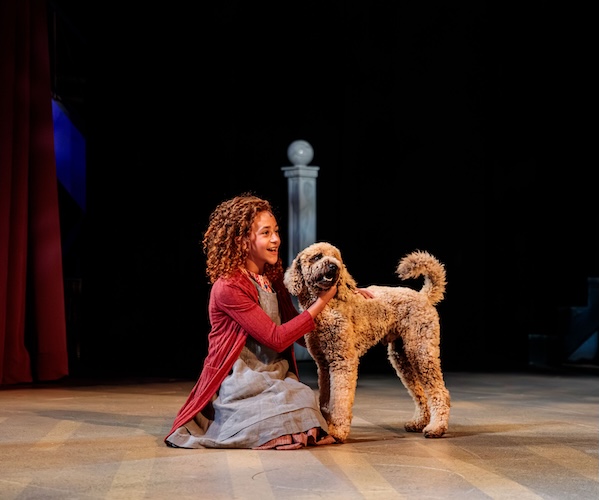
Sky Vaux Fuller as Annie — with Sandy — in the Wheelock Family Theatre production of Annie. Photo: Benjamin Rose Photography
But Annie, undaunted by Miss Hannigan, is intent on her quest to find her real parents. She is certain she will find them, and she escapes from the orphanage, wandering through a poverty-stricken New York City Hooverville (the 1930s version of a homeless encampment). Predictably, she is caught by the police and returned to Miss Hannigan, only to serendipitously become the lucky winner of a dream opportunity to spend the holidays with Oliver Warbucks, the richest man in the country. This interrupts her search long enough for her and Pearl Scott, as the warm and charming Grace, Warbucks’ executive assistant, to sing “I Think I’m Going to Like it Here,” another high-energy number praising the wonders of luxury living in Warbucks’ mansion. De’Lon Grant plays the rags to riches billionaire Warbucks as a youthful, kindly, albeit somewhat absent-minded tycoon. He soon realizes that despite his fortune, something important is missing in his life, and he proposes to adopt Annie.
However, when Annie refuses, still intent on finding her real parents, he taps his considerable corporate political connections, enlisting both President Franklin Delano Roosevelt and CIA Director J. Edgar Hoover to search for her parents, sweetened by a $50,000 reward. That invites the plotting of Rooster, the ne’er-do-well brother of Miss Hannigan, and his accomplice, Lily (played respectively by a rakish Cleveland “Mac” Nicoll and an oh-so-willing Kara Chu Nelson). The three conspire, scheming to split the $50,000 by having Rooster and Lily pose as Annie’s down-on-their-luck parents. They are, of course, ultimately unmasked, and we are treated to another touching number with Annie and ‘Daddy’ Warbucks singing “I Don’t Need Anything But You.”
The final song, “A New Deal for Christmas,” finds FDR telling Annie, “You’re the kind of person a president should have around,” and says that he intends to get everyone “back to paying taxes.” What is needed, he muses, is a . . .a new vision, no . . . a new dedication, no, no, . . . a New Deal, and he firmly opines that “the only thing we have to fear is fear itself.”
Yes, it is the requisite happy ending, but I was troubled by the way the WFT production ignored the opportunity to engage the young audience in learning something about the Depression and the New Deal, one of the most important periods of American history. I believe theater for young audiences has a responsibility not only to provide high-quality entertainment, which WFT certainly does, but to use the unique reach of the arts to engage young people in thinking about the world beyond their own, including an understanding of their civic responsibilities as engaged members of a democratic society.
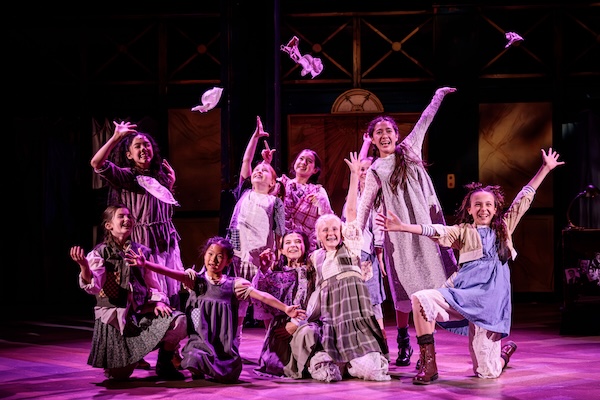
Annie and orphans in the Wheelock Family Theatre production of Annie. Photo: Benjamin Rose Photography
Conveying the value of hope and resilience are undoubtedly important, but positing social and civic responsibility is also essential, and Annie clearly offers that opportunity. But the WFT Educational Guide contains no information on the New Deal, or about the nation’s struggle against fascism, racism, and the othering of the various immigrant communities. It is impossible to believe that today’s children — especially the tweens and teens — are unaware and unaffected by the daily images of masked ICE agents brutally snatching people of color off our streets. To provide no pedagogical material about the historical context of the play is a puzzling omission. Another serious lost opportunity: to leave the image of Warbucks as a kindly, benignly helpful corporate tycoon uncontested.
Junior Programs, Inc., (1936 – 1943) a pioneer in theater for young audiences during the very time in which Annie takes place, knew it had a responsibility to prepare the next generation for their role as citizens in a democracy. Through a series of strategic partnerships with leading institutions of higher learning, they provided detailed, grade-appropriate curricula for K-12 academic subjects that addressed the civic issues embodied in each of their productions. If it had produced a play like Annie, Junior Programs, Inc. would have provided a robust curriculum on the social, cultural, political, economic, and artistic issues for teachers of history, social studies, political science, and literature. JP’s modules were designed to be easily integrated into the existing curriculum, and they were enormously popular, partly because they positioned theatrical productions as catalysts for dialogue. The modules became guides that invited young people to become part of deep and extended conversation about critical civic issues and helped students explore and develop their own sense of agency. WFT might consider doing something similar in the future. It is imperative that every opportunity available be used to prepare our children to support and protect our fragile democracy.
Joan Lancourt, Ph.D., is a local author, most recently of More Than Entertainment: Democracy and the Performing Arts –– Junior Programs, Inc. (1936-1943) Pioneers of Theater for Young Audiences. The book’s website is www.juniorprogramsbook.com
The companion guide is not mean to be a social and economic history of the Great Depression, One could also make the argument that while Annie is set in the Depression it is as much about themes of family regardless of the economic times. As for the show it was well sung and the choreography was well done and that is what often separates regional professional and semi professional theater from some local theater productions who often don’t have both singing and dance skills. As for the sets they were average at best. It was amusing that there was no desk with a pen for in the Mansion scene. Warbucka somehow presents a check that has on it “the jig is up” that is in his jacket pocket even though he just learned who Mudge really was. I guess minor details. Also your comments on the song New Deal for Christmas make no sense. All the references about taxes and the other items is from dialogue after the Cabinet Tomorrow song. So, if you are doing a review you should try to be more accurate.