
Concert Review: Joshua Bell, Anna Handler, and the BSO Confront de Hartmann’s Haunted Ukrainian Concerto
By Aaron Keebaugh
The destruction and displacement of people today so recall the past that Thomas de Hartmann’s music resounds with fierce, resonant force.
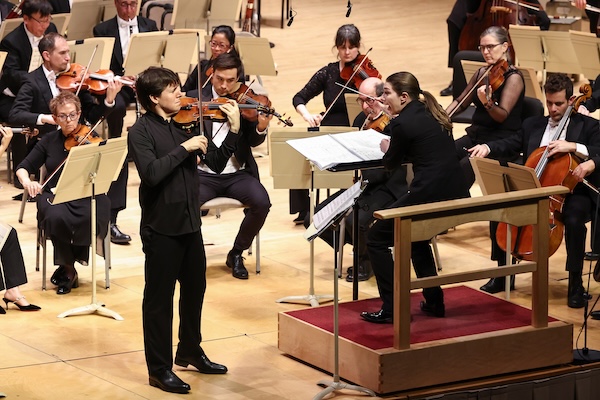
Boston Symphony Orchestra performing at Boston’s Symphony Hall, Anna Handler conductor, Joshua Bell, violin. Photo: Winslow Townson
Composer Thomas de Hartmann may have enjoyed an idyllic youth in Ukraine. But by 1943, in his absence, the Second World War decimated the country.
By that time, de Hartmann had been away from his native land for several decades. But the terrors of war caught up with him, and they permanently affected his recollections. In 1943, he was living in an abandoned house in Courbevoie, France. The Nazi occupation had driven him from his Parisian home. He set to work, despite the troubling time, to put pen to paper and evoke his anguish at the conflagration of senseless violence.
What emerged was his Violin Concerto, a score so rife with nostalgic yearning that musicologists have described it as a musical mourning for the decimation of Ukraine during WWII. 80 years on, little has changed. Ukraine is once again ravaged by bloody conflict brought on by the Russian invasion launched more than three years ago. The destruction and displacement of people today so recall the past that de Hartmann’s music resounds with fierce, resonant force. So thought violinist Joshua Bell when he recently discovered de Hartmann’s Violin Concerto. He recorded the work in 2024 with the Lviv Symphony Orchestra under the baton of Dalia Stasevska. The performance found little hope or solace in the score, which was filled with dark ruminations played out through wailing lines and biting Klezmer passages. In this piece, de Hartmann dramatizes his haunted memories. And, last weekend, Bell and the Boston Symphony Orchestra evoked the tension and desperation of that troubled state of mind, all too relevant today. BSO assistant conductor Anna Handler led the way though this remembrance of things past in her Symphony Hall debut.
I heard Friday afternoon’s performance, which felt surprisingly understated. The opening bars established a somber scene. Bell’s line emerged like wafts of smoke; he was more of a sleekly ghostly presence than a heroic one. The violinist’s silvery radiance was offset by shouts from the brass, reminders that all was not well in this memory. Yet, even amidst this infusion of bleakness, Bell generated flickers of warmth.
That effect continued into the Andante, which glowed with hymn-like reverence. Still, here, too, moods change on a dime. Brief silences break up the energy of melodic lines, as if the music can barely contain a repressed emotional trauma. Darkness returns in the Menuet fantasque, and Bell captured its fleeting black comic levity. The finale exploded with a ferocity generated by soloist and orchestra alike. If Bell serves as a comforting presence earlier in the performance of this concerto, here he was a driving, demonic force — he channeled the rage that lies beneath painful remembrances. Handler kept the orchestral forces in ideal balance, framing Bell’s fiery panache during the compositions Klezmer flourishes and snatches of jazzy rhythms.
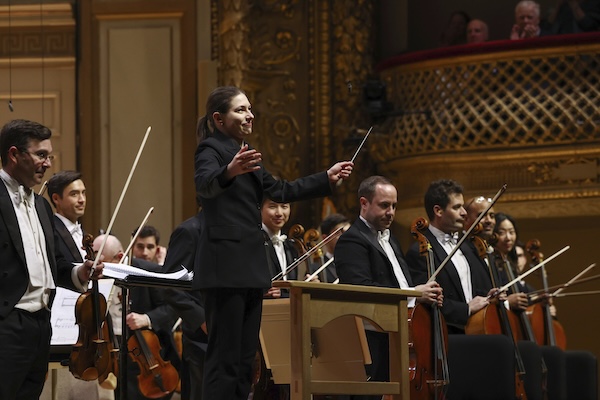
Conductor Anna Handler being applauded at her Symphony Hall debut. Photo: Winslow Townson
For an encore, Bell and the orchestra played the violinist’s arrangement of Chopin’s familiar Nocturne in E-flat, Op. 9, No. 2. The performance was in memory of Scott Nickrenz, longtime music director of the Gardner Museum, who died this past March. Bell’s bittersweet tenderness made for a fittingly moving memorial.
After intermission, Handler led a bold account of Mussorgsky’s Pictures at an Exhibition, heard in Ravel’s familiar orchestration. She led the BSO, maintaining keen attention to every shift in color and dimension. Her brisk gestures drew out the regal pomp of the “Promenade,” the dreariness of the “Catacombs,” the eerie grotesqueries of “Gnomus,” and the terrifying power of “The Hut of Baba Yaga.”
The musical depiction of the marketplace at “Limoge” frolicked. As did “The Ballet of the Chicks in their Shells.” Handler’s quick tempos never undercut the grandeur of “The Great Gate of Kiev”.
BSO principals made superb showings in their featured moments. Trumpeter Thomas Rolfs’s solo in “Samuel Goldenberg and Schmuyle” verged on desperation that was called for. Mike Roylance’s tuba sang mournfully in “Bydlo.” Richard Svaboda’s bassoon conveyed the creaky loneliness of “The Old Castle.”
The concert opened with another musical portrait inspired by visual art. Composer Grace-Evangeline Mason based The Imagined Forest on the work of Berlin-based installation artist Clare Celeste Börsch. Mason described her score as supplying a “forest for your imagination.” That description fit the vibrant colors that emanated from a single pitch played by solo trumpet. But this music was neither rooted in Sibelian forests or Delian summer gardens. Rather, Mason’s score seesaws between pristine clarity and plush resonance. There is a touch of the genially Darwinian: the instruments vie for the spotlight, like plants reaching for the sun. Handler and the BSO reveled in the piece’s radiant splendor. Let’s hear more from Mason. And soon.
Aaron Keebaugh has been a classical music critic in Boston since 2012. His work has been featured in the Musical Times, Corymbus, Boston Classical Review, Early Music America, and BBC Radio 3. A musicologist, he teaches at North Shore Community College in both Danvers and Lynn.
Tagged: Anna Handler, Boston Symphony Orchestra, Grace-Evangeline Mason, Joshua Bell