
Film Review: “Hamnet” — Not to Be
By Peter Keough
In Chloé Zhao’s Hamnet, the Bard is a bore.
Hamnet. Directed by Chloé Zhao, adapted from the novel by Maggie O’Farrell. Opens November 26 at the Coolidge Corner, Kendall Square, Boston Common, and suburbs.
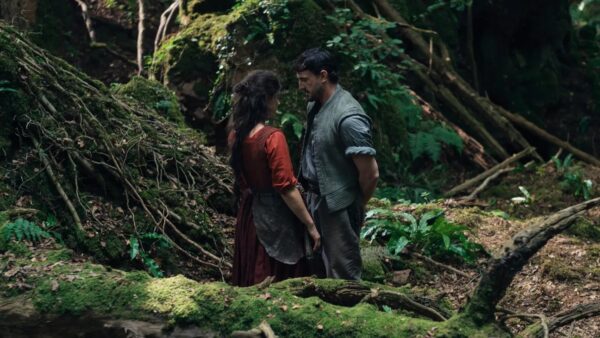
Jessie Buckley and Paul Mescal in Hamnet. Photo: Focus
In two recent film adaptations – of Denis Johnson’s Train Dreams by Clint Bentley and Maggie O’Farrell’s Hamnet by Chloé Zhao – people undergo devastating loss and struggle to respond. In the former, an anonymous drifter fumbles inarticulately for meaning, and the resultant film is a work of art. In the latter, William Shakespeare turns his pain into one of his greatest masterpieces, but the film is an overwrought, pretentious tearjerker.
Not that Zhao – whose second film The Rider (2017) evinces the same kind of spare, limpid poetry as does Bentley’s film – had a lot to work with. O’Farrell’s much-lauded novel is a bloated and meretricious mess. Nor is it the first fiction to pose a connection between the death of Shakespeare’s 11-year-old son Hamnet and the inspiration for Hamlet. In what I think can safely said to be a more lasting literary achievement, James Joyce’s Ulysses contains an entire chapter arguing the case.
Nonetheless, for about the first third, it looks as if the film might transcend its source. Young Will Shakespeare (Paul Mescal, a bit long in the tooth for the 18-year-old Bard) is tutoring the dullard sons of a neighbor to pay off his abusive father’s debts. He spots from the window the Yeatsian vision of a woman emerging from the woods with a hawk.
It’s Agnes Hathaway (Jesse Buckley), whom the people of Stratford rumor to be a witch child. She possesses a knowledge of herbs and certain occult talents which she demonstrates when she grasps Will by the base of his thumb and recognizes a genius whose mind contains worlds beyond mere mortals’ grasp. Though initially playing hard to get, she soon yields to his attentions (note to guys – the story of Orpheus and Eurydice is catnip for chicks). They recognize that they are both unique, gifted beings that the mediocre masses spurn, which bonds them to each other. Then follows the requisite bliss montage, pregnancy, and a hasty and somewhat controversial marriage.
Zhao conveys this exposition through tasteful images, an evocative if occasionally overdone score, and just a hint of the heavy emoting to come. In the first of the requisite agonized birth scenes, the director shows some restraint, as Agnes flees the oppressiveness of Will’s parental home to a favorite spot in the woods, a great tree with a dark opening where, as her crimson gown contrasts with the mossy green of the surroundings, she huddles to give birth. This image — the opening in a tree leading into blackness — will recur throughout the film, matched later by a doorway in the fake forest scenery at Will’s London theater that passes through illusion into the void.
That subtlety gives way to hamminess, mawkishness, and absurdity, a shameless effort to exploit the universal experiences of frustration, rage at iniquity, and grief. Mescal starts it off, chewing the scenery as a drunken Will agonizes in a candle-lit attic attempting to write his masterpieces. Agnes sees his need to escape the tyranny of his father, the strictures of a growing family, and the oppressiveness of a future as a glovemaker. She orders him to go off to seek his fortune in London.
Then it’s Buckley’s turn. Once again she gives birth, indulging in its agonies but with enough strength left over to endure a flashback to the death scene of her own mother. This time she gives birth to twins, but one, the girl, is stillborn! Everyone weeps! But no, Agnes coaxes her back to life! Tears of relief! But later, the plague strikes the 11-year-old bonded pair, first Judith, then Hamnet, who offers his life in return for hers to the specter of Death. He kicks the bucket entwined with his surviving sister — just before the errant father can rush home from touring with his company — giving Mescal the opportunity to indulge in the grief orgy with an added twist of guilt.
These performances bring to mind Hamlet’s thespian advice to the players:
O, it offends me to the soul to hear a robustious periwig-pated fellow tear a passion to tatters, to very rags, to split the ears of the groundlings, who for the most part are capable of nothing but inexplicable dumb shows and noise.
I suspect Hamlet would not have approved of the acting in Hamnet.
Agnes turns on Will, never letting him forget that he wasn’t there when it mattered most, forgetting perhaps that it was she who insisted he move out in the first place (unlike the book, the film fails to register that Agnes herself feels guilty because all her eldritch cures were in vain). Thus defeated, Will heads back to his career, with the dim hope — perhaps — that he can turn this tragedy into, well, a tragedy.
And then (spoilers?), the inevitable play, and what might be the worst adaptation of Hamlet ever performed on screen, with, among other bedevilments, the “To be or not to be” soliloquy presented like a TED talk. Agnes. sitting in the audience, behaves like one of those obnoxious people who insist on loudly asking dumb questions or stating the obvious. Still, once again Zhao’s cinematic instincts briefly rally. In what might be the film’s most heart-wrenching moment, Agnes reaches out to Hamlet, dying at the foot of the stage, hesitantly taking his hand. Hamlet sheds a tear, maybe you’ll shed a tear, but then all the other groundlings start reaching out, and they burst into tears. The filmmakers clearly hope audiences everywhere will be reaching for their hankies, too.
Peter Keough writes about film and other topics and has contributed to numerous publications. He had been the film editor of the Boston Phoenix from 1989 to its demise in 2013 and has edited three books on film, including Kathryn Bigelow: Interviews (University Press of Mississippi, 2013) and For Kids of All Ages: The National Society of Film Critics on Children’s Movies (Rowman & Littlefield, 2019).
“I suspect Hamlet would not have approved of the acting in Hamnet.”
Indeed.
I’m not looking forward to seeing this one. Thanks for the fair warning, Peter.
Amazing how Agnes wears that same red dress for 2/3 of the film. The years pass, the kids age, but Agnes and Will do not. I suspect the main actress will need to see an ENT specialist after all of that screaming.
Totally agree with reviewer. No pace in this film
Over hyped. Unsubtle
I thought the characters were shallow and over-dramatic and the Agnes character was clichéd. Also a poor script.
It was nice to look at, but left me cold emotionally.
Such a stretch from the little boy to the unpleasant character of Hamlet – made no sense!
Most of the film is alright, if not as profound as it thinks it is. But the last 20 or so minutes is a steaming pile of hokum that makes you wonder what everyone was smoking.