
Book Review: Lea Ypi’s “Indignity” — Reimagining a Life in the Ruins of History
By David Mehegan
This tragic, absorbing, and moving quasi-novel is best characterized as a “tour de force”.
Indignity: A Life Reimagined by Lea Ypi. Farrar, Straus & Giroux. Cloth. 338 pp. $29.
In more than forty years of reviewing I have never employed the cliché “tour de force” to refer to a book. But I can think of no better characterization for this quasi-novel, especially when paired, as it should be, with Free: A Child and a Country at the End of History, its 2022 nonfiction predecessor. When read in succession, they constitute a rare, tragic, absorbing, and moving blend of 20th century history and literary art.
Lea Ypi is an Albanian professor of philosophy at the London School of Economics and Political Science, a frequent analyst and commentator in political journalism. Born in 1979 during the fanatical communist regime of Enver Hoxha (pronounced HO-ja) – for whom neither the Russian nor the Chinese communists were extreme enough – she and her family experienced the regime’s fearsome repression, its chaotic 1991 collapse, and the 1997 civil strife that followed. Free is the vivid account of that progression as reflected in the lives of her family: herself and little brother, oft-quarreling parents, and especially her paternal grandmother, Leman, whom she calls Nini.
In the worst times, the parents quietly paper over the truth about the authorities and their crimes while Lea believes all that she is taught in school about the goodness of “the Party” and benign “Uncle Enver.” Still, she puzzles over the many mysteries, secrets, and contradictions in her adults’ words, confusions that are only sorted out after the regime falls. Then she learns that part of the terror they lived through was that Lea’s great-grandfather, Asllan Ypi (the same name as her late grandfather), had been prime minister in the pre-war, pre-communist government. And her grandfather had been friends with young Hoxha – no advantage later with that creep — when both were students. (In the novel, Hoxha is said to smell of lavender and onions.) The family was constantly under suspicion, spied upon, at the risk of possible denunciation and catastrophe.
Nini is the stable hub of the family: multilingual (often speaking French), loving, discreet, wise, and patient. It seems that she never lies — but she does not tell all that she knows. With her mother’s de facto emigration to Italy in 1997, Lea remains with her father and grandmother in Tirana, until later that year she also (against her father’s wishes but with Nini’s support) leaves for college in Italy to study philosophy. Save for short visits, she never returns. At Nini’s graveside in 2006, described near the end of Indignity, Lea said, “Leman Ypi, my grandmother, taught us how to reconcile love with reason, and how to endure pain with dignity.”
However, she was not finished with Nini. Free was an international bestseller (published in the U.S. by W.W. Norton). Later, Ypi was shocked to see a photo of her grandmother and grandfather on their 1941 honeymoon at an Austrian ski resort, posted on social media by a stranger. Here was young Leman enjoying an alpine holiday in Nazi Austria while Europe was in flames. How was that possible?
The photograph gnawed at her, reminding her how little she knew of her grandmother’s story prior to that narrated in Free. She plunged into historical research in state archives, now open to the public in Albania, and in sources in Greece to find the real Leman. She even taught herself to read Greek. But rather than simply write what she found as nonfiction — hewing to exactly and only what documents reveal — she resolved to tell, largely in fictional form, a deeper story of Nini from childhood to marriage and parenthood amid the chaos of war, revolution, migration, repression, and personal relations. “Largely” because interwoven with the belletristic sections are episodes of Ypi’s searches in archives and international locations. No surprise, there was an extensive record of police surveillance. Near the end of her investigations, she makes an astonishing discovery that would never be plausible in fiction but, on reflection, it is is in keeping with the impossibility of fully understanding the human past.
I have always distrusted “fictionalized” history, the sort that mixes real people with characters who are composite or invented. How can one believe what one is reading, separate the known from the imagined? Yet it turns out that Ypi the political philosopher is also an extraordinarily talented novelist. Her pacing, characterization, crafting of dramatic scenes, large and small details, dialogue, and emotional atmosphere in Indignity are so persuasive that it seemed to me not to matter if she has historical details exactly right.
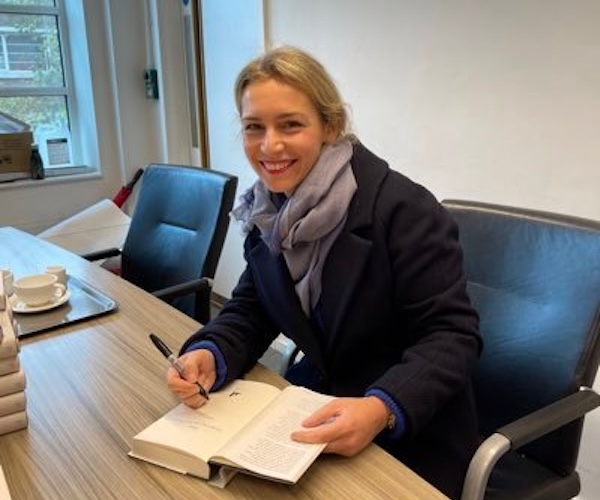
Author Lea Ypi. Photo: courtesy of the artist
Leman Ypi was born to an affluent elite Albanian family in Salonica, when Greece and Albania were both part of the Ottoman Empire. When her independent-minded Aunt Selma commits suicide to avoid an arranged marriage with a repulsive German fascist businessman, the whole truth is hidden from Leman for years. But, when the same businessman comes sniffing around her as a young adult some years later — looking for a Selma replacement — she explodes his scheme by fleeing Greece for Albania to seek her education. Throughout her painful Albanian life under war and oppression, though she never regrets that flight, the memory of halcyon Salonica remains with her.
The political, ethnic, religious, linguistic, and military maelstrom of the pre- and postwar Balkan world would be too complicated for most western readers, so Indignity helpfully includes maps, a cast of characters, an explanation of Ottoman honorific titles, a “note on Albanian pronunciation,” and a historical timeline from the Ottoman conquest of the Balkans in 1362 to the founding of the Albanian Communist Party in 1946. (BTW, the Y in Ypi has an elongated u sound, like the German über.)
It’s hard to choose among the numerous examples of Ypi’s restrained and razor-sharp fiction style, but here is one, from the morning of Selma’s wedding day, about 1930. The little girl Leman has been sent by her formidable grandmother, Mediha Hanim, doyenne of the event, to Selma’s bedroom to ask when she will appear:
“When Leman returned, a few minutes later, she could hear from afar the laughter, the exclamations of admiration, the compliments on the appetizers that had just started to be served, the clatter of dishes and clinking of glasses. Standing in the doorway, clutching the small empty flask she had discovered on Selma’s bed, she trembled in every limb, her face as pale as a waxen statue. She peered into the room, unsure of what to do next. Eventually, Mediha Hamim took notice.
“’Ah, te voila!,’ she said. ‘When shall we see the bride?’
“Leman approached her grandmother slowly, stopping to look around at every step. When she felt the guests’ eyes on her, her body started to shake uncontrollably. She looked up at the chandelier, and felt as if it would come crashing down on her.
“’She … she … Selma isn’t moving,’ she murmured, her hand instinctively rising to her mouth, as if to suppress the rest of the sentence. ‘She’s wearing her wedding dress, but her face is turned away. And … and … I tried to rouse her … but I can’t, she is so heavy.”
Soon the traumatized grandmother is screaming. “Why,” she cries inconsolably, “my love, my beautiful, my clever Selma, why, my angel, my bright star, how could you do this to me, how?” The little girl is told that a stroke has killed her aunt.
As the title suggests, at its heart this is an inquiry into the nature of dignity and its opposite. Leman was no revolutionary nor any sort of political heroine or activist, yet she managed to keep her moral balance, seemed always to speak the truth — however truncated for safety — to maintain her dignity when others discarded theirs for gain. It was the sort of life and character, as Linda Loman famously says of husband Willy in Death of a Salesman, to which “attention must be paid.” Ypi writes, “I feel compelled to rectify, to share the stories she entrusted to me, to tell the truth of her life. But do I even know the truth? Can I recount her life the way she would have done?”
If she fell short of that goal in her own eyes, nobody will do better.
David Mehegan is the former book editor of the Boston Globe. He can be reached at djmehegan@comcast.net.