
Book Review: “Crimean Fig” — Everything Has Its Own Soul
By Michael Londra
The authors assembled in “Crimean Fig” demonstrate they are unafraid to speak up for Tatar language and culture, while simultaneously speaking out against Putin, unwilling to submit.
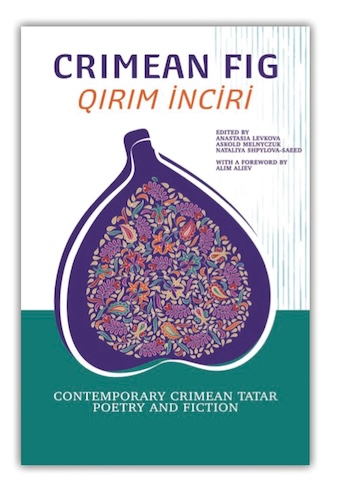
Crimean Fig: Contemporary Crimean Tatar Poetry and Fiction, edited by Anastasia Levkova, Askold Melnyczuk, Nataliya Shyplova-Saeed, with an introduction by Alim Aliev. Arrowsmith Press, 128pp, $18
According to his son, “Noli timere” — Latin for “don’t be afraid” –was Seamus Heaney’s final utterance before he passed away in 2013. The Nobel laureate’s valediction is usually interpreted as solace, encouraging bravery when facing mortality. But Heaney’s counsel also works equally well as life advice — fearlessness as moral and aesthetic imperative — whether you are an artist confronting a blank canvas, for example, or a political dissenter opposing fascist dictatorship.
Speaking to both roles, Crimean Fig: Contemporary Crimean Tatar Poetry and Fiction unites ethical purpose with artistic courage. First of its kind, this anthology collects eight authors from a region perhaps best known to the Anglophone world as occupied territory illegally seized by Russia’s military 11 years ago — an alarming prelude to Putin’s ongoing genocidal war against Ukraine. Indigenous to the Crimean peninsula, the Tatar people have existed beside the Black Sea for over a thousand years, embracing the Sunni branch of the Islamic faith in the 13th century. Despite such longevity, co-editor Askold Melnyczuk notes in his foreword that the Tatar language is “listed as one of the most endangered on the planet.” He goes on to say that when he “asked where I might be able to read contemporary Crimean Tatar literary work, I was stunned to discover that virtually nothing was available in English.” Borrowing its title from the peninsula’s beloved fruit, Crimean Fig attempts to rectify this state of affairs, shining a light on “a neglected…trove of undiscovered literature from that ancient yet enduring culture forged over centuries.”
Beginning with the introduction, “What Do We Know About Crimea?” by PEN Ukraine journalist Alim Aliev, the volume’s principled tone is foregrounded: “Crimea is more than a site of tragic events or a source of breaking news — it’s an incredibly beautiful place with sea, mountains, and steppe, a constellation of ancient civilizations, and a land of remarkable artists and scholars.… [The] texts in this anthology embody the intellectual nerve of contemporary Crimea, which … captures the uncomfortable, sometimes tragic, sometimes heroic and lyrical realities of life under occupation … taking readers on exciting adventures and inspiring them to dream.”
Aliev traces the development of Tatar literature from the 13th century to the “earliest known work,” Mahmud Qırımlı’s poem Yusef and Zuliekha, a retelling of the failed seduction of the prophet Yusuf by his master’s wife Zuleikha, an incident described in the Qur’an. Various courtly and bardic folk traditions are touched on, leading up to Aliev’s discussion of the most important writer in the Tatar tradition, Ismail Gasprinsky. Acknowledged as the first Tatar fiction writer, Gasprisnsky was renowned for promoting the Crimean Tatar language, founding a Tatar newspaper, and championing progressive education reform. His followers “continued his legacy, laying the groundwork for contemporary Tatar literature.”
He goes on to summarize generation after generation of repression and atrocity at the hands of colonizers. Once part of the Mongol Golden Horde from 1239, Crimea became the Khanate in 1441, fell under Ottoman influence as a vassal state in 1475, and was annexed by the Russian Empire under Catherine the Great in 1783. She immediately outlawed the Tatar language. Stalin continued this suppression. Widespread arrests and executions of Tatars occurred during the purges and show trials of the ’30s. On May 18, 1944, Stalin deported almost the entire Crimean Tatar community to Uzbekistan and Siberia, among other isolated and remote Soviet-controlled territories. Nearly half of those forcibly removed lost their lives. Historians have labeled this event an act of genocide. Tatars returned to Crimea after Ukrainian independence in 1991. The renaissance sparked by this homecoming, in the wake of the dissolution of the Soviet Union, came to a halt with Putin’s 2014 invasion and current occupation.

Writer, journalist, and cultural manager Anastasia Levkova. Photo: Davis Center
In the same way that John Coltrane elevated the Rodgers and Hammerstein show tune “My Favorite Things” into serious art, Crimean Fig’s short stories subvert storytelling clichés, twisting them in unexpected and original directions. Mustafa Amet’s “The Black Walls of the Zindan,” adapted from the Tatar by John Fulton and Lara Stecewycz, epitomizes this process of innovative narrative reinvention. (Given that no translation renders the full meaning of the original language, Crimean Fig’s use of the term “adapted” acknowledges this limitation, while offering elegant English interpretations.) Amet begins with a nostalgic opening that could be found in countless sentimentalized recollections of childhood. A beloved family elder dispenses corny wisdom to a young kid who couldn’t care less: “My grandmother used to say that everything has its own soul: stone, grass, water, earth, wood, and air, and even the sun, the moon, planet Earth, and each star … [a]nd with this soul, they are given life from God.… [O]f course, I was only a child and did not pay attention to her words.”
But this conventional coming-of-age motif quickly darkens. The narrator’s “joyful, bright, carefree days” are chillingly interrupted: “I was abducted on a Monday evening while returning home from work. Having left the university, I was walking along the street, when suddenly a van stopped next to me. Four big men jumped out, grabbed me, and tied my hands. They kicked and pushed me into the van and put a plastic bag over my head.” Amet’s economical style is unflinching. The violence is horrific: “A fat, stern-faced man at the head of the table began to interrogate me. At first, he threatened and insulted me, demanding that I confess to being an extremist who was leading a secret, anti-government organization. I denied this. Then, he and his partners began to beat me on the head, buttocks, back, stomach, and urged me to sign blank papers. When I refused, they gagged me, tied special wires to my naked body and genitals, and subjected me to electric shocks. Finally, I signed the papers.”
Other celebrated tales of naïve youth confronting the dark side of human nature — such as Nathaniel Hawthorne’s “Young Goodman Brown” — pale beside the conclusion to “The Black Walls of the Zindan.” (A footnote explains “zindan” means prison.) Having been brutalized, Amet’s narrator will not cede his humanity. By the end, his grandmother’s hackneyed sermon that everything has a soul grows into something more profound — an unexpected lesson in survival. No matter what, our suffering matters. Everything has a soul, even the walls of a prison: “I do not curse my misfortune. I do not blame myself, either. I know that this blind prison will be my witness.”
The struggle for meaning is at the center of Zekiye Ismailova’s “My Blue-Eyed Adile” (adapted by David R. Earl and Scott Aumont). It is structured around the reminiscence of a long-ago lost love between Kahlil and Adile, a boy and a girl whose budding adolescent romance was not to be. A lifetime has passed. Now an elderly woman, Adile learns that — in standard O. Henry fashion — the stranger she has been talking to on a train ride is the granddaughter of Kahlil, and she is named after Adile. As she disembarks at the station, the older woman’s grandson is waiting for her on the platform. He is called Kahlil. The serendipity strains credulity. What makes this scenario powerful and poignant, however, is the skillful way Ismailova interlaces knowledge of a larger social history within these ordinary lives. Names can embody a people’s cultural inheritance, in this case perpetuating the identity of a nation under constant threat of genocide. For Ismailova, a name is also a love letter, mailed on faith into the future. At any moment, that missive may arrive at its destination. The love it carries can redeem what was once thought lost, and our lives may suddenly have significance.
Journalist Alim Aliev. Photo: Davis Center
The additional three stories included here strike different notes, yet remain true to painting everyday Tatar life with honesty and humor. Ismailova’s second contribution to Crimean Fig, “This Is Just What You Need!” (adapted by Shubha Sunder and Scott Aumont) seemingly follows a Matthew McConaughey romcom vibe. Until midway through. At that point, Ismailova transforms her amuse-bouche into a parable of love’s capacity to astonish. Love, as in her “My Blue-Eyed Adile,” is a stealth actor. Even the most cynical, superficial heart is susceptible to being transformed into something virtuous through the gift of love’s grace.
Elmira Bekirova’s “Yearning” (adapted by Shuchi Saraswat and Lara Stecewycz) describes the day of deportation in 1944 when Tatars were ethnically cleansed from Crimea. An old man who lived through it — as well as the Nazi occupation that just preceded Stalin’s decree of population transfer — dreams of his childhood. When he is woken from sleep by the arrival of a destitute man at his door, there is a bloody reckoning linked to the human cost of history’s nightmares.
Finally, the eponymous plants of Zera Bekirova’s “The Walnut Tree and The Geranium” (adapted by William Pierce) are respectively symbolic of the Tatar people and their diaspora. Pen pals meet after a 20-year correspondence in Bulgaria. The visit turns out to be an illuminating voyage of discovery for Ayshe (who lives in Crimea) and Beyan (residing in Bulgaria). Wherever you are, wherever you go, you remain Tatar. The spiritual connection — between those who stay and those who leave — can never be broken.
On the poetry side, the verses in Crimean Fig focus on themes familiar to readers of traditional lyric poets like the English Romantics — the splendor of the surrounding landscape and the natural cycle of changing seasons. Zulbiye Sattarova’s “Crimea” (adapted by Ha Jin) evokes this vision with zesty passion, giving a vivid snapshot of a place with which Westerners, perhaps, have little experience (destan is Tatar for “a legend; a lyric and epic work”): “Crimea is a peninsula / celebrated in destans. / Is there a similar country in the world? / Its mountains and prairies/ are gorgeous. / Its springs and autumns / surpass any praise. / Fragrant air floats/ like balm for the soul. / The blue-blue sea laps / sandy shores … [i]t’s green everywhere. / What an emerald country!”
Crimean Fig also contains examples of witness poetry. Coined by poet Carolyn Forché, poetry of witness is a form of lyrical utterance that honors the experience of those traumatized by extreme events, such as war and torture. Maye Safet’s “Dust” (adapted by Diane Mehta) does exactly that. Her stanzas contain unforgettable poetic testimony: “A savage man yells as if he were hunting, / we the prey, but what have we done wrong? / He grabs my bag from my hands, kicks it away.… I don’t know if right now is late / last night or early morning, / so lost in horror are we.… Do not get in their mad truck / shuddering with flesh, screeching … they will drive us to the abyss … the person who issued the order / to break into our house and murder us.… What a creature! The kind of creature / who lives with such a thought / carries a withered, charred heart.”
For Safet, the homeland is a tongue. In “Khan’s Palace,” the loss of one implies the lack of the other: “We lost the land and speech itself / was lost, abandoned to the land. / They cut its tongue out, and language / starved for conversation, began to lose its mind.” Imagining the Tatars as birds, however, offers an effective poetic defense against barbarity. Sattarova’s “Cranes” symbolizes a people continually forced to migrate: “They were forced to be away, / to go to a distant land.… There’s no other way for them, / all they have is patience. / Hard times will pass. / They have bonded together / and will be back again.”
Askold Melnyczuk. Photo: Arrowsmith Press
Among Crimean Fig’s other notable poems are Aliye Kendzhe-Ali’s “March 3, 2019,” which takes aim at Putin: “Today, inspiration won’t come. / Today is like a night for my people, / today my people fight / with a thousand-headed serpent, / that hides its face.” Seyare Kokche’s “I’ll Never Understand” (adapted by Lara Stecewycz) is filled with grief and disillusionment, angrily questioning a heavenly power: “How could you see these horrible things / and agree, my Allah? I don’t understand.”
Indeed, Crimean Fig constitutes a bulwark against Russian propaganda — much the same way that Seamus Heaney’s writing embodied resistance to British rule in the North of Ireland. He was not afraid to publicly rebuke editors Blake Morrison and Andrew Motion when they (without his consent) put some of Heaney’s work in their Penguin Book of Contemporary British Poetry. In the 198-line poem “An Open Letter,” Heaney “gave out” (as the Irish say) to both of them. He was no Brit. Reminiscent of this example of noli timere is a Latin expression from another canonical Irish writer. James Joyce in A Portrait of the Artist as a Young Man, has his main character Stephen Dedalus invoke the phrase non serviam — I will not submit. The authors of Crimean Fig demonstrate they are unafraid to speak up for Tatar language and culture, while simultaneously speaking out against Putin, unwilling to submit.
The upshot of Crimean Fig, therefore, is hopeful. Fascist regimes want the oppressed to become apathetic, to stop appreciating the simple pleasures of existence, to give in to despair and dehumanization. Despite the trauma detailed in these pages, Zulbiye Sattarova’s poem “Dawn” insists that articulating joy is also a valuable form of resistance. Everything has a soul. Freedom means composing an ode to the sun, if you damn well please: “A golden circle comes out of the horizon, / lighting up the surface of the earth.… [S]mells and sounds are wafting in the air.… [O]ur hearts are full of sweet feelings. / Beauty is the reward Allah gives us, / so we should all be grateful.”
Michael Londra is a poet, fiction writer, and literary critic. He talks New York writers in the indie YouTube doc Only the Dead Know Brooklyn (dir. Barbara Glasser, 2022). His poems “Psalms from a Diner” (published in The Blue Mountain Review), “Mudra” and “Haute Études” (from The Fortnightly Review) were translated into Chinese by poet-scholar Yongbo Ma. “Time is the Fire,” the prologue to his forthcoming Delmore&Lou: A Novel of Delmore Schwartz and Lou Reed appears in DarkWinter Literary Magazine. Contributing the introduction and six essays to New Studies in Delmore Schwartz, coming next year from MadHat Press, he can also be found in Restless Messengers, Asian Review of Books, Boog City, and Cha: An Asian Literary Journal, among others. Born in New York City, he lives in Manhattan.
Tagged: "Crimean Fig", Anastasia Levkova, Arrowsmith Pres, Askold Melnyczuk, Ismail Gasprinsky, Nataliya Shyplova-Saeed, Tartar
Thank you for sharing your heart so openly with us