
Dance Review: Camille A. Brown’s “I AM” — Where Ferocity Becomes Joy
By Debra Cash
There is a sense that once wound up, the dancers are not going to let go – not from their power and not from their dreams.
I AM, Camille A. Brown and Dancers, presented by the Celebrity Series of Boston, November 14-15 at Cutler Majestic Theatre at Emerson College.
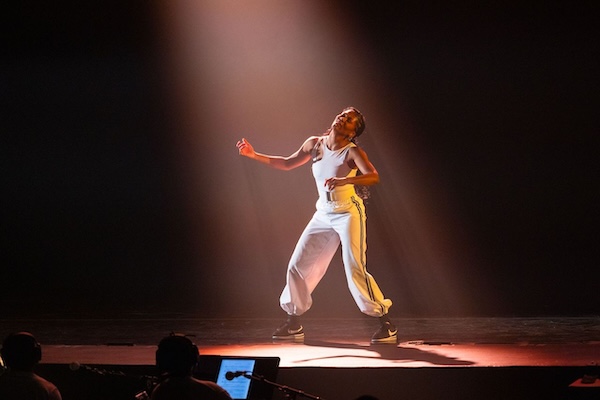
Courtney Ross in Camille A. Brown and Dancers’ I AM. Photo: Robert Torres
Finding joy is hard work.
The high-voltage artists of Camille A. Brown and Dancers – and the gifted musical trio that accompanies her evening-length I AM – seek joy with effort and ferocity. From the opening moments where Martine Mauro-Wade’s drum seems to activate Kai Irby and Nya Cymone Carter’s swinging braids, the polyrhythms of the urban street are punched out, literally and figuratively. It’s in the tone of the women’s biceps, the energy behind their shoulders, the jigger of their sneakers. There is a sense that once wound up, the dancers are not going to let go – not from their power and not from their dreams. The projected starburst behind them will show them the way and celebrate their presence.
Camille A. Brown is one of the few superstars on American dance stages these days. Contemporary dance lovers have kept an eye on her development since she appeared as a live wire performer in the company of Ronald K. Brown (no relation) and then with Jawole Willa Jo Zollar’s Urban Bush Women – both mentors who recognized her choreographic potential – and appreciated the inventiveness of incisive works such as the no-holds-barred deconstruction of blackface mistrelsy, Mr. TOL E. RAncE and the wistful look back to her Queen’s girlhood BLACK GIRL: Linguistic Play.
But Brown’s reputation vaulted forward into more general popular culture when she began choreographing for Broadway – Once On This Island, Choir Boy, Alicia Keys’ Hell’s Kitchen — and when she replaced the original Jerome Robbins choreography with her Black family and backstage knowledge for the Audra McDonald revival of Gypsy. She took the directorial reins for the revival of Ntozake Shange’s 1970s “choreopoem” for colored girls who have considered suicide / when the rainbow is enuf: the show received seven Tony nominations. When she announced she had signed on to direct next fall’s revival of Dreamgirls, none other than Lin-Manuel Miranda posted “And I am telling you I AM going.” Brown’s in demand on stage and on the red carpet. I think she’s the only dance person on social media who routinely and graciously thanks her stylist. (P.S. She looks fantastic.)
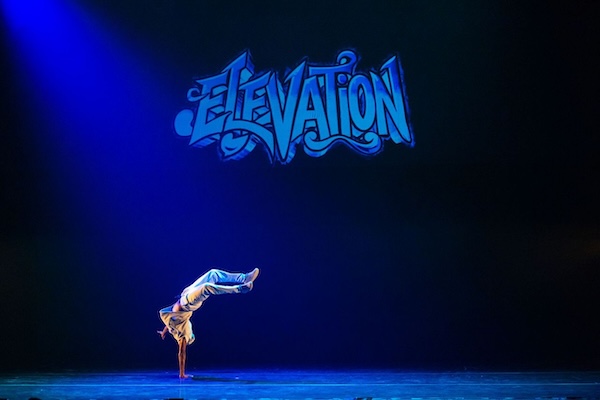
Alain “Hurrikane” Lauture in Camille A. Brown and Dancers’ I AM. Photo: Robert Torres
I AM is the fourth installment in a series exploring and celebrating Black life and identity, but more than stands alone. Brown is an expert on the history of Black vernacular dance styles and I AM’s raw material is a compendium of those styles. It’s fun to try to name them as they pass: attention-grabbing b-boying acrobatics; slinky, almost snooty voguing; rhythmic HBCU stepping; and even a bit of double-dutch and air guitar play. Much of the choreography is structured by duos: the dancers’ moves may look free and spontaneous, but their lucid unison speaks of Brown’s impeccable craft. On occasion, the dance opens up as if those of us sitting in the audience were standing along one curve of the cypher: by watching, we are included in the dancers’ world.
To me, I AM is very New York. The stage space is crowded, full of incident, alert and contrapuntal. While the dancing by Brown’s ensemble is glorious, it also digs deep, which makes the few quasi-narrative solos particularly poignant.
In one early section, with the musical trio –percussionist Mauro-Wade with Meech on keyboards, and Juliette Jones on ethereal amplified violin — playing something like a mellow R&B lullaby, Dorse Brown teeters on one foot as if to launch into flight, and cups his head as if suddenly finding himself crowned. Later on Courtney Ross seems to address an invisible other, first exasperated, then distraught, punching out against an interior, punishing censure that seems to translate into “you are not worthy.”
But she is resilient. She rises, and, as in so many of the sections of I AM, exultantly spreads her arms and opens her chest towards heaven. Camille Brown’s bursting-at-the-seams activity resolves itself into a deep breath of relief and reverence.
Debra Cash is a Founding Contributor to the Arts Fuse and a member of its Board.