
Theater Review: “Summer, 1976” Revisits Simpler Times—A Poignant Portrait of Friendship and Change
By David Greenham
Summer, 1976 is a cleverly designed snapshot of a deep but fleeting friendship.
Summer, 1976 by David Auburn. Directed by Paula Plum. Scenic design by Kristin Loeffler, costume design by Sydney Hobasse, lighting design by Deb Sullivan, projection design by Justin LaHue, property design by Lauren Corcuera, and sound design by Aubrey Dube. Staged by Central Square Theater, Cambridge, through November 30.
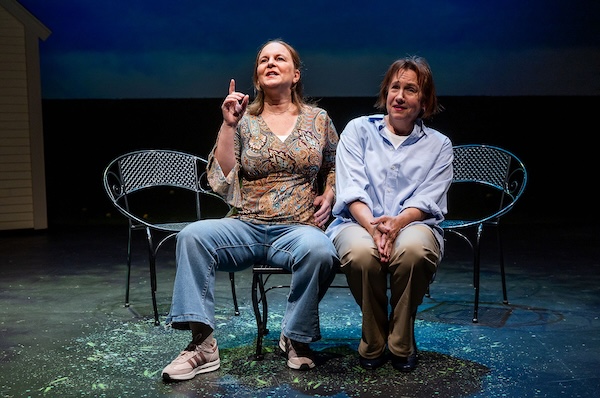
Laura Latreille and Lee Mikeska Gardner in the Central Square Theatre production of Summer, 1976. Photo: Nile Scott Studios
Some of us are longing, it has to be said, for a somewhat simpler time. The days when we didn’t have a small high-speed computer in our pocket offering instant news of the country’s circus-tinged political chaos. The days when children went out to play in the yard instead of sitting, mesmerized, in front of a screen.
That’s the pre-high-technology time Pulitzer-prize-winning playwright David Auburn has imagined in his sweet, if at times predictable, Summer, 1976.
Auburn’s one-act is nestled in the backyards of two nonadjacent homes in Columbus, Ohio, during the bicentennial summer. Single mom Diana (Central Square artistic director Lee Mikeska Gardner), a painter whose work is inspired by Paul Klee, lives with her preteen daughter Gretchen. Diana lacks self-confidence as an artist and confesses that she feels her work is never finished. Alice (Laura Latreille), a bouncy and smiling optimist, lives with her husband, Doug, an economist seeking tenure at Ohio State University, and their daughter Holly. Alice seems to be living, enthusiastically, her own American dream.
“We became friends, as you often do, through our children,” Diana tells the audience.
While their daughters hit it off immediately, Diana and Alice do not. At an early play date at Diana’s house, the girls enter her “strictly off limits” art studio and make a mess, mistreating her expensive paints and cherished brushes. In Diana’s mind, the incident somehow reflects Alice’s lackadaisical approach to parenting. Diana dismissively calls her a “self-imagined free spirit” and marvels at her disheveled house.
For her part, Alice comments frequently on Diana’s stiff demeanor and snobbish attitudes. When Diana snubs her choice of books to read, an unapologetic Alice barks back, “If I wanna read crap in the summer, I’m gonna do it!”
Predictably, they creep toward friendship, slowly sharing their vulnerabilities. Diana reluctantly presents her artwork; Alice says that the work reminds her of Paul Klee. A frustrated Diana tells the audience that she has worked her whole life to move beyond the artist who inspired her.
Somehow, against their will, the two become close friends, becoming just about as inseparable as their daughters. The friendship that develops is deep and lovely. Despite their differences — and quirks — the pair are a delight to watch.
A series of episodic snapshots peel away the layers of the lives as we learn that Gretchen’s father was a fellow art student, “a not smart glass blower,” Diana notes, who, after a few dates, didn’t make the cut. He left school after that semester and presumably doesn’t know he’s a father.
During an early conversation, Alice produces a joint, which they eventually share. She’s been buying the pot from Merle, a grad student who Doug has hired to paint their house. Although we never see him, Merle’s youth and laid-back demeanor provides a fascinating diversion for the friends.
Their relationship takes a deeper turn when Diana, suffering from a paralyzing migraine, calls Alice for help. She proves to be a most steadfast friend.
Eventually, however, there’s a misstep, and the pair split. Alice and her family take a weekend vacation, and Diana confides to the audience that she’s not sure that Alice is happy in her marriage, but reasons, “no outsider can ever understand what makes a marriage work.”
Summer, 1976, is a cleverly designed snapshot of a deep but fleeting friendship. As in his masterpiece, Proof, Auburn’s dialogue is sparse but penetrating. But here, speakers shift seamlessly from being characters to narrators, breaking the fourth wall as they share impressions and snarky asides with the audience. It’s an effective strategy, generating sympathy for the play’s central figures as well as their relationship.
Kristin Loeffler’s simple set focuses on the two houses — Alice’s clapboard cape and Diana’s brick façade. The homes share a common yard, although it is made clear that they are not next-door neighbors. Justin LaHue’s impressive projections lend a powerful serenity and drama to the proceedings: a sumptuous fireworks display, followed by darkness and eventually a thunderstorm, accompany Diana’s migraine. The visuals effectively underline the woman’s pain and fear.
The production is a valentine to Boston theater fans, giving them a chance to celebrate the skills of strong local artists. Beloved Boston stage veteran Paula Plum directs Mikeska Gardner and Latreille, and the results are splendid.
The actors’ chemistry is evident from the very first moment. Mikeska Gardner’s Diana is every bit as stiff as Alice proclaims, but Gardner skillfully probes the character’s vulnerability and fantasies. As Alice, Latreille supplies plenty of carefree energy up front, then slowly reveals the pain that is festering underneath. There’s a terrific moment when Diana observes that Alice is the one who is living the more conventional life. Diana is the unorthodox suburbanite. Our perspectives of ourselves and others can be ever-changing.
Summer, 1976 does a nice job of evoking the satisfactions of a simpler time. But it also makes the point that, while life 50 years ago had far fewer incessant electronic interruptions, it was governed by the same unpredictability that rules us today, and will tomorrow. In the final scene, the two old friends happen to run into each other at the opening of a Paul Klee retrospective in New York. The meeting underlines a timeless truth: our lives almost always take a different path than we assumed they would when we were younger.
David Greenham is an arts and culture consultant, adjunct lecturer on Drama at the University of Maine at Augusta, and is the former executive director of the Maine Arts Commission. He can be found at https://davidgreenham.com/
Tagged: "Summer 1976", David Auburn, Laura Latreille, Lee Mikeska Gardner