
Book Review: “We Had it Coming and Other Fictions” — Bursts of Existential Powerlessness
By Lucas Spiro
Luke O’Neil doesn’t have any solutions to our political dissipation, but he certainly knows how to diagnose its illnesses.
We Had it Coming and Other Fictions by Luke O’Neil. Or Books, 330 pages, $22.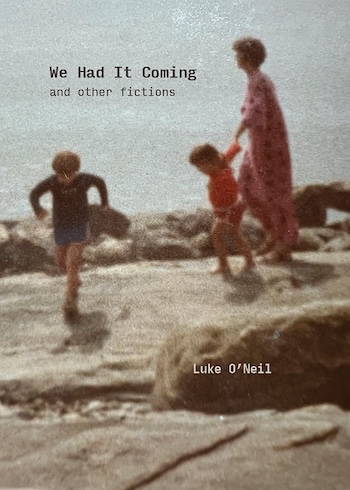
It will come as no surprise to learn that things aren’t great, generally speaking, in the new collection We Had it Coming and Other Fictions by Luke O’Neil, author of the popular blog/newsletter Welcome to Hell World. For years he has been posting his observations from the various rungs of eternal damnation, chronicling the decay, depravity, and desperation of humanity from the crusted-over navel of a condemned world, aka the Greater Boston Area.
The collection is not exactly an assemblage of short stories, although it includes a few. Many of the pieces are flash or micro- or very short stories. There is a sly wisdom in the use of “fictions” in the title, because many of the pieces examine the stories we tell ourselves about politics, love, family, loss, nostalgia, the future of humanity on this planet, They also look at topics on the margins of those issues, such as the internet and media. Because so many of the pieces are so brief (a few dozen words to a few hundred) and are connected to events that are sometimes no more than a few months old at the time of publication, the collection may be, and often reads like, blog posts immortalized on parchment. (I’m not enough of a Hell World head to know for sure.)
For me, the best approach to this book would not be to read it cover to cover – better to refer to it from time to time. Ironically, it is a (mostly) anti-internet book that happens to be written by one of the new media landscape’s more successful practitioners. Would this book have been been deemed an economically rewarding venture to publish if O’Neil hadn’t had a ready-made audience of subscribers? Who knows? But, the man’s got fans. More power to him.
O’Neil doesn’t want us to judge a piece of writing by its length, but to focus on what happens when it challenges us about what writing and story-telling means — how it tests our perceptions of ourselves. We Had It Coming is a collection of existentialist incitements of various lengths, attempts at undercutting national myths and their attendant mayhems, that dare readers to do more than parse imprisoning fictions — perhaps to cross the River Styx or Charles or Mississippi in the hopes that, on the other side, will sit something real.
Many real things and events are referenced in the book. O’Neil often writes about Trump and how awful he is and the awful things he does and doesn’t do. His (it is “his” because there are so few examples of stories that don’t seem to be autobiographical or from his perspective — objections to the prevailing order vacillate between passionate calls for action and despair at the futility of fighting back. He admits to attending a protest and goes into the moral ambiguity of whether or not that matters. It is hard not to be frustrated with these performative expressions of outrage, spurred on by abhorrence at what is happening, followed by a yearning for something resembling community nurtured by shared humanity.
Often, though, the focus is on the personal. O’Neil seems to be constantly in the middle of a breakup or paralyzed in a relationship. He appears to be more committed to observing things unravel rather than helping them die or survive. A recurring theme is how the digital mediates perception and relationships. Everything is eerily personalized to O’Neil and his characters. Meanwhile, the de-personalized algorithm suggests what they should be afraid of — is it home-invasions or climate change this week? What is lacking is the kind of distance that leads to valuable perspective that would lifts O’Neil and company out of their idiosyncratic doom-spirals and into action. O’Neil doesn’t have any solutions, but certainly knows how to diagnose the illnesses.
And that leads to the limitations of O’Neil’s juvenile persona. There’s plenty of outrage and hyper-attention to the things we say and do, but no sense of taking responsibility. There is a passivity that rejects the possibility that O’Neil or his characters are capable of wielding power. It also absolves them of any responsibility. In this way, the collection denies the reality of action, of the ability of people to make change. The stories in We Had It Coming set up an impenetrable wall between us, the regular folks, and power itself, which emanates from people of enormous means and property who also just happen to be pure evil. He’s not wrong about the oligarchy, but his Manichean outlook, coupled with his reluctance the talk about how to fight back grates after a couple hundred pages.
What seems most important to O’Neil is that he conveys to the reader he is a good person and that he takes all the right political positions. He hates fascism, thinks what Israel is doing in Gaza is bad, and, of course, feels personal guilt about all of it. The Leninist in me might have a few suggestions on how to escape this rut, but I wouldn’t want to fall into the trap he sets in “First they came 2” in which he paraphrases Martin Niemöller’s famous poem:
“First they came for the socialists which was pretty funny to be honest because they were mean to me online all the time. Then they randomly stopped there lol. Just before my ass. What are the odds of that? Welp back to normal.”
If I missed the joke then maybe I’m not online enough to get it. But O’Neil seems to be both implicating himself while also poking fun at the person who thinks things can go back to normal, or that “they” ever stop just before their own ass.

Luke O’Neil Photo: Or Books
I also thought we’d moved past the confessional style, the auto-fiction of the early 2000s. But I guess guilt, a Catholic upbringing, progressive liberalism, and maintaining an internet persona is a heady brew that keeps that particular tap flowing. I couldn’t help but get the feeling at times that O’Neil wants someone to reach out and connect with him a la Robin Williams and tell him “it’s not his fault.” Still, I’m pleased that O’Neil has been able to tweak the formula, to go beyond the middle brow, partly because I agree with many of his positions. This is a collection of existentialist prose pieces that scamper from high to low. His narrative personae are as likely to be put out by the fate of insects as by the end of the planet. In this sense, taken as a whole, the book is exemplary in its representation of contemporary alienation. O’Neil’s writing spouts from the Boston dive where Pessoa, Bukowski, and Beckett all get hammered.
The best on offer includes pieces like “Terroir,” a micro-fiction that epitomizes the condensed style O’Neil uses as a building block in his longer pieces. It’s worth quoting in full.
“They had been bombed so frequently by now that even the children had come to know the category of missile by the sound they made as they fell or the size of the hole they left behind. The sensibility of a sommelier.”
Unfortunately, this dark gem is immediately followed by the unforgivably gimmicky “We had it coming” which reads:
We had it coming.
— Luke O’Neill
We had it coming.
Excerpted from We Had It Coming by Luke O’Neill (2025)
Maybe this joke made him chuckle, and maybe that’s enough. But the punch line is an old one and it isn’t very illuminating. I’d be happy to learn why this squib deserves a place in a collection that also asks us, unironically, to examine what it means to be witness to the slaughter in Gaza in real time and to do nothing to stop it. Or to do things that we know won’t stop it because to actually challenge power requires more than any of us in the imperial core are willing to do or give up.
However, O’Neil does offer an admirable challenge to the reader. Instead of something as ephemeral as a post, the very nature of the book form invites the reader to sit with the words on the page, to reflect, to become more human. This may even be truer for the shorter pieces. The internet, with its teeming feeds and endless trough of AI slop, shallow takes, and temptation to debasement, is not about permanence or about moving beyond the doom-scroll dopamine hit. It is dedicated to amnesia (despite the fact that nothing is ever erased, especially that one shameful thing you said and hope no one remembers). We Had it Coming and Other Fictions is assuredly an internet book, a Trump book, a progressive-liberal-democratic-socialist confessional book. The combination would seem to guarantee a sub-par product, But I can’t bring myself to dismiss it entirely. O’Neil’s “fictions” are — often enough — compellingly close to real, tangible, and human truths.
Lucas Spiro is a writer living in Dublin.