
Cultural Commentary: France Marks the 10th Anniversary of the Bataclan Attacks
By Douglas Kennedy
(First published in Liberation on 13 November 2025)
The aftermath of a terrorist act becomes an opportunistic event for those selling us a certain bill of partisan geo-political goods… while simultaneously diminishing our latitude as citizens.
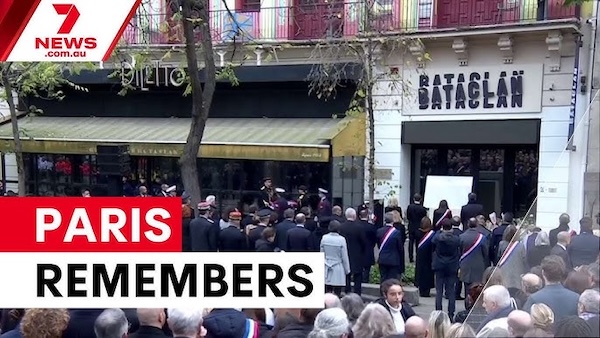
Paris remembers 130 victims on 10th anniversary. Photo: YouTube, 7NEWS
It’s a conversation that still haunts me.
The year was 2017. I was signing my then new book (Toutes ces grandes questions sans réponse) at an event far away from Paris. At the end of a line of readers was a woman in her mid-50s, her face and eyes hinting that this was someone who hadn’t been sleeping for a very long time. She approached me with her book, telling me she’d bought it the week before, but returned this evening to get my signature.
“The chapter that you wrote on tragedy (‘La tragédie est-elle le prix à payer pour notre existence ?’) … it truly spoke to me. You see, I lost my daughter in the Bataclan.”
Immediately I asked this woman (I’ll call her Elise) if she had time for a chat. We adjourned to a corner of the venue. Over the next 45 minutes or so she told me the story of her daughter — a university student who was visiting her parents for a long weekend when she got a call on the morning of Friday, November 13, 2015 from a friend, telling her that she had gotten prized tickets for a concert that night at the Bataclan… and she had to return to Paris for it! Immediately Elise’s daughter asked her parents permission to return early to the metropole for the concert.
“We reluctantly said ‘yes,’ preferring that she spend the weekend with us. She left our house at 15h00 that afternoon. A few hours later she was dead.”
We all know the details of what happened that horrendous night: gunmen burst into the Bataclan during a concert, spraying automatic gunfire. There was an earlier attack the same evening at the Stade de France, and at a café and restaurant near the Bataclan. In total 130 people were killed. Innocents all. Like Elise’s daughter.
“There are days when I wonder how I can keep on living” she told me. “Will I ever reach any sort of accommodation with her murder?”
I looked at her straight on and said, “Speaking as a parent [of children around the same age as Elise’s daughter] I don’t see how it will ever leave you in peace. It’s too vast, too horrible.”
She thanked me for my directness, saying that far too many people had spoken well-meaning platitudes in the wake of her daughter’s death.
“What I have told everyone is what I am going to say to you now: my daughter died for nothing. I repeat: for nothing.”
That line still disquiets me. Because it’s so nakedly true — and because it articulates for me something that is often an afterthought in the wake of a terrorist act: the way that it permanently destroys the lives of those left behind. The nihilism that underscores terrorism is especially heartless as it victimizes those who just happen to be aboard public transport (as in the London attacks of 2007), an airplane (Lockerbie), a place of work or commerce (the World Trade Center… Charlie Hebdo), or a concert venue at the time it is perpetrated. There is a diabolical “musique du hasard” underscoring those who are murdered in such acts of extremist violence. You arrive early for work… and you get blown up. You are 10 minutes late for a meeting in that same building… and you get to live on. You jump into a metro car… and you lose your legs. A split second decision to take another car leaves you ambulant. And no doubt Elise and her husband are still — 10 years on – telling themselves: if only we had insisted that she stayed….
Life is brimming with random nightmares that most of us face in the course of the narrative that is our respective existences. We find ourselves victims of the genetic casino that underscores the unpredictability of serious illness; the arbitrariness of, say, a vehicle skidding on black ice and overturning. If we are not the actors in these chance melodramas someone close to us will be — and we are always left with the thought: if only they hadn’t crossed the road at that moment… and why should a nonsmoker die of stage four lung cancer at the age of 48?
La musique du hazard and all that.
But just as mass terrorism targets those simply going about their quotidian business, so does it also function as a sort of Rorschach test (this one made of blood, not ink) onto which all and sundry can use the event for their own ideological interpretations. “Life can only be lived forward… and understood backwards” – as the great Soren Kierkegaard once noted. As such, it could be seriously argued that one of the many end results of 9/11 was the election 15 years later of Donald Trump. The right — and its anti-multicultural/anti-immigration rhetoric — gained traction thereafter. And we all became the hyper-observed/hyper-profiled citizens of a world where there is virtually no privacy; where facial and iris recognition are now the identifying norms; where we all have an electronic paper trail, informing those in authority of almost everything there is to know about our habits, our movements, the stuff we think is secret (but is now anything but that).
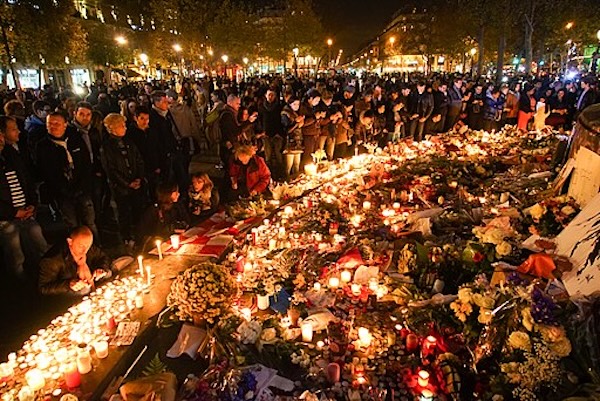
Dozens of mourners attending a civil service at the place de la République, in remembrance of November 2015 Paris attack victims. Photo: WikiMedia
Do we have terrorism to thank for the Surveillance State within which we all now dwell? Has it given governments carte blanche in the name of so-called security? And in a world where the Manichean viewpoint has replaced nuanced debate — where “I’m right/You’re wrong” has become the schoolyard norm when it comes to contemporary political discourse — the aftermath of a terrorist act becomes an opportunistic event for those selling us a certain bill of partisan geopolitical goods… while simultaneously diminishing our latitude as citizens.
The Bataclan, as such, remains one of those terrible seminal events with multiple repercussions thereafter. But whenever I now reflect on it I return to that conversation with Elise, and the story she told of her daughter’s senseless death — and the fact that, for as long as she is sentient, Elise will never shake off its tragic immensity, the dark shadows under which she and her family now live.
And for those who think that, by pointing fingers at one side or another, they can undo the Gordian Knot that is terrorism…
The day after the Bataclan attack I found myself back in my hometown of Manhattan. Up early on Sunday morning (November 15, 2015) I suddenly decided to head up Fifth Avenue to St Thomas’s Church: an Episcopalian (Anglican) denomination housed in a magnificent gothic structure, with a choir that matches Kings College Cambridge when it comes to vocal majesty. I am hardly a believer. But during my 23 years in London I became a habitué of High Anglican services because of the dazzling polyphonic richness of a choral tradition that traces itself back to such giants of Tudor music as Thomas Tallis and William Byrd.
And on that Sunday the choir of St Thomas’s in New York seemed beyond magisterial; articulating, in three- and five-part antiphons, all the unanswerable mysteries of this temporal mess we make for ourselves and each other.
The Episcopalian priest conducting the service was at the great entrance of St Thomas’s as we all filed out. I took his hand and told him that, having just arrived from Paris, in the wake of the Bataclan attack, the service was restorative. At which point this Man of God leaned over toward me and whispered, “When it comes to such horrors we all search for answers. But the truth is… “
He said no more.
Perhaps because there are no answers.
Douglas Kennedy is the author of 27 books, including such acclaimed novels as The Big Picture, The Pursuit of Happiness and The Woman in the Fifth. He has had a pied à terre in Paris for 25 years. A Chevalier de l’Ordre des Arts et Lettres, and completely francophone, he is the most regarded of modern American writers in France today. This essay was commissioned by the newspaper Liberation to mark the 10th anniversary of the Bataclan massacre.