
Doc Talk: The Boston Jewish Film Festival 2025 — Festival of Light
By Peter Keough
The Boston Jewish Film Festival supplies some glimmers of optimism.
The Boston Jewish Film Festival. Screens November 5-16 at the Brattle Theatre, the Coolidge Corner Theatre, the Museum of Fine Arts, the Somerville Theatre, the West Newton Theatre, and other venues, streams November 17-19 online.
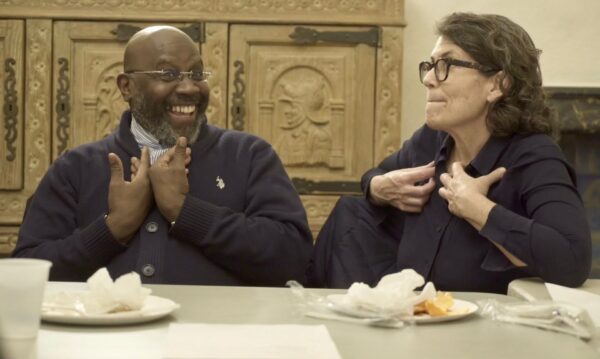
Reverend Robert Waterman and Rabbi Rachel Timoner in a scene from All God’s Children. Photo: DocNYC
In these dark times, the Boston Jewish Film Festival offers a few documentaries that shed some light and offer a little hope.
Not that these things come easily. “I don’t want a Kumbaya moment,” says Rachel Timoner, Rabbi of Congregation Beth Elohim in Brooklyn’s Park Slope, at the beginning of her sister Ondi Timoner’s provocative, inspiring, sometimes brutally honest All God’s Children (2024). As it turns out, that will be the least of her worries.
It’s 2019 and the rabbi is at a meeting with Reverend Robert Waterman, pastor of Antioch Baptist Church in nearby Bedford-Stuyvesant. As an opening montage of news images of murderous attacks on Black and Jewish places of worship demonstrates, these are perilous times for both groups. Though the two communities have had a long history of collaborating for the cause of civil rights, suspicions and divisions have festered of late. Was there something that their two congregations might do to restore their unity and combat this common threat? Enthusiastic and committed, they plan a series of mutual activities.
But then the whole enterprise gets off to a shaky start and threatens to unravel. The idea of attending one another’s services, for example, which at first seemed an obvious step in a process of reconciliation, encounters unexpected challenges. The Seder goes pretty well, with the Antioch people adding some of their own cuisine – yams and collard greens – to the menu. But the Easter celebration at the Baptist church includes a Passion Play — featuring unfortunate representations of Jewish authorities as complicit in Christ’s crucifixion — that almost proves a deal breaker.
Tragically and ironically, what initiates the healing process is the October 7, 2023 massacre of Jews by Hamas. Horrified and bereaved, Rabbi Timoner is also upset by the indiscriminate killing of Palestinian civilians in the subsequent Israeli invasion of Gaza. When her congregation is targeted in a hate crime, Reverend Robert Waterman and Antioch have their back. The two groups go on to join forces to campaign for a law to criminalize deed theft, a shady practice by which Black families have been deprived of their homes and generational wealth.
Timoner combines candid observations with dynamic montages and a compelling soundtrack to compress complex issues, decades of local and national history, and the traumatic events of several years into a cogent appeal for understanding and action. There is no uplifting “Kumbaya” singalong, but there is a joyous, climactic rendition of “Ain’t Nobody Gonna Turn Me Around” that might convert even the most cynical.
All God’s Children screens November 12 at 7 p.m. at the Coolidge Corner Theatre. It is preceded by a performance by the Boston Community Gospel Choir and followed by a conversation with the director Ondi Timoner, Rabbi Rachel Timoner, and Reverend Robert Waterman, moderated by Rav Tiferet Berenbaum. It can also be streamed online November 17-19.
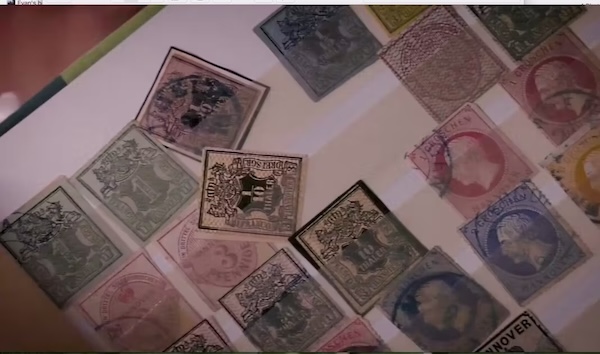
A scene from The Stamp Thief. Photo: BJFF
Dan Sturman’s The Stamp Thief (2025) starts off with a – sort of – film within the film, a re-enactment of Gary Gilbert’s tale about how his grandparents, then married to each other, fell in love and kissed for the first time in the basement of an apartment building in a small town in Poland before the war.
“Is any of it true?” Sturman asks off screen. “Uh, no,” admits Gilbert.
So, from the opening scenes, we enter a world of puckish misdirection, but all for a good cause – the return of valuables stolen by Nazis from victims of the Holocaust. It seems that Gilbert, a screenwriter whose credits include Seinfeld and Sister, Sister, was intrigued by a story from his friend and fellow scribe David Weisberg. Apparently, Weisberg’s father, a psychiatrist, had a patient tell him how his wife’s father had been a Nazi guard at Auschwitz who had stolen priceless stamp collections from Jewish prisoners. These he hid in a zinc suitcase in the basement of the building where he lived and left behind when the Soviets took over.
Gilbert immediately decided he would go to Poland and find the stamps and return them to the legitimate owners or their descendants. It would be the right thing to do — and also make for an interesting documentary movie.
Why not just tell the Polish authorities and have them find the stamps? It turns out that Poland is one of the few European countries that does not feel any obligation to find the actual owners of stolen Nazi treasure. Instead, it keeps it for itself. So Gilbert realized he would have to maintain secrecy as he searched, devising an elaborate subterfuge in which he and his crew of volunteers would pretend to be making a movie using the basement as one of their locations, while covertly digging for the suitcase.
As is acknowledged in the film, the scheme is reminiscent of that in Ben Affleck’s Oscar-winning Argo (2012). Actually, The Stamp Thief is sometimes even more exciting and suspenseful than that film (remember the extended paper shredding scene?), supplying some often hilarious twists, kooky characters (wait until you meet Alan Trustman), and bizarre complications. At its best, the documentary shows how cinematic make-believe can be enlisted in the cause of righting the wrongs of history.
The Stamp Thief screens November 9 at 11 a.m. at the MFA and is followed by a conversation with Gary Gilbert, moderated by Roberta Grossman, Executive Director & Co-Founder of Jewish Story Partners.
Peter Keough writes about film and other topics and has contributed to numerous publications. He had been the film editor of the Boston Phoenix from 1989 to its demise in 2013 and has edited three books on film, including Kathryn Bigelow: Interviews (University Press of Mississippi, 2013) and For Kids of All Ages: The National Society of Film Critics on Children’s Movies (Rowman & Littlefield, 2019).
Tagged: "All God’s Children", "The Stamp Thief", Boston Jewish Film Festival 2025, Dan Sturman, Rachel Timoner
Good job done. Very helpful article
Thanks — glad you find it helpful!
Thank you very much for the background and review. Do you happen to know if they are going put it out on any streaming service?
I believe All God’s Children is available until Nov. 19 in the festival’s virtual line-up. Go here: https://ticketing.bostonjfilm.org/websales/pages/info.aspx?evtinfo=514292~3a1dbf00-5ad7-4f53-af12-28ba7bfe20f4&epguid=1794be97-61f1-4b40-938f-1f50c49c7a63&mdy=11/12/2025&showing=523599&. I don’t know about The Stamp Thief but you might inquire at their website here: https://www.thestampthief.com/