
Concert Review: Pianist Daniil Trifonov and Baritone Matthias Goerne Perform Schubert’s “Swan Songs”
By Susan Miron
For those who love Schubert, this was a memorable occasion indeed.
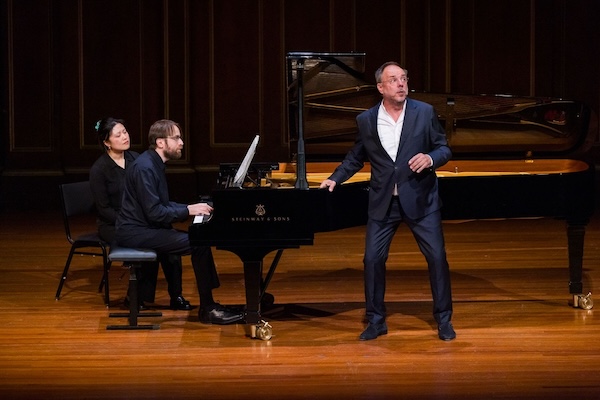
Pianist Daniil Trifonov, baritone Matthias Goerne, and page-turner Rubi Yan at Jordan Hall. Photo: Robert Torres
The idea of hearing a program of late Schubert “Swan Songs” was the irresistible draw for a nearly full Jordan Hall on Friday night. It was also the seventh appearance of pianist Daniil Trifonov on Celebrity Series stages since 2012. Judging from his reception as soloist and musical collaborator (previously called accompanist) on Friday, it would be a wise bet that the audience would be thrilled if he appeared every year.
The program opened with Schubert’s gorgeous Piano Sonata in G Major, D. 984, played gloriously by Trifonov. Schubert only lived to see three of his 12 piano sonatas published. Beethoven’s magisterial output of piano sonatas eclipsed Schubert’s, which fell into obscurity for nearly a century. Schumann deemed Schubert’s G Major sonata of 1826 as “perfect in form and conception.” It was wonderful to hear it again, after a multitude of performances of Schubert’s extraordinary last Sonata in B Flat, which is programmed far more often. In 2011, Trifonov won medals at three very important competitions: the International Tchaikovsky Competition in Moscow, the Arthur Rubinstein International Piano Master Competition in Tel Aviv, and the International Chopin Piano Competition in Warsaw. He is a hugely successful soloist, but Trifonov has steadfastly engaged as a musical partner to a variety of instrumentalists and singers. His numerous recordings have garnered many awards, and he also composes. The last time I heard Trifonov was in concert with his former piano teacher, Sergey Babayan. It was one of my favorite live performances ever.
The second half of this unusual concert featured a collection of late Schubert songs, performed by the currently touring duo of Trifonov and the celebrated German baritone Matthias Goerne (this was his Celebrity Series debut). Dubbed Schubert’s “Swan Song,” (Schwanengesang D. 957) this collection of 14 songs was composed in 1828, during the last eight months of Schubert’s life, along with three famously superb piano sonatas, the Mass in E-Flat, and the sublime Quintet, Op. 163. Ideally, succeeding at this late Schubert piece requires two musicians who have an intimate, intuitive understanding of the texts. This partnership has that in spades.
In fact, Schubert never gave this collection of songs a title. His publisher, Tobias Haslinger, imagined it would help sales if he billed the tunes as “Schubert’s last farewell to song.” The far more popular sets of Schubert’s late-career songs, which are played and recorded far more often, are Winterreise and Die Schöne Müllerin.
Schwanengesang differs from the earlier Die schöne Müllerin and Winterreise song-cycles because it includes settings of more than one poet. Seven texts by Ludwig Rellstab (1799–1860) are followed by six by Heinrich Heine (1797–1856). The inclusion of the last song, to words by Johann Gabriel Seidl (1804–1875), may or may not reflect Schubert’s wishes. In any case, all 14 songs were composed in 1828 and the collection was published in 1829, a few months after the composer’s death.
Throughout the 14 songs, Trifonov played with utmost sensitivity and an impressive palette of colors. Goerne, whom I would venture most of us in the audience hadn’t heard live before, conveyed the poetry passionately. I enjoyed his voice, but I was puzzled by his holding on to the piano so much of the time. And I had a serious problem with the lighting at Jordan Hall; I could not read the words, which are such an important part of Schubert’s songs. Still, the duo seems very happy performing together, and make for an astonishingly good partnership, each responding to every emotional nook and cranny in Schubert’s music. I am sorry I will miss their other US performances of the two more famous late Schubert song cycles.
In 2005, the late Boston Globe critic Richard Dyer described Goerne beautifully: “Goerne has a wonderful voice, imagination to burn, and a formidable technique. To be able to sing every vowel undistorted, on every pitch and at every dynamic level, is a fundamental goal of classical singing, but one seldom met; Goerne can do it.” The singer has similar admiring words for his accompanist. In an interview, Goerne said, “From the first moment we worked together I was thrilled by Daniil’s serious approach, right down to the last detail — and by the reflectiveness that informs his poetic sensibility, It was fascinating to witness the boundlessness, maturity, and understanding that he brought to these songs.”
As an encore, the two performed Schubert’s setting of Seidl’s “Die Taubenpost,” ending the concert on an optimistic note of an aviary postal delivery service taking flight for the cause of love. For those who love Schubert, this was a memorable occasion indeed.
Susan Miron, a harpist, has been a book reviewer for over 30 years for a large variety of literary publications and newspapers. Her fields of expertise were East and Central European, Irish, and Israeli literature. Susan covers classical music for The Arts Fuse and the Boston Musical Intelligencer.