Visual Arts Commentary: What Would It Be Like If Women Ruled Israel and Gaza?
By Orna Coussin
Perhaps asking that Judy Chicago’s exhibition not come was a necessary strategy in the short term, to help end Israeli brutality. But the lesson her show teaches us is necessary in the long term, so that Israelis will stop glorifying that very same brutality.
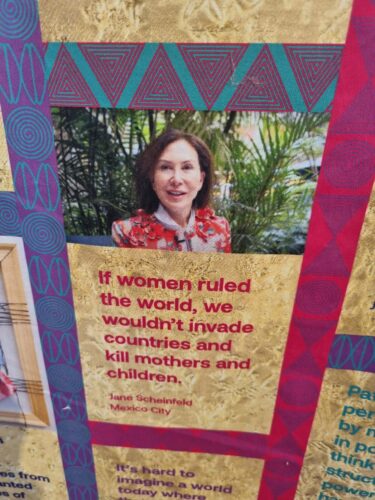
A response in Judy Chicago’s What If Women Ruled the World. Photo: Orna Coussin
Judy Chicago’s exhibition, What If Women Ruled the World, opened in Tel Aviv (at two venues simultaneously — the Tel Aviv Museum of Art and the private Nassima Landau Gallery) at the end of September 2025, and will run until January 2026, at a time when men still — to put it mildly — rule the world. More specifically: it is almost exclusively men from Israel who have been behind the starvation, death, and destruction in Gaza — a horror that has been unfolding for many months, since that Saturday in October 2023 when men from Gaza massacred, raped, burned, and kidnapped hundreds of people in southern Israel.
Guy Ben Ner and other prominent Israeli artists recently sent a public letter to Judy Chicago, asking her to boycott the museum and cancel the exhibition. The impulse behind this appeal was that we, Israeli artists who are horrified by what Israel is doing in our name to human beings in Gaza — to their shelters, their bodies, their souls — are asking the world for help. Please do everything you can; boycott every Israeli institution, including those that sustain us, so that this pressure will force the Israeli establishment to stop. So that we can save the lives of Gazans who are still alive. So that this horrific war will end. So that the Israeli hostages who were still languishing in captivity in Gaza might be freed.
Even now, a few weeks after a so-called ceasefire was declared, in mid-October 2025, and the last of the living Israeli hostages have mercifully been freed, I fully identify with this call for the boycott and I join it. Yet, at the same time, I see how important Chicago’s exhibition in Tel Aviv is to me at this moment. As a teacher of critical writing at the Bezalel Academy of Arts in Jerusalem, I find What If Women Ruled the World a valuable starting point for stimulating essential discussions in Israeli society, at the very least among students. Perhaps asking that Chicago’s exhibition not come was a necessary strategy in the short term, to help end Israeli brutality. But the lesson Chicago teaches us is necessary in the long term, so that Israelis will stop glorifying that very same brutality.
The exhibition at the museum — symbolically placed at the building’s edges, near the exit, like a side note — features a giant quilt (or a digitally printed quilt on fabric) connecting quotes from women and men who answered the provocative question posed in the exhibition’s title and tried to imagine a world ruled by women. Next to the quilt wall, a video plays in which Chicago and her collaborator on the work, Nadya Tolokonnikova — co-founder of the Russian feminist protest group Pussy Riot — speak about the questions they wanted to raise and how their agendas aligned. There’s also a small booth where viewers can enter, one by one, and respond to the question that hovers over the work. But it is unclear which responses are recorded and which aren’t.
In contrast, at the private Nassima Landau Gallery, Chicago receives the full respect she deserves as a groundbreaking feminist artist. The exhibition there, bearing the same name and occupying the entire space, offers a rich sampling of her vast body of work, including images from The Dinner Party, her 1979 installation (a triangular festive table set for 39 iconic female leaders throughout history), and vibrant sexual imagery painted on car hoods from her early work. Friends saw The Dinner Party at the Brooklyn Museum, where it has been permanently installed for years. I envy them — they got to see the real thing, full-size. Disappointingly, the Tel Aviv Museum makes no mention of the exhibition across town and offers no materials for study — everything there feels begrudging and ambivalent. At Nassima Landau you can at least buy some of Chicago’s books and there is curatorial text. At least someone here understands the importance of this artist to this country at this time.
What would it be like if women ruled Israel and Gaza? Every time I’ve been in a situation where this question came up — even among women who define themselves as feminists — I’ve seen eyebrows raised and doubt creep in. “Not sure women would behave differently if they were in power” — that’s the usual response and typically, after it’s uttered, no one lingers on the question; they move on, as if in despair. Usually someone mentions Minister Miri Regev or Minister Orit Strock — two active female participants in Israel’s right-wing government, which bears central responsibility for the genocide in Gaza — as proof that one shouldn’t expect women, as women, to act differently.
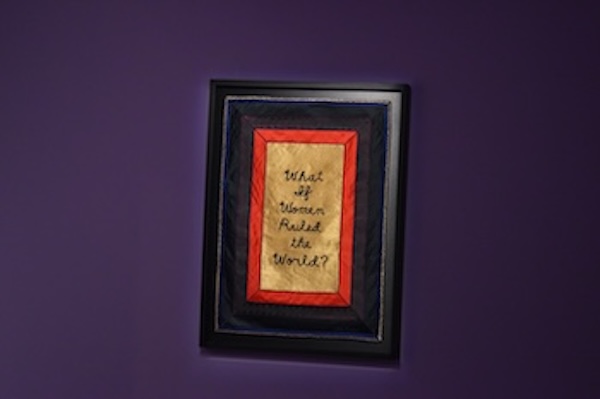
A quilt panel in Judy Chicago’s exhibit What If Women Ruled the World. Photo: Orna Coussin
But the first lesson we can learn from Judy Chicago is that this answer is insufficient and shortsighted, not only because it reflects a failure of imagination regarding the difficulty of projecting into the future an image of a different form of ruling, but because it doesn’t dwell on the full complexity of the question itself.
In Chicago and Tolokonnikova’s quilt, the responses are varied and stirring: “We would instill much more gentleness and empathy amongst beings,” “I can imagine starting to value different kinds of strength, including psychological, emotional strength, and encouraging people to find their own strengths and foster them,” and, “If women ruled the world, we wouldn’t invade countries and kill mothers and children.” Many responses also touch on the deeper foundations of the question, such as the one that said, “The first step would be to abolish gender norms and deconstruct the hetero-patriarchal racist and classist system that surrounds us.”
Here begins the lesson Chicago teaches us — the one I’d like to bring to my students. It’s a lesson that begins with questions, and the first is: What is the category “women” in the question “what if women ruled the world”? Can we think about the question Who is a woman — the question asked in every foundational feminist text — not as the opposite, the other, of Who is a man? As a profound feminist, Chicago is aware that we still think about the categories “women” and “men” only through patriarchy; and that patriarchy is a social system thousands of years old in which most of the power is concentrated in the hands of men, and most women are excluded from it. This is a social system, an entire culture, that glorifies “masculine” traits and gives them precedence, that devalues “feminine” traits and ensures their inferiority. Therefore, we face a paradox: if “women” rule the world, it’s doubtful they would be “women” in the patriarchal sense, and thus doubtful they would rule in the way we understand rule — because the categories would change, the core values would be replaced, relationships would undergo a fundamental transformation.
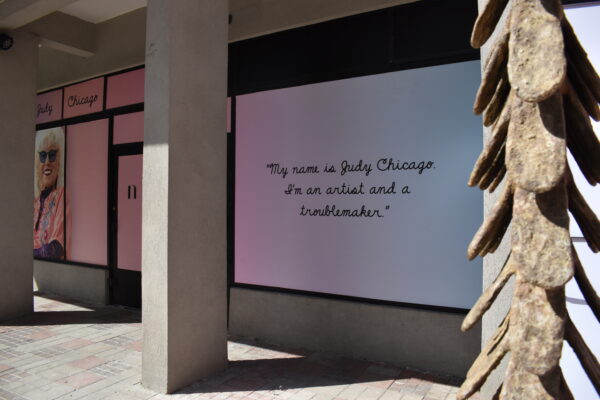
The front of the Nassima Landau Gallery. Photo: Orna Coussin
Chicago’s feminism doesn’t settle for equalizing women’s conditions with men’s within the patriarchy; it aspires to a post-patriarchal world, one in which people of all genders join forces to better the future of humanity. In such a world, which doesn’t glorify the three pillars of patriarchy — nationalism, ownership, conquest — countries don’t invade other countries, their emissaries don’t rape, kidnap, or kill, pilots don’t drop bombs on shelters housing entire families, men and women don’t rush into battle. All these things only make sense within the patriarchy. They have no logic outside that paradigm.
The problem is that I must design such a lesson without the conclusions. The students must arrive at them on their own. I’m not sure how to do that, but I feel a great sense of urgency. It’s unclear which will collapse first: Israel as we know it, or the patriarchy. But it’s never too early to imagine, and to start constructing, a just, sustainable, alternative for both.
Orna Coussin (born in Scotland, 1967) is a Tel Avivian writer, essayist, and writers’ mentor. She has published in Hebrew — her first writing language — 10 books of essays and stories to date. Her essay “How to Resist,” a call for protest, was published in January 2023. Coussin received the Prime Minister’s Prize for Hebrew Literary Works (2009) and an Excellence in Teaching award at Bezalel Academy of Arts and Design (2020), where she has been teaching critical writing for more than a decade.
Tagged: "What If Women Ruled the World", Judy Chicago