
Theater Reviews: “Waiting for Godot” and “Art” on Broadway – More Stars at Ridiculous Prices
By Christopher Caggiano
Broadway is being subjected to a steady parade of Hollywood names parachuting into familiar titles, propped up by prestige directors and stratospheric ticket prices.
The latest trend on Broadway isn’t necessarily a welcome one. Producers seem convinced that what audiences want most is movie stars, not strong productions. Unfortunately, the producers seem to be correct, but the quality of the proceedings is often – nay, usually – wanting.
So we’re subjected to a steady parade of Hollywood names parachuting into familiar titles, propped up by prestige directors and stratospheric ticket prices. These shows sell, but they also feed the sense that Broadway is less about the work itself and more about celebrity spectacle.
Broadway’s latest round of star-driven revivals comes with a curious twist: the tickets, though still absurdly high, are actually cheaper than last season’s celebrity showcases. Good Night, and Good Luck, with George Clooney, averaged roughly $300 a seat. Othello, featuring Denzel Washington and Jake Gyllenhaal, crept closer to $400.
By comparison, Waiting for Godot, starring Keanu Reeves and Alex Winter, hovers around $235, and Art, with Bobby Cannavale, Neil Patrick Harris, and James Corden, about $200. Maybe that signals a market correction – or, more likely, this season’s stars just don’t command the same premium. Either way, audiences are still paying plenty for the privilege.
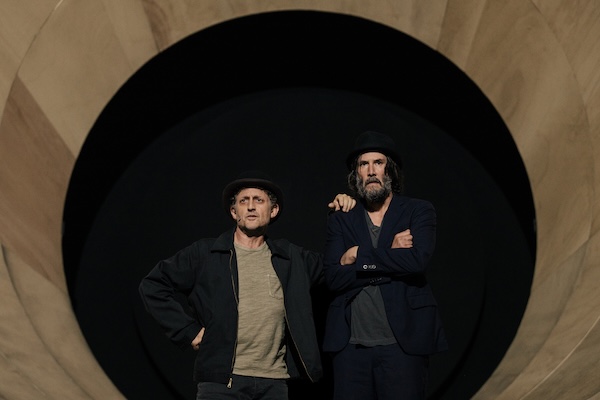
Alex Winter and Keanu Reeves in Waiting for Godot. Photo: Andy Henderson
Waiting for Godot
A confession: I don’t like Waiting for Godot. I don’t like A Delicate Balance, The Skin of Our Teeth, or The Homecoming either. Plays that seem to prize inscrutability over insight have never appealed to me. The playwrights behind these mid-century dramas often seemed to equate opacity with depth, offering fragments of dialogue and murky symbolism instead of plot or motivation. What once passed for existential daring now feels like self-conscious obscurity, the kind of work that mistakes withholding meaning for creating it.
Still, Godot refuses to stay buried. It keeps reappearing on Broadway, most recently with Nathan Lane and Bill Irwin in 2009, then Ian McKellen and Patrick Stewart in 2013, and now Keanu Reeves and Alex Winter. This new production leans heavily on Bill & Ted nostalgia, and the casting makes a certain kind of commercial sense.
But that buddy comedy chemistry doesn’t translate to Beckett. Reeves and Winter move through the lines with a strange detachment, missing the rhythm and the charged silences that purportedly give Beckett’s dialogue its pulse. Winter fares a bit better than Reeves, but the overall effect is mechanical. And yes, there’s an ill-advised air-guitar moment that ruins whatever spell the production might have cast.
The supporting cast brings much-needed grounding. Brandon J. Dirden is commanding and wry as Pozzo, his bravado filling the stage in a way the lead performers never quite manage. Michael Patrick Thornton, as Lucky, delivers the character’s infamous torrent of nonsense with an eerie calm, speaking as if it all made perfect sense – which, of course, it doesn’t. Director Jamie Lloyd incorporates Thornton’s wheelchair use into Lucky’s physical struggle, a choice that feels both natural and affecting. While Dirden and Thornton are on stage, the play actually feels alive.
Soutra Gilmour’s set – a massive pipe that flares toward the audience – is visually striking but a bit mystifying. It might suggest entrapment or endless repetition, but it also looks suspiciously like a skateboard ramp, a visual wink that undercuts rather than deepens the theme. It also severely limits the mobility of the actors in a way that is distracting.
Lloyd has turned minimalism into a Broadway calling card, and he applies his usual stripped-down style here. The result is elegant and occasionally arresting, but also curiously hollow. The production has a certain rhythm and precision, but not much heart.
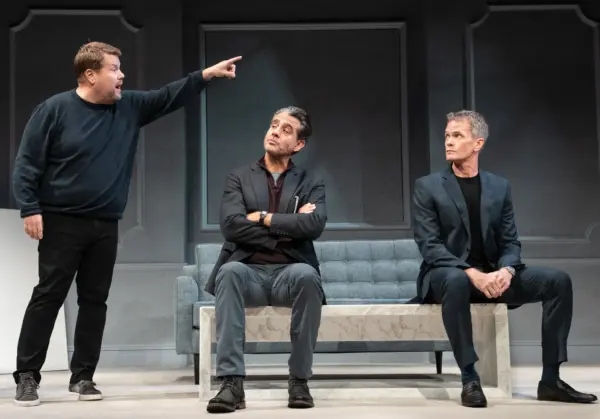
James Corden, Bobby Cannavale, and Neil Patrick Harris in Art. Photo: Matthew Murph
Art
From the moment the audience broke into giddy entrance applause for each of the performers, it was clear this Art revival was more about fame than substance. Yasmina Reza’s play begins with a string of cheap laughs at the expense of modern art – punctuated by Bobby Cannavale’s rather shameless mugging. But these are the same “my kid could’ve painted that” gags that were stale even when the play premiered in the ’90s. What was likely intended to be sharp and topical lands as smug and self-satisfied, the humor too bourgeois and the ideas too thin.
Reza’s dialogue, which depends on philosophical posturing and exaggerated self-regard, sounds especially artificial in the mouths of these popular actors. Cannavale wrestles with the play’s overwritten speeches; Neil Patrick Harris leans too far into irony; and James Corden, the most natural of the trio, nearly rescues the evening with a manic, breathless delivery of Yvan’s wedding monologue. But even his energy can’t disguise how static and talky the play becomes.
The three men are meant to be old friends undone by one of them purchasing an all-white painting – to the tune of $300,000 – yet nothing about their interactions suggests an actual bond. They function less as characters than as opposing viewpoints in Reza’s tidy little debate about taste, ego, and meaning. And, unfortunately, the performers don’t fill in the holes with their rapport. The result feels schematic, a chatty conversation piece that mistakes circular argument for insight.
Art wants to be both a comedy of manners and a meditation on the fragility of friendship, but it never finds the balance. It’s too heavy for farce and too shallow for philosophy. What remains is a lot of talk about art and people that says very little about either art or people.
Christopher Caggiano is a freelance writer and editor living in Stamford, CT. He has written about theater for a variety of outlets, including TheaterMania.com, American Theatre, and Dramatics magazine. He also taught musical-theater history for 16 years and is working on numerous book projects based on his research.
Tagged: Alex Winter, Jamie Lloyd, art, keanu-reeves, samuel-beckett
I don’t care to defend Reza, but Chris’s diss of Samuel Beckett and other writers who “prize inscrutability over insight” should be responded to. I laughed when I read that Godot “refuses to stay buried.”
Not only because the play is enormously popular around the world — AI estimates that there have been well over a thousand productions since 2015. But not-being-able-to-stay-dead is the plight of so many Beckett characters, such as the trio in Play, who speak to us from their burial urns. Here Beckett is satirizing conventional drama — in this case, a love triangle — which is symptomatic of what “self-conscious modernism” does. For reasons too complicated to go into here, there has been a rejection of modernism — among too many critics– because it sees that there are only 7 basic plots and thankfully feels free to chop, fragment, rearrange, scramble, cancel, and undercut the Pavlovian rewards of conventional narrative. This aspect of the “play” of the imagination supplies plenty of insight — if only into congealed ways of thinking and acting — and brings its own emotional rewards.
Beckett’s absurdity (which also, I would argue, undercuts some of the pieties of the existentialists, so he should not be lumped in with them) is particularly relevant now — his dried, decaying, and essentially amoral world is a vision of absence — and that has considerable resonance given the climate crisis.
Also, Beckett is a poet —
“terrified again
of not loving
of loving and not you
of being loved and not by you”
— Cascando
Bill,
All valid points. But, at the risk of losing my critical bona fides, I still don’t like it.
–Chris
Hi Chris,
To each his own — but critics, unlike consumers, should back up their judgments with reasoning of some type — taste articulated. Or, as H. L. Mencken said, “Prejudice made plausible.”
Every critic has biases; mine happen to lean toward comprehensibility and catharsis. I don’t need every play to completely explain itself, but I do want it to reach out, to offer a way in, some indication that the artist has something to communicate beyond the act of withholding meaning. I mean, throw me a bone, guys.
Much of what’s labeled “absurdist” feels to me like a conversation that never begins. The playwright builds a structure of confusion, then invites the audience to marvel at the accomplishment. I can admire the intellect behind it, but rarely do I feel moved, provoked, or illuminated.
I understand what Beckett is after. Waiting for Godot distills the futility of human striving, the idea that we labor endlessly toward salvation, success, or understanding that never comes. The repetition in the play mirrors the monotony of existence; the circular conversations embody the small rituals that keep us from confronting the void. It’s a portrait of waiting as the essential human condition, the Sisyphean task that binds us all. That’s a valid and even profound theme.
But for me, the insight feels more interesting in theory than in theatrical practice. The play captures the meaninglessness of existence by making the experience of watching it feel meaningless too. That may be Beckett’s point, but it’s not an experience I find rewarding. Theater, even at its most despairing, should offer a flicker of recognition, a moment that connects the artist and the audience.
It reminds me of my struggle to appreciate the work of Cy Twombly. I attended a recent retrospective. I actively engaged with the works and attempted to connect with the classical allusions that Twombly was making. I tried and tried to appreciate his aims.
But I still don’t like it.
No problem — you don’t have to like it. My argument stems from curiosity in knowing the reasons you have for not liking it. That is where dialogue, learning, begins. Criticism is like that irritating little kid who keeps asking “Why?”
“there is a last even of last times”
I appreciate the point/counter point dialogue — rare in the arts. Thank you