
Film Review: “Blue Moon” — Hart Broken
By Peter Keough
Director Richard Linklater gets lyrical in Blue Moon.
Blue Moon, directed by Richard Linklater. Screenplay by Robert Kaplow. At the Boston Common and suburban theaters.
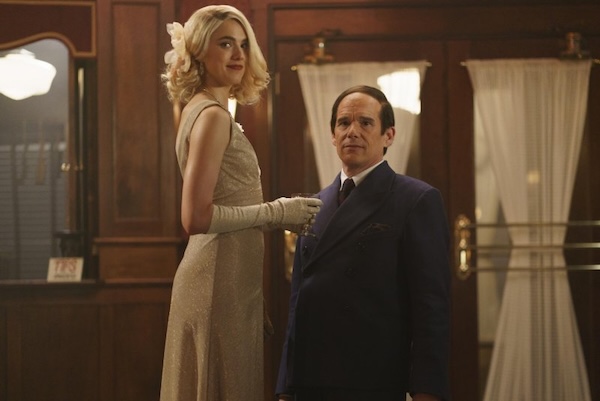
Margaret Qualley and Ethan Hawke star in Blue Moon. Photo: courtesy of Sony Pictures Classics
Had the lyricist Lorenz Hart opted to take up a career as a critic after his partnership with Richard Rodgers was disrupted in 1943, he might have given film critic James Agee a run for his money. Played with sometimes irritating conviction by Ethan Hawke in Richard Linklater’s wordy and well-acted, often entertaining and occasionally enlightening, Blue Moon, he strolls into Sardi’s and declaims to the barkeep Eddie (Bobby Cannavale, less menacing than the publican in The Shining) his gay interpretation of the relationship between Rick and Renault in Casablanca (1942).
But then he unloads on the production that really galls him, Richard Rodgers’s first collaboration with lyricist Oscar Hammerstein, Oklahoma!, the Broadway premiere of which he has just ankled to start some serious drinking before the cast and crew arrive to celebrate. “I was aware of two things,” he says when asked his opinion of the show. “One, it was a 14k hit. And two, it was a 14k piece of shit.” It was, he adds, “fraudulent on every possible level. It was nostalgia for a world that never existed. I had a great sinking in my heart as all around me people are laughing at third-rate jokes. I wanted to grab them by the shoulders and ask them, ‘What are you laughing at?’”
Many of us have experienced such moments.
With his shrunken stature, black-dyed comb-over, and ravaged features (kudos to the make-up team, and those who managed to make him look under five feet tall), Hawke in this mode is a glib Golem, gnomelike, poisoned with self-loathing and self-pity but with a barbed tongue capable of the nastiest bon mots. But, after venting his spleen, Hart must prepare himself to greet and congratulate his ex-partner, perhaps in hopes of a reconciliation. After over 20 years and dozens of hits, their legendary, synergistic, pre-Lennon/McCartney collaboration seems to have ended. Hart’s notorious drinking and erratic work habits forced Rodgers to replace him with the more – in Hart’s words – “earthbound” Hammerstein (a giant man-baby played by Simon Delaney).
Moreover, Hart is also looking forward to reuniting with Elizabeth (based apparently on a real person, Elizabeth Weiland, whose correspondence with Hart is credited by the film as a source), a 20-year-old Yale co-ed. Though gay, Hart has idolized this young woman, who embodies his ideals of beauty, intelligence, and style. An aspiring theater person, Elizabeth finds his attentions flattering and possibly an asset to her career.
So Hart turns his lubricious wit from tearing down Oklahoma! and his replacement Hammerstein to spinning encomiums to Elizabeth’s virtues, which the red-blooded Eddie finds teasing in their lack of specificity. He also enlists as an audience to his paeans those in the pre-party Sardi’s crowd, including Morty (Jonas Lees), an affable off-duty Army sergeant tinkling tunes on the piano who has his own show-biz ambitions, and the cute delivery boy bearing Hart’s bouquet for Elizabeth. He even snags E.B. White (Patrick Kennedy) hiding in a booth scribbling in a notebook. The latter is drawn into the Hart show at first unwillingly, but then he too is “enchanted” (one of the words White helpfully feeds Hart during one of the latter’s exhausting Elizabethan rhapsodies) by the wit’s non-stop logorrhea.
Hart returns the favor to White when he shares a story about a mouse named Stuart who lives in his kitchen. White jots down some notes, and voila, Stuart Little is born. Compare this spurious anecdote about the source of creative inspiration to Me and Orson Welles (2009), Linklater’s previous outing with his screenwriter Kaplow, which offers far better insight into that process. That picture shows how the magic of ingenious stagecraft takes place, whereas this film tends to reduce genius to staginess. But, despite its restrictions to a single set (Sardi’s reconstructed on a soundstage in Ireland), Linklater does draw on some of cinema’s most basic and powerful assets, in particular the pointed use of close-ups and extended reaction shots – often of Hart languishing in recognition of and resignation to his fate.
These tools are not fully utilized until 40 minutes or so into the film when the Oklahoma! party arrives and Hart confronts the reality of his new circumstances. He alternates between sycophancy and bitterness regaling Rodgers (played with edgy charm and irritableness by Andrew Scott, winner of the Best Supporting Performance Award at the Berlin Film Festival), who encourages Hart by inviting him to contribute a few new songs to an upcoming revival of their A Connecticut Yankee. Hart in turn pitches him an extravaganza based on the adventures of Marco Polo – four hours long, a raucous satire lampooning everything including the Broadway musical genre itself. Rodgers looks like he just smelled something bad and says the scenario lacks emotion. Hart accuses Rodgers of sentimentality. It doesn’t go well, though given Hart’s description of a scene in which cannibals sing numbers from Porgy and Bess, it would seem Rodgers made the right call.
Matters go differently with Elizabeth, who is played by Margaret Qualley in her most nuanced and authentic performance to date. Hart, who seems to have had a voyeuristic streak, insists she tell him all the details of the tryst she had with a boy she has a crush on. Titillated by her description of the “pure white skin” on her beloved’s back, Hart’s demeanor transforms when she relates a different tale from what he expected. His response is genuine, compassionate, and bereaved at this new manifestation of human folly and misery. As he promised, Hart introduces his muse Elizabeth to Rodgers and watches them leave together.
As the bar closes, Eddie pours himself and Hart a shot of Old Forester and toasts, “Larry, I think this is the beginning of a beautiful friendship.” Seven months later Hart, 48, would die of pneumonia after being found unconscious in an alley in the rain.
Peter Keough writes about film and other topics and has contributed to numerous publications. He had been the film editor of the Boston Phoenix from 1989 to its demise in 2013 and has edited three books on film, including Kathryn Bigelow: Interviews (University Press of Mississippi, 2013) and For Kids of All Ages: The National Society of Film Critics on Children’s Movies (Rowman & Littlefield, 2019).
Tagged: "Blue Moon", Ethan Hawke, Lorenz Hart, Margaret Qualley, Richard Linklater
It’s rather odd that the character of Elizabeth Weiland is depicted as a 20-year-old Yale student when it’s a well-known fact that Yale didn’t admit women until 1969.