Book Review: Ha Jin’s “Looking for Tank Man”: Memory, Erasure, and the Weight of Exile
By David Mehegan
This is the story of powerless little people caught up in a confusing maelstrom, at the receiving end of senseless violence.
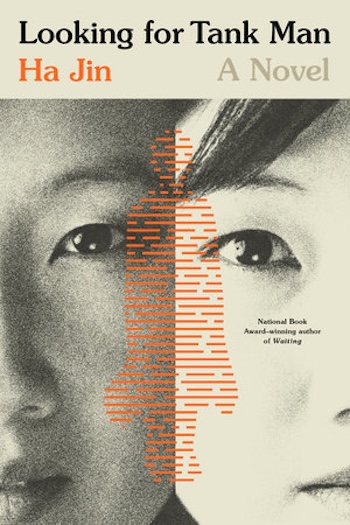
Looking for Tank Man by Ha Jin. Other Press. Paper. 368 pp. $19.99
 It has been almost 40 years since Jin Xuefei, a young People’s Liberation Army veteran with a master’s degree in American literature from Shandong University, came to Brandeis University to pursue a PhD (completed in 1992). Horrified at the Tiananmen Square massacre of students and others in April 1989, of which from America he had a clearer view than his countrymen, he resolved never to go back. In 1991, he enrolled in Leslie Epstein’s creative writing program at Boston University already armed with collections of stories written, as are all his works, in English. His chosen pen name was Ha Jin.
Epstein was stunned, he told me, by the quality and beauty of Jin’s work and became perhaps his strongest advocate and supporter. Armed with his Brandeis doctorate and BU M.A. (1994) in writing, Jin took a job teaching fiction, creative writing, and poetry at Emory University in Atlanta, and in 2002 returned to BU, where eventually he was appointed a William Fairfield Warren Distinguished Professor.
It’s odd, I know, to begin a book review with a biographical sketch. But Jin’s career is so improbable that it’s helpful to know about it when considering Looking for Tank Man. He has published numerous works — four collections of short stories, four of poems, 10 novels, one novella, one biography (the Chinese poet Li Bai), and a collection of essays, The Writer as Migrant, identifying (among others) with the journeys into exile of Vladimir Nabokov, Alexander Solzhenitsyn, and the Chinese writer Lin Yutang. In 1999 he won the National Book Award for the novel Waiting, the excruciating story of a Chinese doctor who must wait an extraordinary 17 years to be free to marry the woman he loves. His writing has been translated into 30 languages.
I have not read all of Jin’s books but found the early works, especially the story collections, the novella In the Pond, and Waiting, to be achingly sad and profound. I do not think, however, that Looking for Tank Man ranks high as fiction. I say “as fiction” because, as with certain other books, notably War Trash, the story is situated so explicitly within recent Chinese political history — there is even a historical bibliography — that the main characters seem in comparison to fade.
Twenty-three-year-old Pei Lulu is at Harvard University on a scholarship, on the strength of her excellent academic record in China. She is close to her divorced parents, especially her mother (dumped by her husband for a younger woman), whom she has promised to care for in old age. During a visit to Harvard by a prominent Chinese government official, Lulu joins a crowd of students who are expected to provide a demonstration of welcome. While most are waving little red flags, one older woman is carrying a sign with the message, “We won’t forget the Tiananmen Square Massacre.” Lulu is curious and surprised. She has only a vague idea of the incident — bloodshed was never mentioned in passing references to it in her schooling — and is stunned by the furious reaction of her fellow students.
“You’d better knock it off,” one male student screams at the woman, “you’re a pathetic liar, and nobody believes you. I lived in Beijing for many years and never heard of the Tiananmen Square Massacre. Look around, see who believes you and your nonsense.… Shut your trap!” Lulu, however, is drawn to the woman’s courage and eloquence in answering the students: Liu Lan had been at Tiananmen Square and seen the killings of hundreds of students and remains committed to proclaiming the truth.
Compelled by curiosity, Lulu takes a Harvard seminar called “Memory and Amnesia: The Tiananmen Suppression and Its Consequences,” where she learns about the massacre from testimony, video, and a mountain of documentary evidence. The class is gut-wrenching. She is especially taken by the famous video of the Tank Man, the never-identified tall figure who stood in front of a column of tanks, moving left and right to block it as it headed to the square to put down the student democracy protest. Though she comes to believe that the video was staged by the Chinese government to suggest the army’s benign intentions, the image of one fearless man standing up to overwhelming power is irresistible. She decides to pursue a PhD after graduation. Her dissertation subject: the Tiananmen Square Massacre.

Author Ha Jin. Photo: Dorothy Greco
The substance of the novel, told by Lulu in the first person, concerns her pursuit of her research, publication of a short book about the massacre, and the harassment and official intimidation she encounters in China when she interviews eyewitnesses, including tank soldiers and student victims. She is especially shocked to discover that her own parents had been part of the protest, but had escaped the shootings. Many decades later, they want her to forget about it, as they largely had. But she persists, and draws their testimony out of them — they had been at the center of the action.
This is the story of powerless little people caught up in a confusing maelstrom, at the receiving end of senseless violence. At times, the narrative comes off as a historical documentary. Details of the massacre — as provided by witnesses, including Lulu’s mother’s contemporary diary — are included in the story. No Chinese officials, other than low-level cops appear, of course. No higher-ups would have talked to Lulu — so we don’t know what was going on inside the quarters of government decision-making.
To most American readers of fiction, Ha Jin’s style might seem stilted, even wooden. The narrator and all the characters speak in fully grammatical standard American English, even when they’re angry, and a certain old-fashioned diction is noticeable. There is much grinning, for example. Lulu says at one point, “I took my leave,” reads “voraciously,” and describes a friend’s reaction to her announcement that she had been accepted into Columbia’s doctoral program: “At that, his face shone with elation. I was pleased to see he was happy for me.” When she asks a small Chinese publisher in New York if he aspires to be “a Random House in the world of Chinese publishing,” he replies, “Ha ha ha, how can I tell what the future holds?” Is this meant to be the sound of laughter, or did he say these words? Lulu is the storyteller, so everything is seen through her eyes and described with her school-learned English. We only know what she knows.
The book is filled with memorable characters: John Bailey, Lulu’s Columbia PhD director, who tries to maneuver her into bed and hints at retribution when she rebuffs him; Meng Wentao, a New York-based veteran of the massacre who gives his whole life over to fighting to publicize the truth, losing his marriage and health in the process; fellow student Mark Stone, whose poster of the Tank Man over his desk both irritates and attracts Lulu; Lulu’s lonely mother, who wants to encourage her brilliant daughter’s ambitions but fears being abandoned again.
Lulu herself is reserved, indefatigable in pursuing her academic goals, and wary of distracting intimacies with men. Her sexual encounters are devoid of detectable emotion. She reports feelings of fear, worry, or anger, but they don’t seem to threaten her controlled manner. She is shrewd and tactical in some respects, yet amazingly naïve about the Chinese authorities’ determination to spy on her — both in China and the US — and to cut off her efforts to get at the truth. It is difficult to believe that she would think she could interview a tank commander, in China, about the massacre and not get into trouble.
Looking for Tank Man loses energy toward the end, and does not provide a clear resolution of Lulu’s life or situation. It ends with her expression of hope and possibility for the future. Tension is released in that she escapes the worst that could happen to her. It seems likely that she will stay in America, but that would seem to break her promise to take care of her mother. Her story is unfinished.
It might be that this is the situation of Ha Jin himself. After Waiting, he set no more books in China and turned to creating Chinese characters in exile, usually in the United States. Yet the struggle of most of them, explicitly or implicitly, against the negative gravitational pull of their native land had the effect of keeping China as the paramount source of tension.
In The Writer as Migrant (2008), Jin writes that he had once seen himself as a spokesman in exile for the downtrodden people of China. But as years passed, “On several occasions, I said I would stop writing about contemporary China. People often asked me, ‘Why burn your bridges?’ or ‘Why mess with success?’ I would reply, ‘My heart is no longer there.’ In retrospect, I can see that my decision to leave contemporary China in my writing is a way to negate the role of the spokesmanship I used to envision for myself. I must learn to stand alone, as a writer.”[1]
He has left it physically, yet the hulking figure of the Chinese communist regime still casts a deep shadow over the characters in Looking for Tank Man and most of its predecessors. It is like an unseen character lurking just offstage. Enormous, powerful, relentless, mysterious, as semihuman as AI, the Chinese Communist Party is politically radical but formidably traditional in its enforcement of social norms, particularly in the ways it exerts crushing pressure on the freethinking individual. In Ha Jin’s books it has not truly been left behind.
David Mehegan is the former book editor of The Boston Globe. He can be reached at djmehegan@comcast.net.
[1] Ha Jin, The Writer as Migrant (Chicago: University of Chicago Press, 2008), 28.