
Musician Interview: Ryan Lee Crosby on Playing the Blues at The Blue Front
By Matt Hanson
There’s an enticingly primeval quality to the way bluesmen Ryan Lee Crosby and Jimmy “Duck” Holmes play off of one another.
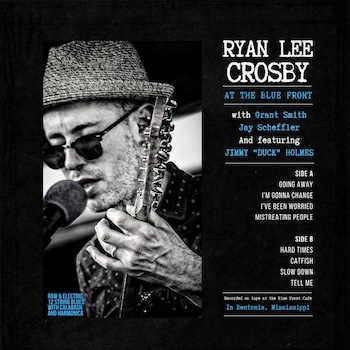
Willie Dixon once said that “the blues are the roots, the other musics are the fruits.” We all know by now how plenty of world-famous bands have harvested those influences. So maybe it’s time to turn our attention to those who are tapping a similar root in a new way. Ryan Lee Crosby is one of the most distinctive of contemporary blues musicians because of his melding of Indian raga with the Delta blues. Crosby’s clearly deeply versed in the blues tradition while cultivating his own personal orchard of sound.
His new record, At The Blue Front, documents a live session at the legendary Blue Front Café in Bentonia, Mississippi, with Jimmy “Duck” Holmes. The earthy, muddy, tactile quality of his way of playing takes its inspiration specifically from the style of playing that is celebrated yearly — and practiced nightly — in Bentonia.
There’s an enticingly primeval quality to the way Crosby and Holmes play off of one another, appropriately so in their version of the blues standard “Catfish.” The resonance of the loping, hypnotic beat intertwines with the subtle clacking and thumping of the percussion while a plaintive harmonica floats above it all. The sound is deep, cavernous even, as if coming from deep in the center of the earth. Crosby murmurs elemental truths about the karmic wages of misdeeds inspired by “Mistreating People.” The lyrics deal with the all-too-human necessity of changing who you are, which means the inevitable need to leave wherever you’re at. The mesmerizing “Slow Down” encourages a more contemplative, reasoned response to the perpetual flurry of modern life. Who couldn’t use a generous dose of this kind of musical medicine these days?
At The Blue Front sounds exactly like what it is: a session conducted late at night on a porch in deep summer heat. It’s well worth sitting in. I called Crosby on the road between gigs — he’ll be at City Winery in Boston on October 24, at The Parlor Room in Northampton on the 25th, and at the Broad Brook Community Center in Guilford, VT, on Oct 26th — to ask about his new record, his collaborator Holmes, and why he decided to take a break from listening to Elliott Smith.
Arts Fuse: I know you’ve been deeply influenced by the Bentonia blues tradition and you’ve always mixed it with Indian music. Do you see the two as having a lot in common?
Ryan Lee Crosby: The Bentonia Blues and Indian raga share some similarities. They are both highly improvised, cyclical musical styles with little to no harmonic movement. Both kinds of music are meant to be played in the moment, from the heart, never to be performed the same way twice. They have a way of drawing both the artist and audience into the present, as well as a kind of otherworldly, hypnotic effect that can induce a dream-like state. So, while I wouldn’t expect everyone to connect the two, for me they are resonant through the lens of my experience as a student of music and also in my appreciation of how they can open up one’s awareness through sound.

Jimmy “Duck” Holmes. Photo: courtesy of the artist
AF: What made you want to make this record with Jimmy “Duck” Holmes?
RLC: It was really just an impulse, an intuition. I love to record and I have loved studying the Bentonia tradition with Jimmy at the Blue Front. This was just an extension of that — I don’t feel that we made the recordings with any expectation that they would become albums. We just did the work for the sake of doing it, and then let the music tell us what to do after the mixes were completed. I see At The Blue Front as a documentation of a mentorship in process as well as an expression of community. It’s also a statement of just how I’d like to make records: as a reflection of a moment in time, preferably recorded in analog, of the songs played that day and the space they were played in. It should all be about communicating a sense of place and connection through the language of music.
AF: What makes Jimmy “Duck” Holmes’s music unique?
RLC: Well, to put it simply, he doesn’t sound like anyone else and nobody else sounds like him. He has a touch on the guitar that is impossible to replicate. Some of those notes are more like textural sounds than distinct pitches. And his singing style — the tone and phrasing — is all his own. I believe that part of this comes from the fact that the Blue Front is (at least, from my point of view), a world unto itself — culturally, as well as its actual location in Bentonia.
AF: What do you think makes the blues relevant today?
RLC: If I can be brief, I might first quote Jimmy and say that the blues is the foundation of American music. You can have a house of any size, but it all rests on one foundation. The blues holds a lot of wisdom and relevance to today’s world; it’s about human experience, it’s about freedom, and its about the kind of transcendence and joy that fosters community. Those are all things I want to see In the world, and that people are yearning for. Of course, the blues might not be what you think it is — there’s a lot of different kinds.
John Lee Hooker said that the blues is healing music. The blues invites us into a space where we can rest our minds and our hearts. It is also party music, where you rest your mind, your heart, and your body. I don’t see that kind of humanity in much contemporary music. There’s an organic quality in the blues that isn’t necessarily found in a lot of contemporary music, with AI and technology. The blues has an organic human quality. It’s a place where you feel that you can rest when you’re wiped out by the digital world. Just for me personally. What the music has to offer me.

Ryan Lee Crosby singing the blues. Photo: courtesy of the artist
AF: The writer Albert Murray once argued that you play the blues in order to free yourself from the blues. I see what he’s getting at, but I’m not so sure if I’m freed from the blues when I listen to someone like Skip James, for example, whose music moves me, but in a depressing way.
RLC: Speaking for myself, I find that blues is music that holds every aspect of what it means to be human. It’s the joy and the sadness, the beauty and the horror. The blues offers an opportunity to feel feelings which might be hard to access, which might be hard to reach otherwise. It lets your feelings go through you.
I used to listen to a lot of Elliott Smith and Townes Van Zandt, both of whom I still love now, but I sometimes feel that the feelings those songs create don’t really go anywhere. Sometimes an Elliott Smith song can feel like a black hole you can’t get out of. When I listen to the blues, even those Skip James records which are brooding and heavy, there’s a rhythm and groove to them which helps the feelings pass through you. Does the music make me tap my foot, get your body moving, have the capacity for those feelings to move through you? That’s just my way of relating to it.
Matt Hanson is a contributing editor at The Arts Fuse whose work has also appeared in The American Interest, The Baffler, The Guardian, The Millions, The New Yorker, The Smart Set, and elsewhere. A longtime resident of Boston, he now lives in New Orleans.
Tagged: "At the Blue Front", Blue Front Café, Jimmy “Duck” Holmes, blues