
Film Festival Preview: GlobeDocs Film Festival 2025 — A Varied Mix of Documentaries
By Ed Symkus
Our critic watched a half-dozen films in this year’s GlobeDocs Film Festival and shares his thoughts.
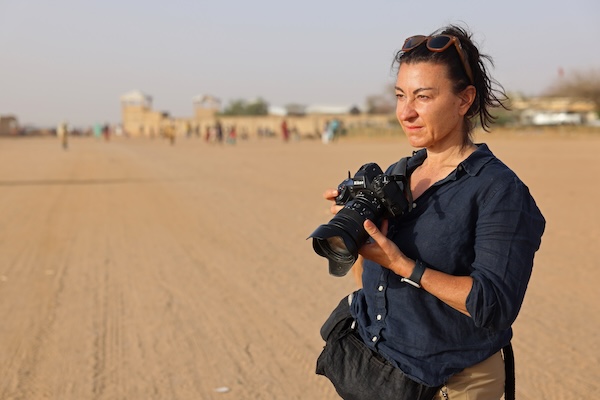
A scene from the documentary Love + War. Lynsey Addario on assignment in Iridimi Refugee Camp, Wadi Fira, Chad. (National Geographic/Caitlin Kelly)
An email came to me recently from my editor at The Arts Fuse, asking if I’d be interested in covering the upcoming GlobeDocs Film Festival, and wondering if I could do “an all-encompassing piece that cherry-picks and focuses on a representation of the titles,” if I’d “pick a few films that look of interest and write reviews. Maybe a few comments on what seems to be the general drift of the festival.”
Hell, yes! Right up my alley. I procured a list of the documentaries — 30 in all, half of them features, (80-117 minutes), half shorts (5-30 minutes) — set up an interview with Director of Programming Lisa Viola, then, having decided that I would stick to the feature-length offerings, methodically chose which ones to watch. By that, I mean I wrote down each title on 15 scraps of paper, put them in a baseball cap and, knowing nothing about them, drew out six.
The result: A phone chat with Lisa Viola about the inner workings of the festival — ready to celebrate its 11th edition — and a riveting, informative, often entertaining two-day delve into a varied mix of documentaries.
“I’ve been a film festival programmer my entire career,” said Brookline native Viola. “I started off in the ’90s at Sundance, when it was a very small festival, I moved back to Boston and worked with Connie White on the Boston Women’s Film Festival and on the Provincetown Film Festival — I’m artistic director there now — and I’m the founding director of programming for the GlobeDocs Festival.”
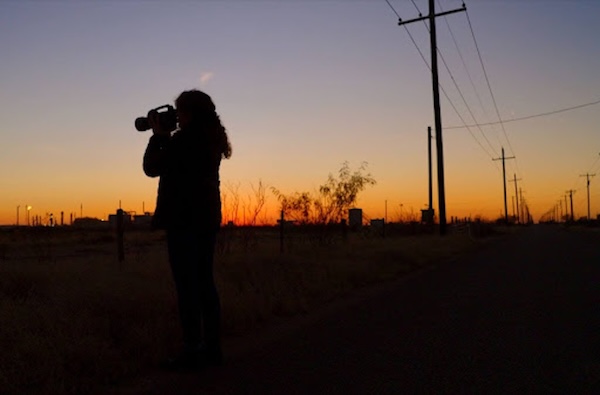
A scene from This Is Not a Drill. Photo: GlobeDocs Film Festival
Viola’s main responsibility is curating the festival, an undertaking that involves viewing a lot of movies.
“We receive submissions through a portal, where any filmmaker, around the globe, is welcome to submit a film,” she explained. “This year we got about 200. I watched all of those. I have a small programming committee that helps me, and we select the films that we think are going to work well for the festival.”
She and her committee are searching for diverse styles and topics, for films that she hopes will interest audiences that are looking for a wide range of documentaries.
“It’s a challenge,” she admitted. “You start with an enormous pile of films. You’re viewing it, taking notes, sort of cataloguing everything, considering how it will fit into a program. It’s a puzzle that comes together as you watch and rewatch and discuss and figure out what will make the best program.”
Having now checked out brief synopses of all 15, here’s an idea of how much that programming range stretches. Andre Is an Idiot focuses on Andre Ricchiardi, a man determined to keep his sense of humor upon finding out he has a terminal illness. This Is Not a Drill follows a small group of environmentalists and wealthy heirs who intend to expose some dirty secrets of Big Oil. The Boston-based Cathedrals features two friends who made a film together 50 years ago, went their separate ways, and have now reunited to share stories on their lives and the world. Ask E. Jean explores the career of journalist-author-talk show host and victor in two cases against Trump E. Jean Carroll. The Stringer uses the iconic, infamous Vietnam War-era photo “The Terror of War” to look into the world of freelance photojournalism.
These, and four other films — Love+War, The Bend in the River, The Chaplain & the Doctor, and Shuffle — span the documentary landscape. As are the half-dozen films I watched and will share a few thoughts on.
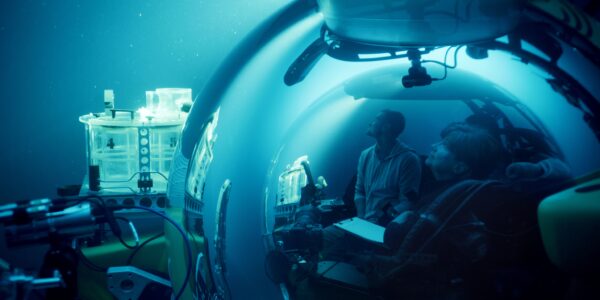
A scene from A Life Illuminated. Photo: GlobeDocs Film Festival
A Life Illuminated — Arlington, MA, native Dr. Edith Widder is a marine biologist and self-proclaimed “explorer.” The film, rife with archival footage, follows her 40-year career down in the deeps, often in high tech submersibles, and tracks her current quest. She intends to find and be the first person to photograph an example of flashback — light that’s produced by a living organism in answer to a light that’s flashed on it. The visuals are stunning, and there’s a cameo by a giant squid!
Coroner to the Stars — Thomas Noguchi had a long run (1967-82) as Chief Medical Examiner and Coroner for the County of Los Angeles. His job was to investigate the cause of sudden, unexpected deaths. During that time, he became known as the founding father of forensic pathology (and it’s said that Jack Klugman’s character on the TV show Quincy, M.E. was modeled after him). But controversies plagued Noguchi’s life even earlier — as a deputy medical examiner, he was assigned to look into the 1962 death of Marilyn Monroe. Later, after working on the cases of, among others, John Belushi, Natalie Wood, and RFK, detractors accused him of seeking fame by sensationalizing the deaths of celebrities. This is an inspirational character study.
Croft — After a tour of duty in Vietnam as a Marine Private First Class, Hal Croft returned home to Reading, MA, and decided to dedicate his life to teaching. In the classroom at Reading Memorial High School, he was a respected English teacher; after school, he became a revered track coach. Things were great at work, but not at home, where his family didn’t know how to cope with what seemed to be emotional difficulties. The film is loaded with people talking about him — from now-adult former students to his wife and kids. And there’s plenty of time spent with Croft, looking back on events that shaped him. The second half of the film, which focuses on his time in Vietnam, gets pretty dark, but despite never receiving the help he needed, he gave help to many others. Re-creations of episodes in his life by actors are nicely done.
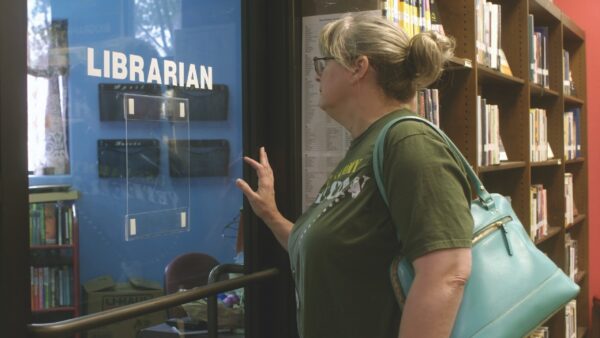
A scene from the documentary The Librarians. Photo: GlobeDocs Film Festival
The Librarians — This one couldn’t be any more timely. Set mostly in contemporary Texas, it’s about Republicans (and Christian groups and conservative school boards and oh-so-righteous organizations such as Moms for Liberty) demanding that certain “offensive” books be removed from school libraries (one list has 850 titles), while frustrated librarians are being fired for not complying, for asking questions, for pushing back. The film pulls no punches. It includes clips of Dwight Eisenhower in 1953 telling Americans, “Don’t join the book burners,” and of Joseph Goebbels urging Germans to burn books (and an obligatory clip from the film Fahrenheit 451). Emotions run high on both sides of the issue, but the conservatives are much louder about it all. This is heartbreaking, sobering, and scary, but some hope is offered. There are fighters out there.
Cover-Up — The spotlight here is on the renowned investigative journalist Seymour Hersh, formerly a writer at AP, The New York Times, and The New Yorker – and now working with Substack. Upon meeting him in the film’s opening moments, it’s clear that he’s a feisty fellow but isn’t very comfortable talking about himself or people he has exposed in his long career. It was Hersh’s deep research and writing that made people aware of Lieutenant William Calley, who led the 1968 massacre at My Lai. It was his work on the Watergate scandal (separate from Woodward and Bernstein) that prompted Richard Nixon to say to Henry Kissinger, “This fellow Hersh is a son of a bitch.” It was his reporting on torture at Abu Ghraib that opened the eyes of the world. He’s always said that his job is to find secrets and facts, and publish them. This film is riveting.
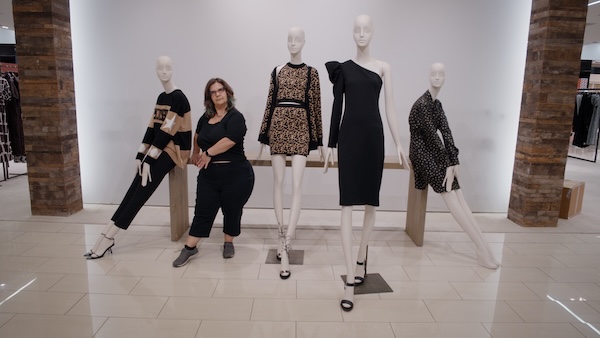
A scene from The Tallest Dwarf. Photo: GlobeDocs Film Festival
The Tallest Dwarf — Julie Wyman is 5-feet tall. She’s fairly well proportioned, but her arms and legs are shorter than what is considered “normal.” Same with her dad, Boris. She’s not technically a dwarf, because to claim that term, you must be under 4′ 10”. But she has wondered if she has a form of dwarfism, and if there are other people like her. That’s the basis of this film, which she wrote and directed. She meets up with and becomes close to members of Little People of America (founded in 1957 by actor Billy Barty) and its offshoot Dwarf Artist Coalition, and gets a peek at the Bruce Johnson Dwarf Images Archive. There are discussions about seemingly mundane subjects, such as where to buy clothes and how to make cars drivable, as well as more lofty ones: how to adapt both physically and emotionally to the condition, whether or not to go for a change, be it through growth hormone therapy or a surgical treatment called limb lengthening. We get personal horror stories but no self-pity, upbeat attitudes and even a few big laughs.
“I’d encourage people to step out of their comfort zone,” said Viola. “Obviously, they won’t know much about these films, because they haven’t been released. I’d love for people to come and have a sense of discovery, to take a chance on these films.”
The festival is offering in-person screenings, split between the Coolidge Corner Theatre, the Brattle Theatre, and Alamo Drafthouse Cinema Boston Seaport, October 22-26, and virtual screenings via the Eventive platform from October 26 to November 2. In-person screenings will include documentary filmmakers in conversation with Boston Globe journalists.
Festival tickets and all-access passes can be purchased online at Globe.com/filmfest
Ed Symkus is a Boston native and Emerson College graduate. He went to Woodstock, has interviewed Russ Meyer, Eva Green, and Julie Andrews, and had a nice chat with Roger Ebert, and has visited the Outer Hebrides, the Lofoten Islands, Anglesey, Mykonos, Nantucket, the Azores, Catalina, Kangaroo Island, Capri, and the Isle of Wight with his wife Lisa.