
Doc Talk: Eyes in Gaza
By Peter Keough
Documentaries at the Boston Palestine Film Festival look into the abyss.
The Boston Palestine Film Festival. At the Museum of Fine Arts, the Brattle Theatre, and the Coolidge Corner Theatre, and other venues, from October 17 through 26.
As Trump basks in glory following the fragile Gaza ceasefire, it might be a good time to take a look at what two years of hell have wrought.
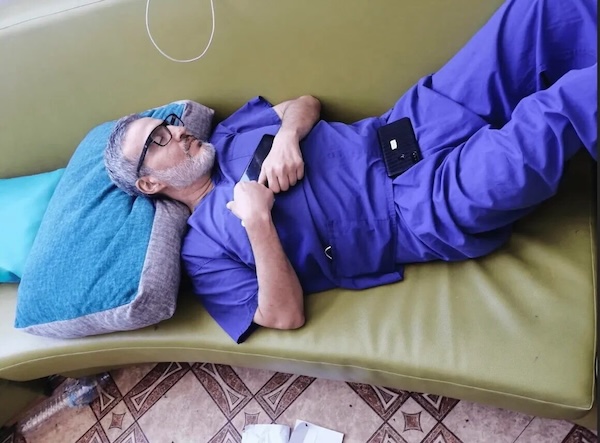
Dr. Ghassan Abu-Sittah in Carol Mansour and Muna Khalidi’s A State of Passion. Photo: The Boston Palestine Film Festival
“Shit you can’t imagine has happened,” reports Dr. Ghassan Abu-Sittah in Carol Mansour and Muna Khalidi’s A State of Passion (2024; screens at the MFA October 24 at 7 p.m.), as he treats the wounded during the Israeli assault following the Hamas attack on Israel on October 7, 2023. He’s a renowned London-based plastic surgeon (the filmmakers share an infomercial in which he explains his exclusive scarless lip-lifting procedure) whose family had once lived in Gaza. Inspired by the Palestinian cause, back when he was 14 he wanted to train as a jihadist. His father, also a doctor, convinced him he could do more good as a physician.
And so he has. This is the sixth time since the First Intifada in 1987 that he has been in Gaza tending to desperate medical emergencies during Israeli onslaughts. But never has it been this bad. For 43 days he operated non-stop in shattered hospitals performing surgery on horrific injuries with few medical supplies, often reduced to using vinegar and dishwashing liquid as anesthetics.
Many of the victims are children. He recalls performing six amputations in one night, one on a three- year-old boy who was the only survivor in his family. “So he has no one left.” He adds, “We put their limbs in boxes with their names on them, like a little casket.”
Such details get to you, like Abu-Sittah’s description of the human detritus that remains after bombings, such as the barrette in a child’s hair, or nail polish on a victim’s hand, or how a polyester shirt shrinks on the body of a victim burnt to death. That, and the photos, quickly montaged, but not quick enough.
In contrast to these ghastly images are scenes of Abu-Sittah at his London home with his family. They meet friends, wash dishes, cook meals, and relax in pajamas. But the bourgeois calm is superficial: the doctor is constantly on the phone learning of the endangered status of colleagues back in Gaza who are targeted by Israeli forces. His wife, a Gaza native, is in a state of constant anxiety about the fate of her father and other family members who are still in the war zone.
She notes that at home the doctor sleeps better at night, but still cries out aloud from bad dreams. As Abu-Sittah states at the film’s opening, “I cannot unsee what I saw. I cannot unhear the cries and the screams that I heard and unsmell the smell of festering wounds.”
Two documentaries in the Shorts Program: A BPFF Homage to Gaza (screens at the MFA October 18 at 2:30 p.m.) further illustrate the medical plight suffered by children in Gaza in this and in previous conflicts.
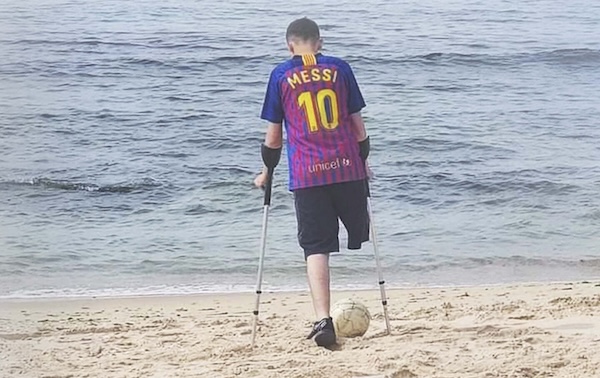
A scene from Jen Marlowe’s Severed. Photo: The Boston Palestine Film Festival
In Jen Marlowe’s Severed (2025) Mohamad Saleh, now 18 and living with his mother in exile in Cairo, relates how as a 12-year-old he had been shot in the leg by a sniper during a previous Israeli action against Gaza. Because of inadequate medical treatment, the wound failed to heal. His leg was amputated and required several subsequent operations.
But the real nightmare did not begin until the recent war, during which, among many other ordeals and indignities, he was forced to flee on crutches through sand as an Israeli soldier took pot shots at him to speed him up. Now in relative safety, and with his leg possibly on the mend, he and his mother watch a news report about the bombing of his former school in which 30 students were killed.
The only sound you hear in Rehab Nazzal’s Vibrations From Gaza (2023), other than occasional bird songs and the distant throb of waves, is the buzz of drones and the thud of explosions. The deaf kids enrolled at the Atfaluna Society for Deaf Children profiled in this subtle but poignant film can sense them as well. There is the suggestion that the constant aural assault of the war machines has contributed to a widespread phenomenon of hearing loss in the region. Yet, though often terrified, the children seem impossibly cheerful and resilient.
This film was made before the recent invasion. According to a UN report on the Atfaluna Society from June, 2024, “When the war broke out in October, all of its offices and assets were destroyed, and the staff was forced to flee. Now, after much struggle to rebuild, the organization is reborn from its ashes and provides support to children living with disabilities.”
Doctors are not the only profession targeted in Gaza. Journalists are as well. Exiled Iranian filmmaker Sepideh Farsi wanted to enter the zone to film what was happening there but was forbidden by the authorities. So her friends put her in touch with 25-year-old Palestinian photojournalist and poet Fatma Hassouna, who was then living in Gaza City.
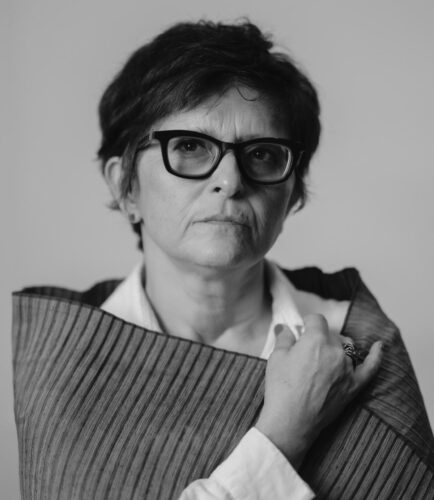
Exiled Iranian filmmaker Sepideh Farsi. Photo: courtesy of the artist
Farsi’s Put Your Soul On Your Hand And Walk (screens October 21 at 6:30 p.m. at the Brattle Theatre) consists mostly of Farsi’s video phone calls with Hassouna, who invariably greets the filmmaker with a radiant smile. She is irrepressibly upbeat despite the grim events surrounding her, some of which are shown in news broadcasts and Hassouna’s own vivid and poetic photographs (occasionally she’ll turn the phone to the window to reveal the latest devastation in her demolished neighborhood). Her demeanor only cracks a bit when she relates a particularly heinous episode, such as finding her aunt’s severed head blocks away from where her home had been obliterated.
Despite her indomitable attitude, hers is a tale of constant attrition and diminishing hope. Farsi fears for her. “Each of our conversations could be the last,” she says in voiceover. “Israeli bombs fall everywhere in Gaza all the time. So every time we connect and I can see her face it feels like a miracle.”
The miracles would continue for a year until their last phone call on April 15. Farsi tells Hassouna the good news that their documentary had been accepted by the Cannes festival and hopes that Hassouna can attend. She also wonders if it might be better now that their story is public that Hassouna consider relocating someplace else.
Hassouna says, “I can’t leave Gaza. Even if everything and everywhere is destroyed. This is our land. We will rebuild Gaza. I don’t know when but I believe everything will end.”
Peter Keough writes about film and other topics and has contributed to numerous publications. He had been the film editor of the Boston Phoenix from 1989 to its demise in 2013 and has edited three books on film, including Kathryn Bigelow: Interviews (University Press of Mississippi, 2013) and For Kids of All Ages: The National Society of Film Critics on Children’s Movies (Rowman & Littlefield, 2019).
Tagged: "A State of Passion", "Put Your Soul on Your Hand and Walk", "Severed", Boston Palestine Film Festival, Carol Mansour, Fatma Hassona, Jen Marlowe, Muna Khalidi, Rehab Nazzal