
The New York Film Festival: Gaza Photographer Resurrected on Film, Shocking Desert Rave Saga, and Jafar Panahi Returns
By David D’Arcy
Three powerful films at NYFF about violence, survival, and revenge.
It was hard for a film to distinguish itself at an event like the New York Film Festival (Sept. 26 – October 13) in which a no-budget film of iPhone images was vying for attention with the likes of Julia Roberts, George Clooney, and Bradley Cooper. It’s even harder when that film is a window onto Israeli-besieged Gaza at a moment when anything about Palestine risks being overtaken by events, such as the latest ceasefire deal.
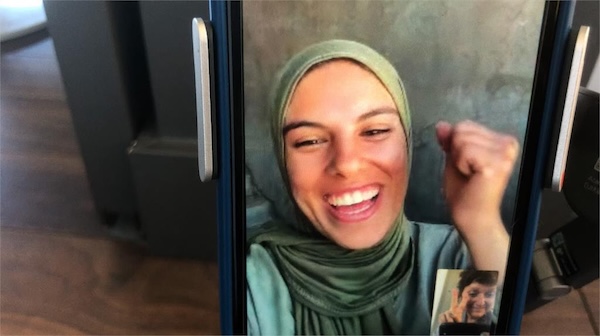
A scene from Sepideh Farsi’s Soul on Your Hand and Walk, featuring photographer and poet Fatma Hassouna. Photo: NYFF
The film is Put your Soul on Your Hand and Walk, by the Iranian director Sepideh Farsi (Iranian exile, that is). It’s a series of filmed telephone conversations with the young photographer and poet Fatma Hassouna.. The filmmaker could not enter Gaza, and her subject could not leave. Calling that a cinematic challenge is like calling the Israeli invasion of Gaza a peacekeeping operation — which is one of the many things the Israeli government has called it. Fatma Hassouna., whom we see and hear from in cell phone calls over the course of a year, was killed along with family members in an Israeli bombing just after the announcement last spring that the film was accepted into ACID Cannes, a parallel event at the Cannes Film Festival. It’s poignant testimony and a stunning work of cinema.
The doc is also a work of improvisation, sort of like walking outside or eating a meal in Gaza, but a lot safer. Connections on the phone are reliably unreliable. When phones do work, Fatma’s face – let’s call her Fatma, as a character in the film – is stretched into focus. In her mid-20s, she is surprisingly cheerful, with a huge smile, as she tells of planes circling overhead, buildings crumbling, and loved ones killed. The head of one victim was found a street away from her body. You’ll hear about more casualties.
Fatma’s photographs capture the “work in progress” of IDF destruction, but they also show the people around her, including the improvisatory bricolage that keeps daily life moving amid the rubble. There are also elegiac views towards the sea, sometimes just glimpses of water and sky seen through holes in damaged walls. Given the paucity of means, this film’s visual power is all the more impressive. And how often do you find a face, like Fatma’s, which can hold your attention for almost two hours?
With that smile, Fatma assures Sepideh that “we have nothing to lose,” even as she professes her belief in God and replies matter-of-factly when Sepideh asks why she covers her head. “I’m a Muslim,” she answers. Farsi, from Iran, was imprisoned as a teenager by the Islamic Republic and has no religious faith. No matter. They bond over faulty connections, but share genuine emotion.
And this doc is real cinema, made under austere, strikingly appropriate conditions, given the subject. Technologies that are undependable at best somehow make connections possible in a place where electricity for Palestinians can be as rare as food or water. A place where you take your life in your hands if you insist on standing in natural light. The siege of Gaza makes Fatma look back longingly, with that same grin, to the days of COVID: “I was a happy person. I had privacy.”
This is a cinema of the possible, often a cinema of hope. Fatma talks of traveling someday – to Tehran, where Farsi is from (and can’t visit) or to Rome. She speaks fondly of her family. The phone encounters often go over the same ground, in part because they are filled with long, heartfelt expressions of affection from both sides. And there is the unsaid relief from Fatma that she’s still alive, given the constant explosions and clouds of smoke in the background. This should not be a surprise – war, for those trapped inside it, can be as monotonous as it is frightening. Her face is as radiant as ever when she reads fatalistic lines from her poetry, like these:
Tomorrow and the day after tomorrow I will actually
become a past person in the category of “was”
“She had dreams and she loved life even though it was hard on her.
She was talented and she wanted to live and she was.”
And she was.
As world leaders grab headlines for signing peace deals, a film like Put Your Soul on Your Hand and Walk risks being filed away, forgotten with the progression of events (and the tremendous loss of life) before combatants were pushed into a cease-fire. Yet the documentary may have traveled more since its Cannes premiere than peace negotiators have. Oscar talk may have something to do with the attention the film is getting, but this is still a portrait of determination that deserves to survive.
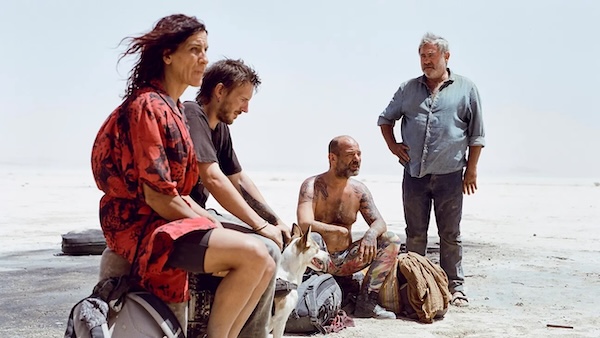
A scene from Oliver Laxe’s Sirat. Photo: NYFF
Also at NYFF, in Sirat, directed by Oliver Laxe of Spain (but French-born), it is people who disappear, in ways guaranteed to shock the most imperturbable among us.
There are commercial war film extravaganzas. There are war films that try to show or describe the actual horrors of war, especially the widespread and senseless killings of non-combatants, as Put Your Soul on Your Hand and Walk attempts to do. And there are films like Sirat, a “can-you-top-this” shock-fest that sits on the border of horror and the unimaginable.
The narrative is set in the broad and vast Moroccan desert, where anything civilized seems far away. Luis and his son Esteban are driving to a desert rave, where revelers ingest this era’s version of LSD and dance as long as the music throbs. Laxe has a good eye and ear for lost souls, and his cast certainly looks the part, except for father Luis (Sergi Lopez) and son Esteban, who are searching for Luis’s daughter, who may have disappeared in these parts – the first disappearance of many in Sirat. But armies are fighting nearby, and the partiers are told by soldiers to drive off to safer territory. Most do that, except for father and son, along with their dog and some ultra-hardcore headbangers, who all head for empty land in trucks with a massive sound system. One final rave before going home?
Nothing goes right. The weather is fierce, roads barely exist in the Road Warrior-inspired tale, a crash takes its toll, and then the convoy reaches a broad plain that turns out to be a minefield. If you haven’t seen how a mine can destroy vehicles and people, you’ve hit the jackpot with Sirat. The arbitrary violence makes it feel like an exploitation film, but the experience of war — when the ravers encounter the mines — is grimly and instantly realistic. So much for romantic danger. Utter and immediate destruction greet the would-be seekers of the next thrill, though Laxe has a devilish sense of timing. You feel every tentative step they take on their way to oblivion. (Is a rocket attack on a boat in the Caribbean — which we can watch and rewatch on the internet, thanks to our tax dollars — any more humane?)
The deadly indifference of land mines is what war was — and still is — in places like Afghanistan, Congo, or Sudan.
Reviewers have compared Sirat to Mad Max or Zabriskie Point. I thought of Jerzy Kosinski’s The Painted Bird, his hyper-deadpan, unsettling book about a journey through hellish encounters. I also thought of the pursuit of shock (albeit sanctified) in Mel Gibson’s The Passion of the Christ.
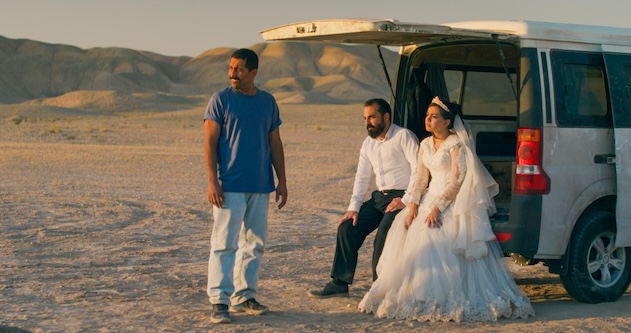
A scene from Jafar Panahi’s It Was Just an Accident. Photo: NYFF
Also at the NYFF was It Was Just an Accident, which won the Palme d’Or at Cannes this year. Jafar Panahi of Iran returned to New York with a film he didn’t have to make in secret—as was the case with his previous projects.
Not that Panahi didn’t have a brush with the authorities; if he didn’t get away with murder, as the saying goes, he did get away with an act of revenge. Not that you can do much in secret in Iran.
Here is the film’s story. A man pulls into garage outside Tehran after his car is damaged in an accident. Vahid, who wors there, recognizes the squeak of a prosthetic leg—belonging, he believes, to the intelligence officer who tortured him as a political prisoner.
Vahid stalks the former agent, abducts him, and ties him up in the back of his van. But, needing to be certain of the man’s identity before taking action, he enlists the help of a photographer—herself a former detainee—who is busy shooting a couple about to be married. They, along with other former prisoners, join Vahid on a journey across Tehran and through the trauma of recent history, each wrestling with the question of vengeance and justice.
If you’re wondering, it’s a comedy.
Should he kill the suspected torturer? That’s the question mulled in Panahi’s dark, farcical tale. But the larger question is how Panahi managed to make such a subversive film at all. In interviews, he claims to have distracted police long enough to resume covert filming and finish the project—though here, for the first time in years, he did not have to work entirely in hiding.
The gnawing question of vengeance brings humanity into the farce, even as the captive—dubbed ‘Peg Leg’ for his limp—is threatened with being buried alive, to the point that Vahid digs a hole and covers him with dirt. Panahi, who previously evaded a 20-year ban on filmmaking, does not forgive his enemies, but neither does he kill them on screen. By the standards of the Islamic Republic, that’s humane. Reality check: It Was Just an Accident will not screen in Iran.
To hear from Panahi himself, here is a conversation at the NYFF on October 10 between the Iranian director and Martin Scorsese.
David D’Arcy lives in New York. For years, he was a programmer for the Haifa International Film Festival in Israel. He writes about art for many publications, including the Art Newspaper. He produced and co-wrote the documentary Portrait of Wally (2012), about the fight over a Nazi-looted painting found at the Museum of Modern Art in Manhattan.
Tagged: "It's Just an Accident", "Put Your Soul on Your Hand and Walk", Fatna Hassouna, Jafar Panahi, Oliver Laxe