
Book Review: “We the People” — When Constitutional Crisis Meets Narrative Excess
By Daniel Lazare
Ultimately, all of the digressions, anecdotes, and mini-profiles in We the People seem like an avoidance mechanism whose purpose is to steer clear of a constitutional crisis that is too painful to face.
We the People: A History of the U.S. Constitution by Jill Lepore. New York: Liveright, 720 pages, $39.99
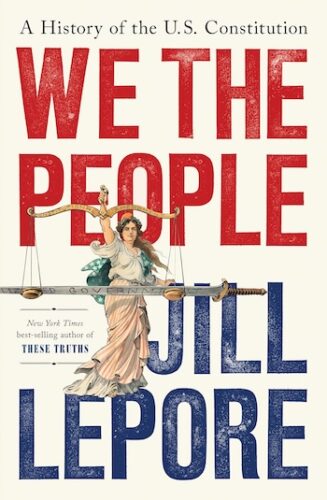 Are books fit subjects for psychoanalysis? If so, Jill Lepore’s We the People would be first on the couch. Its topic is American constitutional history with a particular emphasis on Article V, the 140-word run-on sentence that says you need the approval of two-thirds of each house of Congress plus three-fourths of the states in order to change so much as a comma. The amending clause is a killer, Lepore notes, one that has led to a constitutional deadlock that grows more dangerous by the week. But, instead of exploring the implications of this fact, all of which are explosive, she pours out an abundance of anecdotes whose purpose, to quote George Orwell, is to fall “upon the facts like soft snow, blurring the outlines and covering up all the details.”
The result is a book that is padded, overlong, and hence far less powerful than it ought to be. This is not to say that Lepore doesn’t do a good job. She does — with certain aspects, that is. She deals with the immovability of Article V by citing Antonin Scalia on the three-fourths half of the rule, the one that now allows as few as 13 states to veto any attempt at constitutional reform. After running the numbers, Scalia’s conclusion was that “something like less than two percent of the population can prevent a constitutional amendment.” The math seems a little off, since the 13 least populous states add up to 4.4 percent of the population, meaning that a majority would be somewhere around 2.2 percent or 2.3. But why quibble? The point is that Article V allows infinitesimal minorities to veto any and all efforts at constitutional reforms sought by the remainder. Hence Lepore’s conclusion: “That is not a constitutional door. That is a constitutional barricade.”
Quite right. Article V is an example of the tyranny of the minority that bottles up the desire for change until it’s ready to explode. As We the People puts it, “It is a rule of American history that when amendment becomes impossible, the risk of insurrection rises.” A constitutional freeze that began early in the 19th century thus contributed directly to the Civil War some 60 years later. The constitutional freeze that began in the early 1970s contributed to Donald Trump’s attempted coup in January 2021.
Instead of a force for stability, an unchangeable Constitution is the opposite. Lepore tosses in a corollary for good measure: “The more difficult it became to amend the Constitution, the more politicized were nominations to the Supreme Court.” This is accurate as well, given how vicious confirmation battles have become. As she notes:
The tit for tat had begun in 1967, when Strom Thurmond had tried to trip up [LBJ nominee] Thurgood Marshall with obscure questions about constitutional history in an attempt to prove that Blacks were racially inferior to whites. Birch Bayh had then defeated the nomination of [Clement] Haynsworth and [G. Harold] Carswell by introducing evidence that they were secretly segregationists. Feminists had defeated [Robert] Bork by claiming he would turn back the clock on women’s rights and overturn Roe. By the time Bush nominated [Clarence] Thomas, sexual harassment was the topic of the day.
And so on until 2018 when Democrats tried to deep-six Brett Kavanaugh by bringing in a mystery witness named Christine Blasey Ford with a tale of sexual assault at a teenage party that was not quite as iron-clad as they wanted us to believe. (Ford was unable to remember key details while a friend named Leland Keyser, who was also present at the party, later said her account didn’t hold up. “I don’t have any confidence in the story,” she told reporters.) But the nomination went through regardless, sending polarization rocketing upwards even more. We the People sums up how the vicious cycle works:
It was because of the insurmountable hurdle of Article V that … liberals had sought constitutional change through the courts instead of by way of amendment…. The greater their success, the stronger the backlash. The stronger the backlash, the greater the polarization. The greater the polarization, the greater the difficulty of amendment. The greater the difficulty of amendment, the greater the recourse to the courts. And then the wheel turned again.
Lepore explores other aspects of the breakdown. There are the endless wars over interpretation and original intent. The latter concept seems sensible enough. If you want to know more about a particular clause or text, then why not explore the thinking of those who formulated it? But the effort leads to a paradox. Participants in the 1787 constitutional convention were so intent on secrecy that they nailed the windows shut and pledged to keep mum about the proceedings for half a century after. “Whatever venerations might be entertained for the body of men who formed our Constitution,” Madison wrote in the Federalist Papers, “the sense of that body could never be regarded as the oracular guide in expounding the Constitution.”
So it seems that the founders’ original intent was that we should ignore original intent. But yet another problem looms: we’re drawn to original intent regardless. Lepore tells of a New Deal constitutional lawyer named Jacobus tenBroek who denounced the doctrine as out-and-out fraud:
Any theory which describes the meaning of the Constitution as changeless, which understands that constitutionality is decided by the outcome of a judicial search for the original intent, which makes of a constitutional issue only an historical question, which denies the proper influence of the altering factual world upon the meaning of the document — any theory which does all these things — is an utterly false portrayal of what the Supreme Court actually does.
Instead, tenBroek argued in behalf of a “doctrine of constitutional adaptability” that would allow Americans to interpret the document more flexibly in view of changing historical circumstances. This seems sensible too, since it’s obvious that modern society can’t be forced to conform to an 18th-century constitutional framework. But then tenBroek went and spoiled it all by arguing that flexibility was “the framers’ original intent,” to quote Lepore. The circle of confusion was thus complete. Even if you adhere to original intent, you’re stuck with the problem of which original intent to adhere to, the one that says we can be as flexible as we wish or the one that says we can’t. Americans are like characters in Dante’s Inferno, condemned to argue for all eternity over a doctrine that no one believes in, yet no one can quite let go.
There’s also the theory of implicit rights, which refers to rights that the Constitution does not lay out in black and white, but which nonetheless seem to flow from the document’s overall logic. For conservatives, it’s an article of faith that liberal Supreme Court justice William O. Douglas stretched things to the breaking point when, in a 1965 decision, he claimed to discern a general right of privacy in various “penumbras” and “emanations” arising out of the Bill of Rights. Not surprisingly, Clarence Thomas supposedly put up a sign in his chambers saying, “Please don’t emanate in the penumbras.” But Lepore cites an anti-abortion group called United for Life, which claimed to discern a general right to life that is “implicit in other, more explicitly protected rights.” So we’re back to implicit rights after all. When the other side does it, it’s playing fast and loose with the text. When our side does it, it’s strict construction at its finest.
One could go on — and indeed Lepore does for close to 600 pages. But despite her deep knowledge of the subject and her formidable analytic abilities, she lards the text with so many digressions that the reader winds up lost. There are side excursions into complicated 18th-century devices known as orreries, which were designed to show the planets revolving in their orbits. There are further digressions about Jefferson and his slaves, about native-American efforts to devise constitutions of their own, about Dred Scott and the problem of a constitutional reading that holds that all men are not created equal, and so on.
Lepore paints an extended portrait of a pioneering Black journalist named Ethel Payne, a reporter for the Chicago Defender. We see Payne covering the Bandung Conference in Indonesia, listening to the Brown v. Board of Education hearings, and reporting on congressional efforts to amend the Constitution so as to prevent integration once and for all. The Bandung Conference, which took place in 1955, was especially important because it shows how appalled the ex-colonial world was about US racial policies. But it’s unclear why Payne merits attention and not, say, Dean Acheson, Truman’s secretary of state, who complained that Americans “are reminded over and over by some foreign newspapers and spokesmen, that our treatment of various minorities leaves much to be desired.” Acheson was a key supporter of Brown because he thought desegregation would enable America to fare better against the Soviets. It was proof, as the historian Mary Dudziak has argued, that desegregation was as much “a Cold War imperative” as anything else. But why Lepore places a peripheral character like Payne at center stage instead is unclear.
Ultimately, all these digressions, anecdotes, and mini-profiles seem like an avoidance mechanism whose purpose is to steer clear of a constitutional crisis that is too painful to face. We the People is particularly unsatisfying when it finally gets to Trump. This, after all, is the man who lost the popular vote in 2016 and only squeaked into office by virtue of a constitutional quirk; whose presidency sparked a near civil war over alleged Russian influence; who was impeached twice; who ran afoul of Democratic “lawfare” aimed at destroying his business and putting him behind bars for the rest of his life, and who then clawed his way back into the presidency in 2024.
Now that Trump is busy trying to put enemies like James B. Comey and Letitia James in jail, it’s a sterling case of backlash and polarization raised to the nth degree. It should have gotten Lepore’s juices flowing because it illustrates all too well how a frozen constitution leads to democratic collapse. Yet her discussion goes flat. Instead of confronting the problem head-on, we get still more digressions — into Jefferson’s use of child labor, into an early-19th-century French loom that used punch cards to weave new patterns, into AI, the climate crisis, and even William F. Buckley Jr. The prose is so cloying as to make even Oprah Winfrey’s toes curl:
No constitution can be kept forever, like a butterfly under glass, tacked down with pins…. To constitute is to become or establish; to amend is to mend, correct, repair, and improve. Americans might learn again to amend, or else they could invent a new instrument to guarantee liberty, promote equality, nurture families, knit communities, thwart tyranny, and avert the destruction of a habitable earth. Constitutions began with stones and seashells, with old books and oak trees, with sheepskin and goose feathers. From the burning, scorched earth, new ideas might arise once more, seedlings, sprouting, tendrils wending to the sun.
Yuck. Calling for a new instrument of governance means calling for revolution. Lepore takes refuge in excess verbiage because she’s afraid to confront where all this is going. Paging Dr. Freud…
Daniel Lazare is the author of The Frozen Republic: How the Constitution Is Paralyzing Democracy (New York: Harcourt Brace, 1996).
Lazare is too modest to say it so I will: His 1996 takedown of Constitution-worship, The Frozen Republic, remains the gold standard in explaining — and foretelling — how Article V and numerous other provisions set up the USA for three decades of epic fails that have edged our society onto, and now apparently off, the brink of collapse.
My one complaint with his review is his psychoanalysis motif. There’s no mystery in Lepore’s failure to confront what lies ahead. As Lazare himself notes, America’s crisis is indeed too painful for most of us to face. If I’m able to face it at all, it’s in large part because The Frozen Republic has guided me through every step of our descent into the inferno.
Changing the Constitution directly by We the People is presupposed by the American Constitutional Tradition. This a tradition includes the Article Seven precedent, when on a date we have not been taught, Americans abolished our first Constitution written in 1777 and replaced it with the second one written in 1787.
Only by presuming that Article Five is exclusive, and that only public officials can amend it or replace it, can we self-shackle ourselves into falsely thinking that Article Five is “an insurmountable hurdle” as stated by the author of the book. Daniel Lazare reviewed.
The precedent for the direct way We the People as the Sovereign can abolish it and replace it has already been done — contrary to the official amending Article 13 in the first Constitution. This important and auspicious event happened on a date hardly any American knows — on June 21st 1788 when representatives of We the People abolished their Constitution when the ninth of 13 states ratified the new and current one in Constitutional Assemblies.
We the People are the Sovereign. This is made plain by the most quoted political words in the English language:
The Preamble by James Wilson:
“We the People… ordain and establish this constitution…”
The Declaration of Independence:
“…whenever any Form of Government becomes destructive of these ends, it is the Right of the People to alter or to abolish it, and to institute new Government…”
The Virginia Declaration of Rights:
“…whenever any government shall be found inadequate or contrary to these purposes, a majority of the community hath an indubitable, unalienable, and indefeasible right to reform, alter, or abolish it, in such manner as shall be judged most conducive to the public weal.”
Obviously, what We the People ordain and establish, we can re-ordain and reestablish, as the author of the Preamble made clear in his remarks in Pennsylvania to their Ratification Assembly.
Who are We the People? A majority of those who vote in a national referendum to decide anything. This is one of many ways we self-govern. This is a direct way.
Our states have been doing this for more than 200 years. See the book by John Dinan The American State Constitutional Tradition.
We’ve held 233 state Constitutional Conventions, and we’ve created — ordained and established if you will — more than 150 new state constitutions since 1790.
Other nation-states do it routinely. The average duration of a constitution worldwide is 12 years. The duration of a constitution in Europe is 32 years.
The author of the Preamble, James Wilson, put forth this view very clearly in his presentations to the Ratification Convention in Pennsylvania. So did James Madison in his proposed addition to the Constitution while the Bill of Rights was being written. So did Patrick Henry and George Mason in the Ratification Assembly discussions and debates in Virginia. So did Samuel Adams in a letter to his cousin John Adams. So did Thomas Jefferson on numerous occasions.
So should we, now.
Yale constitutional scholar Akhil Reed Amar supports this view of the non-exclusivity of Article Five, and the legal power of majority rule popular sovereignty, in two really good documents, he makes the case that the four difficult pathways to ratifying amendments in Article Five are exclusively for public officials.
And that the Sovereign — We the People — retain the right to abolish and replace the Constitution anytime we want, for any reason, on our own authority, because we say so. How? By majority-rule popular sovereignty in a national referendum.
Here are references to the two documents by Akhil Reed Amar:
The article “Consent of the Governed: Constitutional Amending Outside of Article 5”:
https://openyls.law.yale.edu/server/api/core/bitstreams/b59203e5-02d5-4f3b-bf77-98be64c7e904/content
And
The book: “For the People”
https://www.amazon.com/People-Constitution-Really-About-Rights/dp/0684871025
Daniel Lazare also wrote a very clearly argued and brilliant article along these lines titled “A Constitutional Revolution”:
https://www.jacobinmag.com/2017/01/constitution-trump-democracy-electoral-college-senate
My conclusion is that we Americans do not know about our own powers as the Sovereign of our sovereign nation-state. Why? Because of our vulnerability to propaganda of members of the American oligarchy. Thus, we sleepwalk through our political lives in a deep political coma, unaware that we are even in a coma, and this not knowing we ourselves have the power to recreate our political system with far more knowledge available to us than the framers of our constitutions written in 1787, and before that in 1777.
If you who are reading these words suspect you may be in such a political coma (as determined by the argument above being unfamiliar to you). And if you want to awaken into your immense powers as American citizen members of We the People, I suggest reading the two documents by Akhil Reed Amar and the excellent article referenced above by Daniel Lazare.
As Daniel Lazare implies by the title of the superb aforementioned article, a “constitutional“ revolution is far better for all of us than a “violent” revolution.
I’ve read all her books and was educated and charmed and have highly recommended them. But in this case, she has come up with a book that is convoluted and does not fulfill the expectations set up by the Introduction.
I’ve noticed this more and more in New Yorker contributors. Yes, we know the six uncommon words in the sentence, but really don’t want to spend the time sorting out the point. We know you’re smart, but let’s just get on with it. I’m not anyone special, just a dedicated history buff.