Concert Review: Jonathan Cohen and Handel and Haydn Society Explore the Operatic Dimensions of Handel’s “Saul”
By Aaron Keebaugh
Saul may be an oratorio, but it’s about as operatic as one can get.
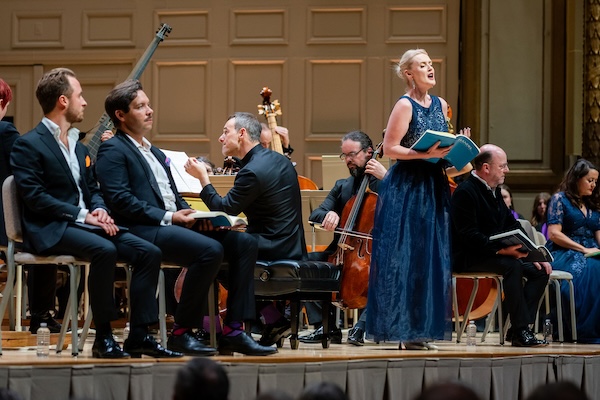
Soprano Sarah Brady sings the role of Merab in the Handel and Haydn Society’s performances of Handel’s Saul. Photo: Robert Torres
Handel’s Saul was not merely a sideshow at this past summer’s Glyndebourne Festival. Rather, it was a main event. Conductor Jonathan Cohen led the Orchestra of the Age of Enlightenment in rehearsals and performances that stretched from April through late July. The production, which featured staging by Barrie Kosky, even moved The Guardian’s critic to proclaim that Cohen tapped deeply into the oratorio’s sense of unsettled urgency.
It’s little surprise that Cohen wanted to bring some of that summer magic to Boston. Last weekend, he led the Handel and Haydn Society at Symphony Hall in its first performance of Saul since 2016. And while there was no serious intent at a full staging, the vivid performance had enough grit and intrigue to be fit for any lavish production.
The story of Saul revolves around the title Israeli king, who attempts to place the young shepherd boy David into predicaments that could cost him his life. Along with David, Jonathan, Saul’s son and heir to the throne, does everything he can to placate Saul’s jealous rage, but to no avail. In a desperate attempt to hold on to power, Saul seeks advice from the resurrected spirit of the prophet Samuel, who envisions a bloody future for the king and his progeny. Samuel’s prediction comes true when Saul and Jonathan are killed in battle. A sorrowful David then ascends to the throne, hoping to rule with greater compassion.
Deeply probing its themes of madness and political vengeance, Saul is almost Shakespearean in effect. Handel’s music sensitively underscores every emotional nuance, from Saul’s tirades, his daughter Merab’s disgust at the young upstart David, and Jonathan’s loyalty and warmth to David’s assurance that God will provide the clearest path forward.
Cohen’s lively tempos and wide dynamic sweep set the music ablaze brightly. The H+H orchestra, filled out with kettle drums, trombones, organ, and carillon, created a sound that could charge forward one moment and envelop you the next. The score’s triumphal march bounded with regal pomp. Yet the lyrical moments, which were rendered with subtle energy, suggested that all was not well.
That sense of decadence was most evident in Neal Davies’s portrayal of Saul. His stentorian baritone conveyed the full range of the king’s mental frailty. Hints of tenderness in Davies’s singing generated a reflective sympathy for Saul as he fumed over being passed over in favor of an unknown youth. Yet the character’s wild rage, barely contained by Davies’s precise diction, revealed the burning beneath the surface.
As Jonathan, Linard Vrielink aimed to soothe these turbulent outbursts. His bell-toned tenor made a sturdy counterweight to Saul’s angry tirades. Vrielink softened his voice at all the right moments, symptomatic of his care for family and friends. “Birth and fortune I despise” channeled Jonathan’s alienation from his inherited privilege as well as his newfound camaraderie for David.
And the friendship between these two brothers in arms formed the beating heart of this performance. Christopher Lowrey portrayed David as a charming and stoic presence in the face of life-threatening dilemmas. He and Vrielink explored depths in their relationship well beyond what the librettist Charles Jennens drafted on paper. Theirs was not merely a friendship borne of similar experience, but a deep and abiding connection created through a shared trauma that even suggested a romantic attachment. When both fail to quell Saul’s irrational anger, they lean on each other, shielding themselves from further harm from the man who tried to kill them — merely for questioning his judgment. Lowrey’s buttery countertenor also served as a sonic complement to Vrielink’s bold declamation. But Lowrey could just as easily turn up the heat — his voice took on fierce energy when David learned that the Amalekite killed his friend.
Lowrey found an equal musical and emotional partner in Amanda Forsythe, whose singing made the role of Michal a stalwart presence, hovering between desire and desperation. Forsythe’s soprano was delicate; her vocal flourishes frolicked gracefully. She maintained her pure tone even as her character complained that her older sister didn’t deserve David’s affection.
As Merab, Sarah Brady embodied the figure of a bitter and self-absorbed royal daughter. Her bright-tone soprano appropriately soured with a spiteful edge as Merab decried her father’s wish for her to marry the son of a shepherd. Yet, here too, Brady’s insightful singing fleshed out what could easily be a one-dimensional character. “Author of peace who can’t control” was an impassioned plea for Merab’s father to be released from his mental turmoil.
The smaller roles were also sung with soulful conviction. Jonas Budris infused defiant power into the brief role of Amalekite. Steven Soph was smoothly stern as the High Priest. Stefan Reed cast an eerie vocal and physical presence as the Witch of Endor. As the ghost of Samuel, Ryne Cherry sang with measured but penetrating assurance. David McFerrin’s bold baritone added an imposing heft to the role of Doeg.
The H+H chorus, amplified with members of the ensemble’s youth choruses and CitySing choir, rendered their parts with clarity, zeal, and a palpable force that enhanced the drama going on upstage. “Along the monster atheist strode” sounded with raw power. “Envy, eldest born of Hell” opened Act 2 with grim solemnity. The “Hallelujah” chorus during Act 1 set the tone for an ironic play between David’s piety and Saul’s bitterness. Saul may be an oratorio, but it’s about as operatic as one can get.
Aaron Keebaugh has been a classical music critic in Boston since 2012. His work has been featured in the Musical Times, Corymbus, Boston Classical Review, Early Music America, and BBC Radio 3. A musicologist, he teaches at North Shore Community College in both Danvers and Lynn.
Tagged: Handel and Haydn Society, Jonathan Cohen, Linard Vrielink, Neal Davies, Sarah Brady