
Musician Interview: The Cult’s Billy Duffy Talks About Exploring Musical Impossibilities
By Rob Duguay
“Vinyl is special because it makes the music less disposable, it makes listening a little less convenient. There is something tactile for people to hold and look at, an object to cherish.”
British rockers The Cult have a bunch of hits that every fan of guitar-driven music knows. These include “She Sells Sanctuary,” “Love Removal Machine,” “Bad Fun,” and “Fire Woman,” among others. Before the band became a thing back in 1984, lead vocalist Ian Astbury and guitarist Billy Duffy launched a project called Death Cult. As part of the “Paradise Now” tour, this earlier material is being performed live in a show that features two sets of songs: Death Cult tracks along with The Cult’s most recent material. Bostonians will have a chance to experience this duality when the expedition makes a stop at The Orpheum on October 11. The whole thing starts at 8 p.m. with Patriarchy, the Los Angeles based metal project of multimedia artist Actually Huizenga, kicking the night off.
Duffy and I had a talk ahead of the show about what inspired the idea of playing two sets in one evening, performing at historic venues, the importance of vinyl in the streaming age, and the chances for a new album in the near future.
The Arts Fuse: What is this tour all about? Is it just you and Ian revisiting the early stages of your songwriting partnership with Death Cult followed by the band playing your latest material?
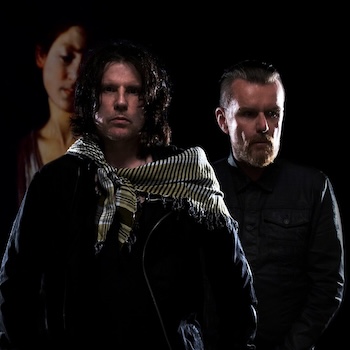
The Cult — Ian Astbury and Billy Duffy, Photo: Tim Cadiente
Billy Duffy: We revisited the Death Cult idea in England a couple years ago, and it was a very successful tour. We wanted to bring the approach to the United States, so we tried it out in Los Angeles and people seemed to like it, so we thought about taking it around the rest of the country. Ian came up with the idea of splitting the show into two sets. I don’t know how it’s going to go here, but that’s the premise, and hopefully people will enjoy it. We couldn’t really take the Death Cult thing around the United States before now because it’s a lot more challenging to tour here than in the U.K. The audiences in the U.K. are a little different in the sense that the majority of them got into us a little bit earlier than the majority of the fans in America did. The Death Cult thing may be somewhat of an acquired taste.
Still, I think people are pretty excited to hear those early songs. It’s very different from [our third album] Electric, it’s very different indeed.
AF: Absolutely, especially because the earlier material has more of a post-punk, gothic vibe. The Orpheum is a place that’s been around since the 1850s. Being from the United Kingdom, you’re no stranger to performing in historic venues. What are your thoughts on performing in a venue originally built for presenting classical music and plays?
Duffy: I kind of dig it. A lot of venues in the U.K. are like that, so I’m used to it. I like all of the old venues, but I particularly like to play in the ones where the history is more aligned with the history of rock and roll. There are the old vaudeville theaters or whatever from back in the 1890s or 1920s. But I like the ones where the formative rock bands played. I love hearing about places that Jimi Hendrix or The Doors played at back in the ‘60s. I dig that kind of history, and I think there’s good juju in those venues, from the perspective of rock and roll.
AF: On October 17, The Cult are going to be doing vinyl reissues of two of its newer albums, Choice of Weapon and Hidden City. Why these two reissues? Are there any extra tracks on these releases?
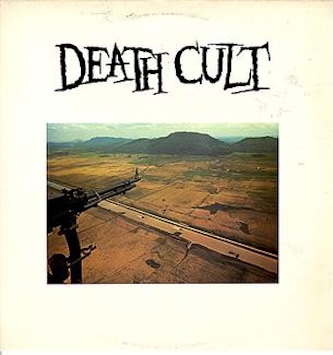
Cover of The Cult’s four-track EP, when it was the post punk/gothic rock band Death Cult.
Duffy: The honest answer is that it has more to do with the label [at Cooking Vinyl]. Both albums sold out and were out of print. The band didn’t ask for the reissues, but we obviously support them. We’re not on Cooking Vinyl anymore, we no longer have a deal with them, but we are supportive of what the label is doing. It’s great to have the music out there and, funny enough, we’ve always had vinyl.
I don’t think there’s ever been a Cult record that’s been released without being available on vinyl, before it was even trendy to do it, after vinyl made a comeback. We have always stuck with vinyl; there are people who just love it. So it’s nice to be able to satisfy that demand. It’s good that the two albums are coming out — it’s good timing, given this tour.
AF: In the current age of music streaming services, do you feel that vinyl records have become a commercial necessity? As a touring, full-time musician, you make much more revenue from vinyl than from a Spotify stream.
Duffy: Vinyl makes music a little bit more important, and I like the fact that people cherish vinyl. Obviously, the convenience of a billion songs at your fingertips is nice to have, no complaints about that. Although, like you say, it’s pretty common knowledge that musicians don’t generally become rich off of streaming services. Somebody is getting rich, but it’s certainly not the musicians. Still, it’s very convenient — it kind of is what it is. Vinyl feeds a fetish that some people have about the music, which is kind of cool.
Vinyl is special because it makes the music less disposable, it makes listening a little less convenient. There is something tactile for people to hold and look at, an object to cherish. That is particularly good for younger people. It is an opportunity for them to have that experience — many are growing up without it. It’s easy for me to talk, because I grew up with vinyl as well as cassettes and CDs. People who are just discovering music now, they think everything is on their phones. That’s cool, too. But it is good to support releasing stuff on vinyl.
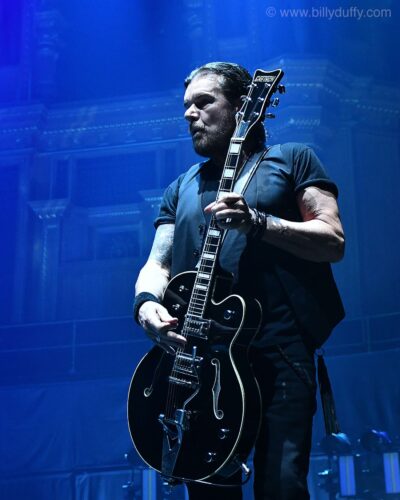
Billy Duffy at Royal Albert Hall in 2024. Photo: Billyduffy.com
AF: At the moment, vinyl is bridging generations. People who listened to music during the ‘60s, ‘70s, and ‘80s can introduce younger people to playing a record. There’s a notable difference in sound quality between a vinyl record and an mp3, and that should be embraced.
Duffy: Absolutely, but the convenience of having every song in the entire known universe at your fingertips still has a value. I’m not going to say that it’s a terrible thing.
AF: It’s been a few years since The Cult released their most recent album, Under the Midnight Sun. Are there any plans for a new record?
Duffy: We’ve done a lot of touring over the last two or three years, so we’re naturally reaching a point where we’re going to be doing fewer shows. Generally, that’s around the time we start thinking about creating new music. I would imagine that we’re going to get into it. We haven’t done anything yet, but it is probably going to be one of the next things on the agenda. I don’t see us touring as heavily next year as we have done. Enough time has passed, and I feel like we got something to say — that’s the impulse behind making new music.
You have to really feel that you have something to say and mean it. For us, it’s quality, not quantity. We don’t want to churn out record after record just because we can. It’s nice to let a little time pass, finding things to write about, and let the band evolve. We try not to make the same record every time. Our intention is to attempt to explore different musical impossibilities. That’s the goal, seeing if we can come up with something new and exciting for ourselves.
Rob Duguay is an arts & entertainment journalist based in Providence who is originally from Shelton, CT. Outside of The Arts Fuse, he has also written for DigBoston, Aquarian Weekly, Providence Journal, Newport Daily News, Worcester Magazine, New Noise Magazine, Manchester Ink Link, and numerous other publications. While covering mostly music, he has also written about film, TV, comedy, theater, visual art, food, drink, sports, and cannabis.