
Concert Review: Boston Symphony Orchestra Embraces the Contradictions of Mahler’s Symphony No. 4
By Aaron Keebaugh
The Latvian conductor can sometimes overindulge in pieces that demand shifts in emotional direction on a dime, so the frenzied eclecticism of Mahler’s Fourth feels tailor-made for him.
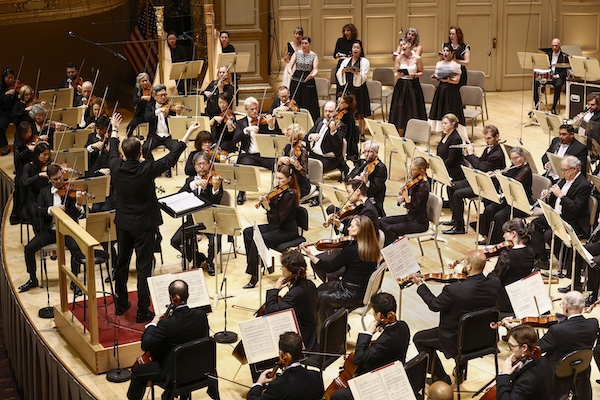
Andris Nelsons conducting soprano Nikola Hillebrand and the Lorelei Ensemble at Boston’s Symphony Hall. Photo: Winslow Townson.
“No music on earth compares with that of heaven.” So sings the soprano soloist at the close of Gustav Mahler’s Symphony No. 4. Given the composer’s worldly outlook, which saw him loading the score with everything from beer-swilling folk tunes to sounds that suggest childish naivete, the opposite of this sentiment is just as true. At its height, this symphony blazes brightly because of how it sheds traditional notions of continuity. Mahler embraced everything, including an array of musical and philosophical contradictions.
And, because of that, Mahler’s Fourth Symphony remains a bit of a puzzle. Following its premiere in Munich in 1901, critics and audiences alike decried the music as being unintelligible. It has fared better over the last century, though its wild flights of fancy and unexpectedly peaceful conclusion still yield a vast array of interpretations. Few in my experience have been as dramatic in tackling its contrasts than Andris Nelsons, who led Mahler’s symphony with the Boston Symphony orchestra this past weekend. If the symphony ultimately revels in heavenly bliss as Mahler intended, Nelsons ran headlong against the grain, plowing headlong into the earth. The result was an exhilarating spectacle.
The Latvian conductor can sometimes overindulge in pieces that demand shifts in emotional direction on a dime, so the frenzied eclecticism of Mahler’s Fourth feels tailor-made for him. He loved to gallop free, pushing the tempo in the first movement’s opening sleigh bell flourishes — despite Mahler’s insistence that the music should not rush. Yet the result never felt forced, precisely because Nelsons was consistent — he leaned just as heavily in the opposite direction. He lingered in the lyrical passages, milking them for all of their worldly schmaltz.
Details also emerged in boldly colored flourishes. Principal trumpeter Thomas Rolfs’s solo, with its allusion to the opening of Mahler’s Fifth Symphony, was a cry of desperation straining to break free of the dense web of strings and winds. In the Scherzo, concertmaster Nathan Cole tore through his featured moments with demonic glee. Everything felt tastefully on edge, the music bawdy, eccentric, even appropriately grotesque.
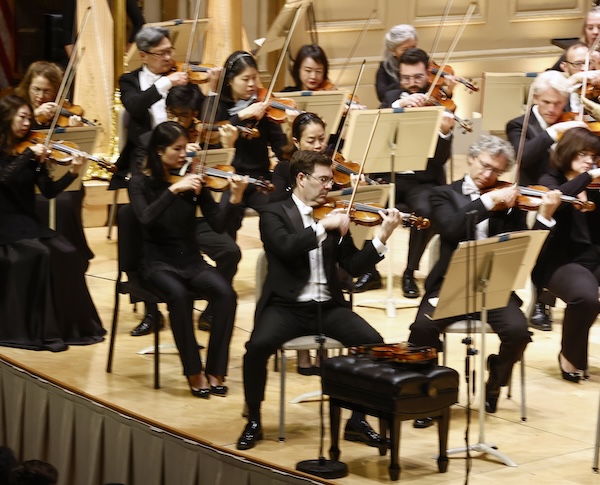
Concertmaster Nathan Cole performing Mahler’s Symphony No. 4. Photo: Winslow Townson
The third movement tipped the balance toward the sublime. Nelsons coaxed an enveloping warmth from the strings. Lines rose and fell like gentle waves before a sudden propulsion of the tempo allowed the music to dance. The finale, a setting of text from Des Knaben Wunderhorn, was serene. Soprano Nikola Hillebrand, making her BSO debut, sang with beguiling tenderness and effervescent joy — this was a sound worthy of a childlike view of heaven. Here, too, Nelsons leaned into the extremes. Lyrical passages carried palpable weight. Quotes from the symphony’s opening theme recalled the earlier fin de siècle decadence — the dissipation split the air with wild abandon. We might be in heaven, the performance suggested, but there was still time for a party.
The first half of the concert was dedicated to another scene of otherworldly charms.
Claude Debussy’s Nocturnes, composed between 1892 and 1899, easily conjures up images of swirling clouds and seductive vistas. Nelsons’s clear-eyed direction made these dulcet visions feel all the more immediate. He shaped Nuages in broad strokes. Strings and winds lifted their melodies aloft with hushed reverence. Robert Sheena’s English horn solo provided a splash of color in what was a study in gray.
Fêtes complemented these sensations with the boldness of a searchlight cutting through the fog. The ensuing march, with its rousing fanfares, charged forth with suitable bravado. Sirènes, by contrast, was sweeping and alluring. The Lorelei Ensemble sang their wordless parts with soft radiance. Nelsons let the music flow naturally, even as the brass attempted to elbow its way out of the surrounding soft texture. The result was a musical atmosphere scattered with vibrant colors, an ideal paradise, supplied by Debussy.
Aaron Keebaugh has been a classical music critic in Boston since 2012. His work has been featured in the Musical Times, Corymbus, Boston Classical Review, Early Music America, and BBC Radio 3. A musicologist, he teaches at North Shore Community College in both Danvers and Lynn.
Tagged: Andris Nelsons, Boston Symphony Orchestra, Lorelei Ensemble, Nathan Cole
Wonderful review of a sublime performance. The glorious sound of the orchestra amidst the exquisite beauty of the hall was absolutely breathtaking. I was in heaven. Thank you.