
Book Review: “Queer Enlightenments” – Flaming Creatures of Yore
By Trevor Fairbrother
This lively foray into popular history, and others, exemplifies the move to attract younger audiences with open and freewheeling interests in gender and sexual nonconformity.
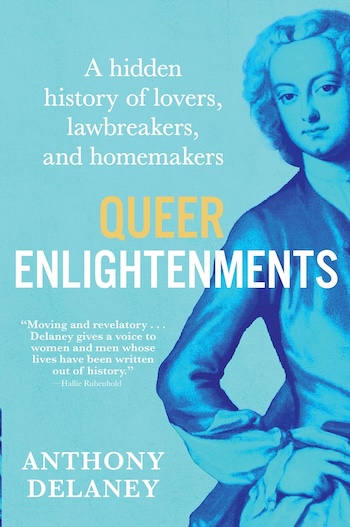 In 2022 Anthony Delaney completed a PhD Thesis in History at the University of Exeter; the title was “Cotqueans: Queer Domesticity in Eighteenth-Century England.” Now comes his first book, Queer Enlightenments: A Hidden History of Lovers, Lawbreakers, and Homemakers (Grove Atlantic, 352 pages, $30). It is a foray into popular history and, to quote the publisher’s synopsis, one that offers both “an illuminating romp through the historical archive and an evocative new chapter in our shared history.”
Delaney proffers a sequence of narratives focused on the following people:
Gabriel Lawrence, a purveyor of milk in London; a widower and father. In 1726 he was arrested in a raid on Mother Clap’s “molly house” (a tavern/coffee house catering to men attracted to men). He was hung for sodomy.
John, Lord Hervey, a politician and foppish courtier; a husband and father. In 1731 an anonymous pamphlet described him as a “delicate Hermaphrodite” and a “Master-Miss.” He defended his honor by dueling the author, then secured and decorated a London residence for his lover, politician Stephen Fox.
John Chute, an amateur architect, part of the aristocratic bachelor circle of Horace Walpole. He traveled across Europe with Francis Whithed, his beloved “other half.” Friends referred to the couple as the Chuteheds.
Chevalier d’Éon, a French soldier and spy employed by King Louis XV. In 1777, when a politically exiled resident of London, d’Éon began to present as a woman. In the 1790s the Chevalier made a living by performing fencing exhibitions in a frock.
Lady Eleanor Butler and Miss Sarah Ponsonby, upper-class women ostracized in their native Ireland for their insistence on living together. In 1778 they established a rural retreat in Wales and enjoyed public respect as “The Ladies of Llangollen.” Over the years they transformed a stone cottage into a Gothic fantasy named Plas Newydd, which attracted visits from the likes of Sir Walter Scott and William Wordsworth.
William Courtenay, an English nobleman associated with two separate same-sex scandals. In 1784, at the age of 16, he began a liaison with the rich London aesthete and writer William Beckford. In 1811 he and a laborer were charged in Devon with buggery. The first scandal had forced Beckford to live in exile; the second delivered the same fate to Courtenay.
Anne Lister, an English landowner and industrialist. In 1816, at the age of 25, she began a diary documenting many details of her life and times, including encrypted entries concerning her female lovers. In 1826 she inherited Shibden Hall, Yorkshire, and in 1834 welcomed Ann Walker there as mistress of the house.
George Hall, a young factory worker in Glasgow who, in 1821, married and emigrated to North America. In 1836, when Hall was arrested in New York City for public drunkenness, it transpired that he was a woman and had been living as a “female husband.”
Peter Sewally, a Black working-class New Yorker whose alias as a female streetwalker was Mary Jones. In 1836 he received the first of several prison sentences for pickpocketing and vagrancy. An indomitable sex worker, he was nicknamed “Beefsteak Pete” after police officers learned that he wore a girdle with a fake vagina fashioned from meat.
Transworld Publishers, a division of Penguin Random House, initiated this project in the UK and titled the book Queer Georgians. On its website, Transworld claims that its company ethos “turns authors into brand names, builds debuts into bestsellers, and makes us hugely successful year in, year out.” The publisher in the US opted for a title that alludes to the Age of Enlightenment, not wanting Americans to think that Delaney’s work is about the denizens of a socially conservative southeastern state.
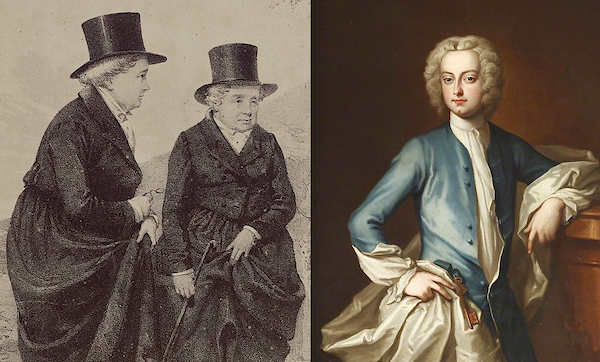
Left: detail of James Henry Lynch’s lithograph of the Ladies of Llangollen, c. 1833-45. Right: detail of John Fayram’s painting of John, Lord Hervey, c. 1737. Photo pairing by author.
Queer Enlightenments targets a general readership, but the author speaks briefly of his academic background. He states that his approach to queer history broadly adheres to Eve Kosofsky Sedgwick’s concept of “the open mesh of possibilities” wherein gender and sexuality are not fixed or monolithic (as posited in her 1993 book Tendencies). Furthermore, he rejects heterosexuality as the default or orthodox expression of sexuality. But he has scant interest in queer theory and describes Michel Foucault’s analysis of the discourse on sexuality as “a clever exercise in semantics” that has hindered “meaningful historical insight or analysis.” All the same, Delaney has coined the term heteroregulation to address “the deliberate social, cultural and legislative acts that were calculated to control and admonish minority groups across several centuries.”
Delaney described what this project meant to him in a recent article for The Irish Times: “[It was] not just a recovery of lost lives, but the discovery that those lives speak directly to ours. In a world where queer rights and dignities are again being questioned and pared back, these histories matter more than ever.” In his book he occasionally makes personal asides to suggest how the struggles of his subjects can resonate with people today. For example, in the “Prologue” he writes, “I count Lady Eleanor Butler and Miss Sarah Ponsonby as my direct ancestors. Not because we’re blood kin but because, like them, I am a queer person originally from County Kilkenney in Ireland.” Later in the book he writes, “Their history grounds me in a place where I once thought I could never truly belong because of my queerness.”
The publisher stresses Delaney’s commitment to restorative history: the excavation and resurrection of individuals whose narratives were long buried and obstructed. Indeed, the working-class characters evoked in Queer Enlightenments would still be blanks if they had not incurred criminal records that were eventually unearthed by someone’s diligent research in public records. The politicos and patricians, on the other hand, were achievers who left abundant paper trails and long historical legacies.
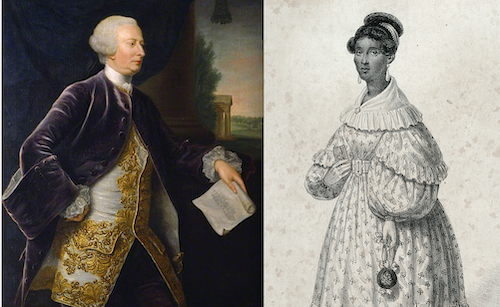
Left: detail of Gabriel Mathias’s painting of John Chute, 1754. Right: detail of Henry R. Robinson’s lithograph of Peter Sewally, alias Mary Jones, 1836. Photo pairing by author.
I don’t have the expertise to judge the extent to which Delaney is providing new information and original insights. When I looked into the case of Peter Sewally/Mary Jones I learned that Jonathan Ned Katz devoted an excellent chapter to the cross-dresser in his landmark study Love Stories: Sex Between Men before Homosexuality (2001); Delaney’s narrative is much the same, the main difference being that it quotes and discusses longer passages from period newspapers and police files. Delaney has a background as a performer, and I suspect his experiences in that realm fuel his gusto as a popular historian. He graduated from London’s Royal Central School of Speech and Drama in 2010. In addition to stage, film and television work, he found success co-hosting the podcast After Dark: Myths, Misdeeds and the Paranormal (developed by History Hit, which calls itself “The world’s best history channel on demand”). Delaney’s thespian proclivities are conspicuous in the photograph he uses for his social media profile: standing inside a ruined Gothic church, he masquerades as a rapt cleric in an ostentatious surplice.
Queer Enlightenments is occasionally tarnished when Delaney criticizes others working in the same field. For example, he rails at Gentleman Jack – the 2019 television series based on Anne Lister’s diaries – for conjuring romantic storylines that whitewash the subject’s domineering personality. (“Gentleman Jack” was a nickname that some people used to disparage Lister.) Delaney allows readers to think that he is the first person to “reveal” her toxic streak. I subsequently learned that a biography written by Angela Steidele had already characterized Lister as “a beast of a woman.” In 2018 The Guardian highlighted those words in a positive review of Steidele’s work. In another instance, Delaney disagrees with writers who have recently argued that Friedrich Wilhelm von Steuben, the Major General of George Washington’s Continental Army, was queer. He admits to omitting von Steuben as a subject in Queer Enlightenments because he has yet to see “convincing archival material” to support claims that he was attracted to men.
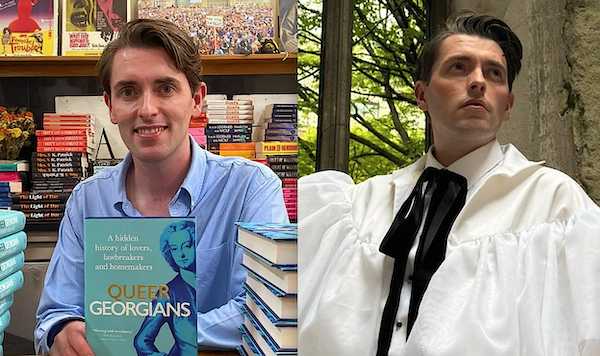
Details of two recent photographs of Anthony Delaney. Left: at Gay’s The Word bookshop, London. Right: image used for social media profile. Photo pairing by author
No surprise that Delaney is a live wire on social media, but he overdid it when he dissed The National Trust in order to promote his book. Standing in front of The Vyne, the Hampshire residence of John Chute, he berates the heritage organization for not giving visitors information about Chute’s queer life and legacy. Delaney makes accusations about “erasure” that are self-serving and he blithely ignores the Trust’s substantial efforts in its recent public programs to research and reveal queer history. For example, 2017 saw the publication of Prejudice & Pride: Celebrating LGBTQ Heritage, a 56-page book by Alison Oram and Matt Cook. The book has a section about Chute and also features John, Lord Hervey, Chevalier d’Éon, and William Beckford. Moreover, the Trust’s visually sophisticated book features color photographs that outshine the 25 mediocre black and white reproductions in Queer Enlightenments
Fifteen years ago, mainstream publishers would probably not have invested in an endeavor that rousingly portrays queer ancestors from the pre-Wilde era. Now it exemplifies the move to attract younger audiences with open and freewheeling interests in gender and sexual nonconformity. One wonders where Delaney will go from here. At the end of Queer Enlightenments, he writes: “Where once you felt isolated or downtrodden, I hope you find companionship in the pages of this book.” His next venture, whatever it is, will surely transpire with commensurate flourish.
Trevor Fairbrother‘s most recent contribution to The Arts Fuse was a review of the exhibition catalogue Queer Lens: A History of Photography (J. Paul Getty Museum, Los Angeles, 2025).