
Children’s Book Reviews: Invitations to Read and Learn
By Cyrisse Jaffee
Two new nonfiction books offer important information for young readers — about the fight for reading and learning about their bodies.
Fight for the Right to Read: Samuel Wilbert Tucker and the 1939 Sit-Down Strike for Library Reading Equality by Jeff Gottesfeld and Michelle V. Green. Illustrated by Kim Holt. Creston Books, 2025.
The Ultimate Book of the Human Body by Anne-Sophie Baumann. Illustrated by Vanessa Robidou. Twirl/Bayard Editions, 2025.
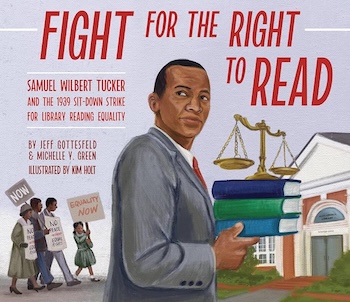 Elementary-school children who are taught about the modern civil rights movement — an increasingly important (and endangered) subject these days — are often told about a handful of prominent figures, such as Martin Luther King Jr. and Rosa Parks. Without diminishing their contributions, recently books have thankfully expanded that limited canon with biographies of Thurgood Marshall, Ruby Bridges, John Lewis, Ella Baker, Shirley Chisholm, and more. The story of Samuel Wilbert Tucker, however, remains little-known and this new picture book is a well-deserved addition to the field.
Born in Alexandria, Virginia, in 1913, Tucker was a 25-year-old lawyer when he decided to challenge the segregated (“whites only”) public library in his town. In a move that was as dangerous as it was bold, he asked four local Black men, trained in nonviolence, to visit the library together and register for a library card. As expected, they were turned away. Instead of leaving, each man took a book from the shelf, sat down in a chair, and started quietly reading. The white patrons were “stunned.”
The police chief was called and the young men were told to “move on.” They refused and were arrested. In the meantime, Tucker had called on supporters, reporters, and photographers to cover the story as the men left the building. When the men were tried in court on a charge of disorderly conduct, Tucker defended them, proving that they had not been disorderly at all. The case stalled out. Bowing to the Southern “separate-but-equal” doctrine, a library was built to allow Black people to have library cards. But that library was certainly not equal — it was tiny, shabby, and held only used books.
It took 20 years before the library in Alexandria was truly open to all. In the meantime, Tucker continued to fight for equality; he was named as Lawyer of the Year by the NAACP in 1966. It wasn’t until 2019 that all the charges against the men were officially dropped.
The story is told simply but effectively, with full-color illustrations that make the story even more accessible. An Afterword expands on Tucker’s remarkable life. (For instance, he never went to law school but passed the bar exam on his own!) Many kids today may not think twice about being able to visit the library — this excellent and inspiring story will deepen their knowledge.
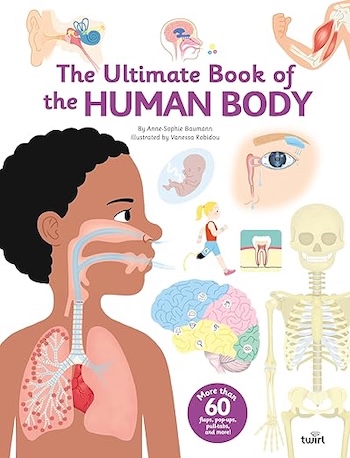
The Ultimate Book of the Human Body by Anne-Sophie Baumann, will also greatly expand kids’ knowledge. This oversized book is thorough without being boring and features lively facts about the human body, using interactive diagrams, pop-ups, and pull-tabs. Along the way, common questions such as “Why Do We Cough”? or “What Is Ear Wax”? or “Why Is Pee Yellow”? or “Why Do We Bathe”? are answered in short, easy-to-read segments. The drawings, by Vanessa Robidou, are cheerful and multicultural, featuring boys and girls of different colors and hair styles. The diagrams are clear and well-labeled.
Yes, there is a section on pooping, which will make kids giggle, but also answer their questions in a matter-of-fact manner (curiously, farting is not discussed). The two-page spread on Birth and Growing Up includes a diagram of a sperm approaching an egg. There is a little booklet on how babies are made, which mentions male and female body parts, as well as sexual intercourse, but it does not go into too much detail.
The final spread on “Living Well” has one mention about the benefits of going outdoors and enjoying nature, but it mainly discusses diseases and disabilities such as diabetes, Down syndrome, vitiligo, and so on — an odd mishmash of topics. Perhaps something got lost in translation here (the book was originally published in France).
Despite this flaw, this is a good choice to use with children ages six and up. In addition to kids browsing through it on their own, parents, caregivers, and teachers can choose how much (or little) information to present, according to the child’s level and experience.
Cyrisse Jaffee is a former children’s and YA librarian, children’s book editor, and a creator of educational materials for WGBH. She holds a master’s degree in Library Science from Simmons College and lives in Newton, MA.
Tagged: "Fight for the Right to Read", "The Ultimate Book of the Human Body", Anne-Sophie Baumann, Jeff Gottesfeld, Kim Holt, Michelle V. Green, Samuel Wilbert Tucker