
Theater Review: “The Hills of California” — The Power of Family Matters
By Martin Copenhaver
The play eventually packs a wallop, but it drags its feet at the start.
The Hills of California by Jez Butterworth. Directed by Loretta Greco. Staged by the Huntington Theatre Company at the Huntington Theatre, 264 Huntington Ave, Boston, through October 12.
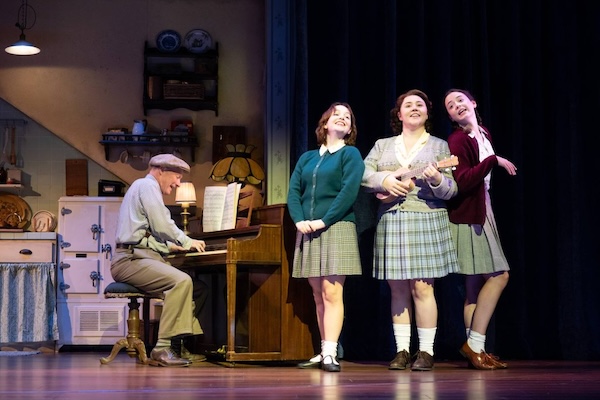
Mike Masters, Nicole Mulready, Meghan Carey, and Chloé Kolbenheyer in the Huntington Theatre Company production of The Hills of California. Photo: Liza Voll
Almost as soon as the lights come up on Jez Butterworth’s play, The Hills of California, it is clear that the title is ironic. The play does not take place in sunny California, but in a much bleaker setting—in a down-at-the-heels guest house in Blackpool, England, a seaside resort well past its prime. The action toggles between 1976, when the Webb sisters have returned home because their mother, Veronica, is dying, and 1955, when a volcanic Veronica is desperately trying to shape her daughters into the next Andrews Sisters. The title of the play borrows the title of a Johnny Mercer song that is a favorite of the sisters, a song that evokes a dreamland that is far from where they live their lives.
In the scenes when the sisters are young, Veronica is a martinet intent on making her four daughters into stars in a genre of music that is already passé. The pull of music is genuine, however. Among other virtues, music is a way to escape the dreariness and disappointments of reality. “What is a song?” Veronica asks her daughters, as if leading them in a catechism. “Somewhere you can live. And in that place, there are no walls. No boundaries. No locks. No keys.” Music also provides the sisters an opportunity to harmonize, even when their relationships are decidedly discordant.
The play—which eventually packs a wallop—drags its feet at the start. The first act, and much of the second act, is spent introducing us to the Webb sisters, first as adults and then as teenagers. Butterworth seems so determined to contrast the older sisters that he reduces them to types Jillian (Karen Killeen) is the anxious and fretful one, so much so that she cannot muster the gumption ever to leave home. Ruby (another wonderful performance from Aimee Doherty) is the pathologically cheerful one, always determined to spin gold from the straw of her life. Gloria (Amanda Kristen Smith) is the sister who roils with scalding, relentless anger (and often hilariously). Joan, the oldest sister, is the one who is ever-present in her absence, a memory of whom infuses every interaction.
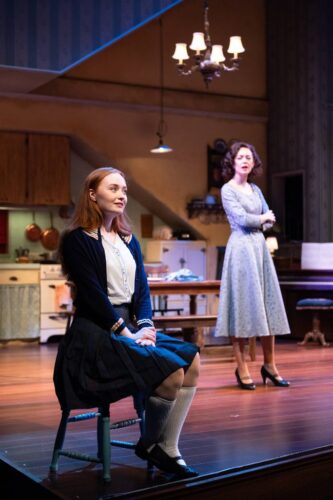
Kate Fitzgerald and Alison Jean White in the Huntington Theatre Company production of The Hills of California. Photo: Liza Voll
In addition, the actors portraying the four sisters as teenagers are all excellent. The oldest sister, Joan (as played by Kate Fitzgerald) is particularly heartbreaking. She is deemed the most talented, but that also makes her the most vulnerable to exploitation. Watching the misuse unfold is devastating.
Kyle Cameron has the thankless task of portraying a boarder named Jack. He periodically bursts into the room to deliver some old-timey one-liners (“Where do you find a cow with no legs? Right where you left it.”). He also mugs and pantomimes like a burlesque clown. Quite simply, it doesn’t work. I suppose Butterworth included Jack for some comic relief but more often the relief comes when he exits the stage. It is also not believable that the goof-off Jack would, in fact, have connections with a successful theatrical agent who would come to hear the Webb sisters at Jack’s behest.
Without question, the stand-out performance here is by Allison Jean White. She plays Veronica and then, later in the play, the adult Joan after she returns home. This double duty is not just true of this production; it was the case in both the West End and Broadway stagings. This double casting underscores the inescapability of heredity. Joan can’t help but carry her mother around with her—the ultimate trap. In key respects, the two characters are quite different, however, and present a considerable challenge for an actor. Veronica is steely and ruthless in her determination. The adult Joan is world weary and rueful. White does a brilliant job with each—a true bravura performance, doubled.
Comparisons between Veronica and Mama Rose of Gypsy are inescapable (and may be intentional). Both are stage mothers willing to do anything to advance the careers of their daughters—perhaps for the daughters’ sake, but most assuredly for the mothers’ sake. They are both trying to make it in a world that has passed them by, and both by using outmoded forms of entertainment. Most salient, both Veronica and Mama Rose are willing to sacrifice their daughters for a shot at the big time. The comparisons are so easily drawn that it cannot be coincidence that the sacrificial daughters in the two plays have names—Joan and June—that are so similar.
So much of the action in this play occurs offstage. We never see the elderly Veronica, sick in her bed upstairs. For much of the play we do not see the adult Joan, although her presence seems to hover over all the other characters. And the horrifying turning point in the drama, what can be called the denouement even though it occurs at the end of the second act, with an entire act to follow, also occurs out of sight on the second floor. Offstage seems to be where life happens, yet in ways that we may try to deny or keep at a distance.
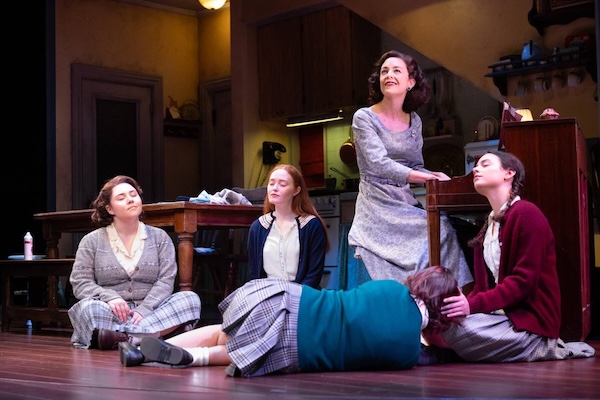
Meghan Carey, Kate Fitzgerald, Alison Jean White, Chloé Kolbenhyer, and Nicole Mulready (on floor) in the Huntington Theatre Company production of The Hills of California. Photo: Liza Voll
Contributing to this sense of distance is the towering flight of stairs that ascends from the parlor to the second floor, which is out of sight. It includes 30 steps (yes, I counted) and a landing, which makes it seem like it reaches up to another world. The set is both stunning and clearly serves the story.
Tolstoy famously wrote, “Happy families are all alike; every unhappy family is unhappy in its own way.” That observation is so often quoted that we can treat it like received wisdom. But is it true that every unhappy family is unique in its unhappiness? Hills might prompt us to question the maxim. The family portrayed is characterized by unresolved conflicts and lingering hurts; the past seems inescapable and, per William Faulkner, not even past. Like all unhappy families. Like all families. Which is what gives this play its power.
Martin B. Copenhaver is an author and former seminary president who likes to tell people that he once made a television commercial with Larry Bird. Because it’s true.
Tagged: "The Hills of California", Alison Jean White, Chloé Kolbenhyer, Jez Butterworth, Kate Fitzgerald, Loretta Greco, Meghan Carey, Nicole Mulready