
Classical Music Album Review: Estonian Festival Orchestra and Paavo Järvi Celebrate the Music of Arvo Pärt
By Jonathan Blumhofer
Arvo Pärt’s ubiquity in concert halls and on disc for much of the last fifty years suggests that he’s got plenty to say to our cultural and historic moment.
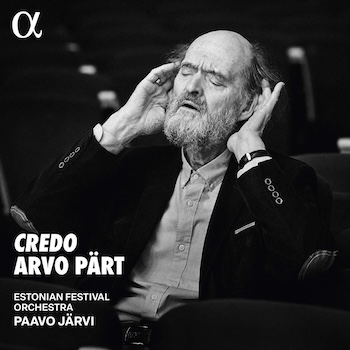 What do you get for a national icon on his 90th birthday? If you’re the Estonian Festival Orchestra and Paavo Järvi and we’re talking about Arvo Pärt, what’s better than a new recording? Enter Credo, a celebratory compendium for the Estonian composer, whose big anniversary fell on September 11th.
Pärt’s ubiquity in concert halls and on disc for much of the last fifty years suggests that he’s got plenty to say to our cultural and historic moment. Given the Eastern Orthodox focus of so much of his output, that may be surprising. Yet much of his work, with its spare textures, slowly evolving structures, and reasonably straightforward harmonic patterns, taps into a less-well-defined spirituality—and a good bit of its general appeal comes across on the present album.
Now, doing justice to the breadth of Pärt’s output on a single recording is something of a tall order: not only is Pärt prolific, but much of his music exists in multiple versions. For Credo, Järvi & Co. have gone with a selection of more or less familiar items—Fratres, the Cantus in Memory of Benjamin Britten, Credo—and interspersed a half-dozen or so selections of more recent vintage.
For better or worse, not all of them lean obviously into the composer’s familiar tintinnabuli style. Mein Weg, a six-plus-minute effort from 1998 (heard in the version for fourteen strings), gets bogged down by its canonic concept—though the music’s biting dissonances and energetic tempo set up a welcome contrast with its immediate companions.
Silhouette, on the other hand, an enigmatic homage to Gustave Eiffel and his eponymous Parisian tower, emerges as a strange but weirdly entrancing post-apocalyptic Valse triste. Written for Järvi and the EFO, this is its premiere recording. Further echoes of Sibelius seem to emerge in Swansong, a genially noble work that dances hypnotically between major and minor modes.
In general, Järvi and the EFO ensure that the disc’s reflective numbers are well-defined, texturally and rhythmically. Pärt’s string orchestra setting of Da pacem Domine, for instance, is as hypnotic and harmonically static as the original choral version. Yet the composer’s subtle approach to voice leading, which Järvi and his forces ably convey, holds the ear’s attention.
In Für Lennart, the apparent simplicity of Pärt’s language belies music of real emotional weight, especially over the piercing attacks of its middle episode. La Sindone, a meditation on the Shroud of Turin, veers into cinematic territory with its striding climax. But that moment is bracketed by a series of gentle, fragmented figurations and an eerie final chord.
Then there are the classics.
Järvi’s account of Fratres is well-directed and -shaped. While there’s rarely a sense of a steady pulse in this music, the score’s chant-like phrases emerge with weightless, dancing beauty.
A similar aura pervades the Cantus, in which the amount of rhythmic ambiguity Pärt mined out of six independent parts—sans triplets, quintuplets, and the like—continues to amaze. Here, the music unfolds inexorably, like an object emerging out of the mist.
Credo, Pärt’s contemplation of the biblical injunction to love one’s enemies, has lost none of its potency, either textual or musical. Järvi’s got a special connection to the piece: his father, Neeme, led the premiere in Tallinn in 1968. This account, in which pianist Kalle Randalu, the Estonian National Male Choir, Ellerhein Girls’ Choir, and Ellerhein Alumni Choir join the EFO, moves smartly and with purpose; the ferocious aleatoric climax cooks.
That might have been a nice way to end things. But the inclusion of Pärt’s short Estonian Lullaby, which features the girls’ chorus and the EFO, proves to be a magical nightcap—pure, sweet, and innocent as can be.
Jonathan Blumhofer is a composer and violist who has been active in the greater Boston area since 2004. His music has received numerous awards and been performed by various ensembles, including the American Composers Orchestra, Kiev Philharmonic, Camerata Chicago, Xanthos Ensemble, and Juventas New Music Group. Since receiving his doctorate from Boston University in 2010, Jon has taught at Clark University, Worcester Polytechnic Institute, and online for the University of Phoenix, in addition to writing music criticism for the Worcester Telegram & Gazette.
Tagged: "Credo", "Fratres", "the Cantus in Memory of Benjamin Britten", -Arvo-Pärt, Estonian Festival Orchestra