
Book Review: “The Endless Week” Offers a Brave, Inside-Out Internet Novel Experience
By Kai Maristed
The Endless Week is a brave, uneven, at times brilliant swathe of prose. Experimental? For certain. Perhaps the only way to write an Internet novel is by looking from the inside out.
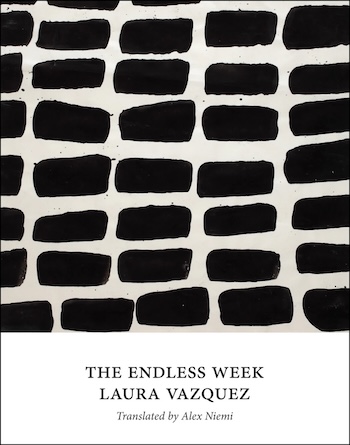
The Endless Week by Laura Vazquez, translated by from the French by Alex Niemi, 296 pp, Dorothy, a Publishing Project, $14.25
 Have you ever wished you could have cracked open Joyce’s Ulysses before all the scandal and fanfare, in order to let the unorthodox prose work on you directly, with no one ahead in age and stature to tell you it’s either a fraud or part of the canon of masterpieces? Same desire for Proust, maybe. Or, most recently, the Nobelist Jon Fosse, another writer who strives to “make it new,” in the words of that ever controversial iconoclast, Ezra Pound.
Good news: with The Endless Week, you can be that first reader. Free to decide. Is this wildly original “novel” — one that jettisons conventional elements (think character development, place, continuity, attribution of dialogue, etc.) in favor of obsessive cataloguing of the permutations of things and ideas (more on this later), in a relentless world of death and suffering (Beckett/de Sade) — a masterpiece? Or self-indulgently over the top?
Pound was a brilliant poet whose lines made much new, however insane his politics were. Laura Vazquez is also primarily a poet (no reflection intended on her politics). In 2023, still in her 30s, she was awarded the French Prix Goncourt for the body of her poetry, already translated into nine or more languages. Born into a poor family in Perpignan, she suffered a form of nervous breakdown in her youth, then supported herself by busking in the streets with friends, and only signed up for university courses for the sake of the stipends. Her poetry attracted growing interest; she was a Villa Medici resident in 2022-23. Vazquez now lives in Marseilles while traveling extensively, giving readings and workshops. She gently advises her Instagram followers to contact her through her website, as she spends little time on social media. How else to eke out the hours needed for a 316-page debut novel? (One wonders how the current cohort of social-media-savvy authors ever manages to get any actual writing done.)
Ulysses (later to significantly fatten the bottom line of Random House) was first published by Joyce friend and believer Sylvia Beach, in Paris, with a run of 1,000 copies. In contrast, The Endless Week was launched in France by Edition Points, a major player in a country that buys 14 books per capita per year. But the critical response there, apart from The Endless Week being declared a runner-up for the oddball Wepler Prize, was sparse and, while admiring the author’s fearlessness, on the vague side, praising her “poetical prose,” (actually, thankfully, there’s not much of that).
Instead, early in the book we hear this:
“Hello everyone, today we meet again for a new video on the subject of people, meaning cells. Your parents carry you and you are born, a doctor takes you out and you open your eyes. Cells surround your body, but you don’t see them…
“Who is the opposite of God? It’s a person. If there are problems, the problems aren’t the person’s, they belong to God. Who creates illness? It’s not a person, it’s nature. Everyone prays so they don’t have to understand. From their right hand all the way to their left, everyone is praying. Cells assemble, they touch and they ask, they beg, you could say that they pray…
“He moved his face close to the camera and said: Start the day without thinking, do an experiment. Let other things decide, let them choose your tastes, your problems, your movements. Stay at your house for an entire day, make the day last longer. Stay at your house an entire week, make the week last longer…
“When I was a kid, I thought like a kid, I talked like a kid, then, at night, I slept like a kid, and everyone treated me like a kid. I had compassion for objects. When my parents got a new car, I felt bad for the old car. I felt pity for the papers in trash cans. Then I became a person and now I’m speaking to you.… don’t forget to like and share, ciao, bye, see you next time.”
(That was admittedly a long quote for a book review, but Vazquez’s lines often require context and more context. A radical way to review The Endless Week would be to let readers drink from the hose, by simply offering three pages of curated quotes.)
The person posting above is Salim, a teenager. He videos himself, posts his poems, too, and garners tons of likes and wilted roses and urgent confessions from strangers. We learn that Salim has in fact been staying inside his house for years — perhaps since his mother left the family? — a circumstance that concerns the social worker who stops by to uselessly pressure Salim’s already overburdened father, whom one would be tempted to call nutso except that this term needs to be relative, and everyone in the book’s small cast is more or less off the center beam. If there is a center beam in life? Point taken, Vazquez.
Salim lives with said father, who has a mania about cleaning. And with his older sister, Sara, and the Grandmother, who cannot rise from her sickbed, who is deeply beloved, and dying in pain; you could say she IS pain, that she embodies (sic) disease. A male and female nurse patiently tend to her. Although she can communicate only by twice winking one eye, the novel expresses her universe, as well.
“…they might as well stab her skin instead of covering it in ointments, they might as well use blades instead of oil, sabers instead of gloves. Her body is a blade that cuts itself. They might as well clean her neck with an axe.”
“We don’t know objects well until we’re sick, we don’t know our rooms. We don’t know anything about a house until we’re sick in that house.… The grandmother heard the sheets, she heard her veins and the beating of her bones. We don’t know bones beat because we hear almost nothing. But the grandmother heard everything. Threads had sprouted like lentil shoots between the grandmother and each thing. And each thing washed over her, because the weaker the body, the more the mind expands.”

Author Laura Vazquez. Photo: Dalkey Archive
The fourth central person is Jonathan, Salim’s friend, initially via the Internet. Presumably older since he is long since heavily into drugs and alcohol. Good guy, even so. All three young people are prone to the similarly-voiced, lengthy obsessional parsings of phenomena that typify The Endless Week. Here is Sara, whose experience is mainly visual rather than verbal (i.e., Instagram etc.)
“She saw people according to their details, because there is always a detail that surpasses the person. There’s always an enlarged pore, a hair, or excretions, tears, odors, fat, zits, lumps, an eye that sparkles…. The eye of an older person, for example. That eye is so old. That eye seems so sticky. Are you going to die in a second? Everything is so close, it’s sickening.
“…Why is reality so close? Why are people so close? Why does reality always stay too close by? Why can’t it move farther away? Can’t we put it aside for a few seconds? Can we get some room to breathe? She wished she could change their faces with her phone, change the faces of passersby with software. To make them blurry, farther away, less real.”
Some of these spoken or interior monologues turn into rewarding rabbit-holes. Others, after proliferating bifurcations and no seeming end or point, invite glossing over.
There are points being made, though, as the narrative goes on. Keep an eye on those cells. On earth, decay, the question of what, if anything, defines a person. Always, these being kids after all, questions are asked. Not of books — there are none in the apartment scoured constantly by the father. Not of teachers. Being unschooled (although somehow literate), Sara and Salim go straight to the fountain of knowledge, that is, the Internet.
“He typed the word cell in his phone, he read: The cell is the smallest element forming all living organisms. A cell allows people to become enclosed and isolated.” Nice juxtaposition, Vazquez.
When Jonathan’s cell phone is stolen, he becomes convinced that he has no pulse. That his heart has stopped. Salim agrees. They MUST get Jonathan to the ER; it’s that critical. The father, meanwhile, educates his children, via smartphone, with lists of tips for life culled from the Internet. Some are more original than others. “If you find a fat maggot in a bowl of cherries, the bowl of cherries becomes disgusting, but if you find a cherry in a bowl of maggots, the bowl of maggots does not become delicious.”
Kids hunkered side by side, connecting with each other through their phones. Jonathan’s lifeline cut. Paternal advice replaced by Facebook-style aphorisms. What kind of world is this? Recently, in The Point, Sophie Kemp discussed the genre of “the Internet novel, which has existed for almost all of the 21st century.” Most of these are updated epistolary, plotty novels. My judgment, not hers, but an unsatisfied Kemp concludes, “In all of these works, we are in on the joke the entire time. We are meant to read all of this and feel like we are hovering over them. Like a computer is a two-way mirror.” In other words, the real experience has yet to be conveyed.
The Endless Week has often been described as surreal, which it is in part — macabre, Dali-esque, extremely disjointed, although at other moments sharply realist and sometimes achingly tender. “Magical realism” is another proposed box, and a poor fit. Certainly it is a brave, uneven, at times brilliant swathe of prose. Experimental? For certain. Perhaps the only way to write an Internet novel is by looking from the inside out. Perhaps this surreal-realist-thematically obsessive-experimental approach has birthed a true Internet novel, which, by definition, cannot resemble our 20th-century, pre-online idea of a novel at all.
Kai Maristed (www.kaimaristed.com) studied politics and economics in Germany; she lives in Paris and Massachusetts. She has reviewed for the Los Angeles Times, New York Times, and other papers. Her four books include the collection Belong to Me, starred by Publishers Weekly, and Broken Ground, a Berlin Wall story. Recent work is in Five Points, Ploughshares, and Agni. Her new collection, The Age of Migration, winner of the Kevin McIlvoy Book Prize, will be published in April 2026.
Tagged: "The Endless Week", Alex Niemi, Dorothy A Publishing Porject