
Toronto International Film Festival – Putin’s Media Fixer, Ukraine “Future” Doldrums and a Korean Hijack Farce
By David D’Arcy
A trio of political films at TIFF — ranging from tragedy to farce.
All sorts of celebrities travel to the Toronto International Film Festival to talk about films they made or films in which they appear. Even Barack and Michelle Obama were there, on video, to promote a film that they executive-produced, The Eyes of Ghana, about the early days of independence under the leadership of Kwame Nkrumah of Ghana, Africa’s American-educated glowing hope who ended up falling out of favor with the United States and with military putschists at home. What a coincidence, in the days of an activist Cold War CIA, to have both those opponents at the same time.
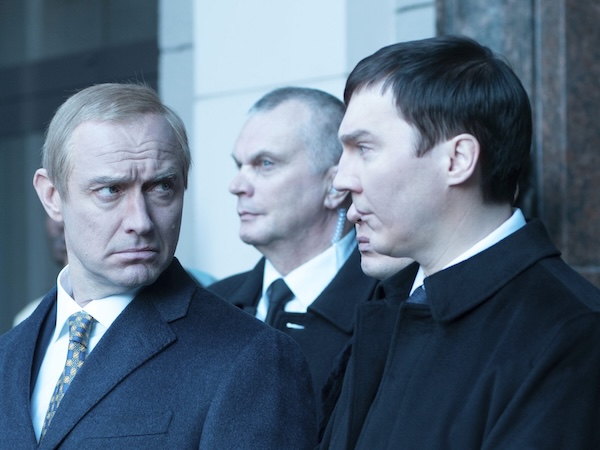
A scene from The Wizard of the Kremlin. Photo: TIFF
Vladimir Putin found his way to TIFF as a character in The Wizard of the Kremlin, a French film in English adapted by director Olivier Assayas and the writer Emmanuel Carrere from a novel written in French by Giuliano da Empoli, a Swiss-Italian former adviser to Italy’s former prime minister Matteo Renzi. The novel (Arts Fuse review) was a huge success in Europe, but it took years before the publication of an English translation, which got little traction in the U.S.
The film made its North American premiere at TIFF and it received a lukewarm welcome, even with Jude Law as a Putin-modeled character called the Tsar and Paul Dano as Vadim Baronov, a doughy adviser who moves from the arts to commercial media to advising the man in the Kremlin. His character is inspired by Putin muse Vladislav Surkov.
Shot in Riga Latvia, a sovereign state whose existence could be threatened by Putin’s nostalgia for empire, the film focuses on the decadence of Russia at the end of the Gorbachev era, when Moscow seemed at its weakest and gangster profiteers ran booming businesses threw endless parties. We see a changing of the guard after Gorbachev was ousted when a drunk and feeble Boris Yeltsin can barely stay conscious, and the FSB (former KGB) finds a man to replace him.
Law plays Vladimir Putin as a scowling ruthless tyrant who presides amid the golden trappings of pre-communist splendor. Does Russia need a gruff strongman to keep from falling apart? He thinks so, and Baronov’s mission is to help him communicate that need to political rivals and to the general population. One dictum that Baronov holds dear – “adulation is more effective than talent.”
We learn all this when a journalist (Jeffrey Wright) visits the retired Baronov’s luxurious dacha outside Moscow and learns how the right soothsayer helped a man without charisma become a leader called the Tsar. The dour Putin, at least as played by Law, doesn’t need much charm; nor does Baronov once his status becomes impregnable. At one point, TV broadcasters ridicule Putin on a popular satirical puppet show (soon taken off the air). Baronov tells one of the show’s producers that “it’s up to the prime minister to determine the lines between satire and insult, especially during election season. The prime minister has determined a line that must not be crossed.”
Of course, Putin has threatened and done much worse than canceling a puppet show. He joins Adolf Hitler (The Great Dictator) and Kim Jong Un of North Korea (The Interview) in the ranks of murderous tyrants who have been the subject of scripted films (both comedies) during their lifetimes. Aassayas says he wasn’t interested in laughs; he wanted to focus on the inner workings (“rouages”) of power in the film. But we don’t see anything near the worst of it.
Still, in rooms in the Kremlin lined with gold – a favorite material for our own president, too – we get an elegantly phrased back-and-forth between Putin and Baronov justifying whatever harshness the Tsar deems necessary. Putin’s notion of his authority — governing is not an activity that can be left to . . . accountants” — and the language he and Baronov are throwbacks to imperial times, to a leader’s cruel indifference to the fate of ordinary people whom he’s ordering into war. This inhumanity comes across just fine even when the script by two Frenchmen is translated into English. Refusing to be loved, Law finds the right acid tone to ensure that you’re not seduced by a war criminal.
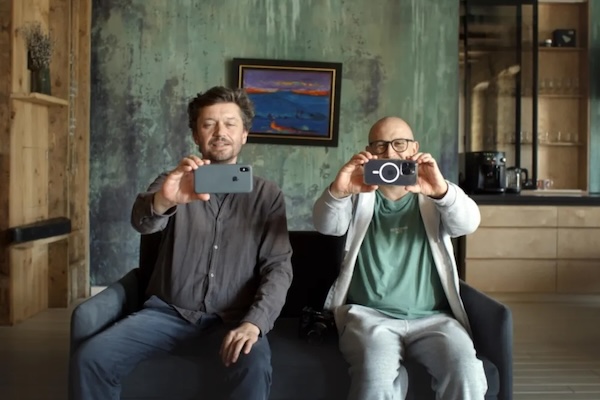
A scene from To the Victory. Photo: TIFF
From the other side of the line of fire came To the Victory, a no-budget mix of wish fulfillment and regret from Valentyn Vasyanovych. The setting is Ukraine in the near future, after it prevails in its war with Russia. I did say wish-fulfillment. A middle-aged filmmaker, Roman (played by Vasyanovych), lives in Kiev with his son. His wife and daughter, who fled to Vienna during the conflict, don’t want to return to a devastated country where so much has to be rebuilt. With his family divided, and his son demoralized, Roman does what filmmakers do. He tries to make a movie. Without much money, he hires his friends. They all drink together – victory is a good reason to raise a glass – and complain that they’re in a rut.
It’s no surprise, in the hands of a filmmaker, that making a film serves as a metaphor for everything else in life. To the Victory is, among many things, a study in trauma. Once the thrill of victory loses whatever glow it had, the task of rebuilding is long and grueling, and the laughs from getting drunk with friends go only so far. Be careful what you wish for, Vasyanovych seems to be saying, because you might get it. The reality, of course, is that Ukrainians are coming to terms with a far worse fate, and its not over.
To the Victory won the TIFF’s Platform Award, a juried prize in a section that leans toward experimental work, for “bringing cinematic language to its roots and, at the same time, masterfully playing with audience expectations.” True enough.
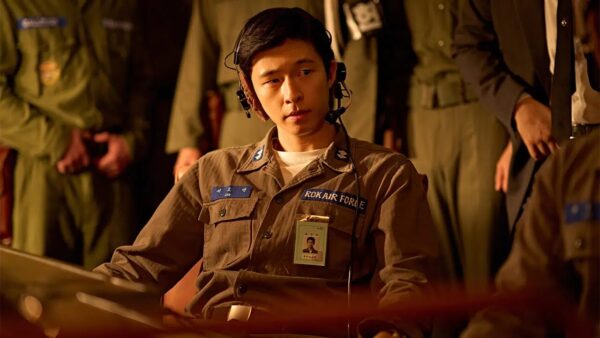
Hong Kyung in Good News. Photo: Netflix
Good News, the latest from the Korean director Byun Sung-hyun, is inspired by a true story. In 1970, a group of fanatic political cultists from the Red Army Faction in Japan hijacked a plane traveling from Tokyo to Fukuoka and ordered the crew to fly to Pyongyang, capital of North Korea, where the group planned to mastermind a new stage of its revolutionary strategy. The plane made the flight, and then landed, which is about all that went according to plan.
Good News is a comedy on a grand scale, all the more entertaining when things go wrong, as they do.
Dogmatic radicals tend to be humorless and angry, and these are, which makes for scary moments and plenty of laughs inside a lurching airplane. Call it in-flight entertainment.
Naturally, the South Korean military scrambles to get control of the hijacked plane, with self-important American officers part of the effort. But then the South Koreans hand the job over to an odd character, a disheveled figure of mysterious background called Nobody (Sul Kyung-Gu’s take on Colombo, only messier). He takes charge as the hijackers scream at passengers and, in South Korea, stuffed shirts in uniform order around underlings. The ineptitude and cowardice of those authorities ring true.
How to get the plane to land safely? Nobody the fixer has an idea – dress up the airport in Seoul as Pyongyang, dress a hundred women in identical white dresses with identical welcome bouquets, and play the national anthem of the DPRK over loudspeakers. The grand spectacle works. The hijackers think they’re in the workers’ paradise, until the handcuffs go on. Enough spoilers for now.
If there is an Oscar for Best Deadpan Performance, Sul Kyung-Gu should get it, no contest. The deeply irreverent and hilarious Good News is a Netflix production and it will stream soon – in Korea. We can only hope that, given our president’s fondness for North Korea’s leader, Kim Jong Un, it can be viewed in this country soon.
David D’Arcy lives in New York. For years, he was a programmer for the Haifa International Film Festival in Israel. He writes about art for many publications, including the Art Newspaper. He produced and co-wrote the documentary Portrait of Wally (2012), about the fight over a Nazi-looted painting found at the Museum of Modern Art in Manhattan.
Tagged: "Good News", "To the Victory", Byun Sung-hyun, Emmanuel Carrère, Olivier Assayas, Sul Kyung-Gu, The Wizard of the Kremlin, Valentyn Vasyanovych