
Book Review: “Organizing America” — Celebrating Unsung Heroes
By Bob Katz
The book presents brisk, information-rich capsule biographies of twenty largely under-publicized figures who, against the odds and at significant personal sacrifice, worked valiantly to promote a range of underdog causes, from abolition to union organizing to disarmament.
Organizing America: Stories of Americans Who Fought for Justice by Erik Loomis. The New Press, 259 pages, $27.99
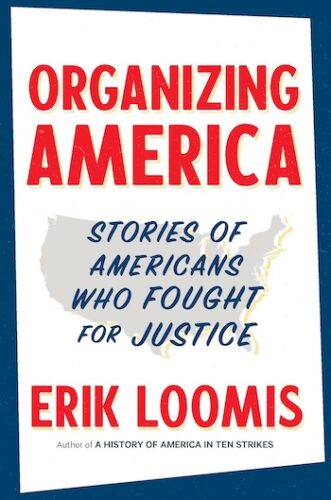 In the tradition of activist historian Howard Zinn, Erik Loomis’ Organizing America: Stories of Americans Who Fought for Justice, presents an alternative roster of progressive heroes whose achievements, taken together, tell an alternative version of the American story. A University of Rhode Island professor, Loomis is explicit about his motive: “I found that students needed more than just political knowledge. They needed hope.”
Toward that end, the book presents brisk, information-rich capsule biographies of twenty largely under-publicized figures who, against the odds and at significant personal sacrifice, worked valiantly to promote a range of underdog causes, from abolition to union organizing to disarmament. These mini-bios (8-9 pages each), stretching in time from Benjamin Lay (born 1682) to Richard Oakes (born 1942), have the stated aim of demythologizing what it takes to become a movement leader. Loomis’ message is clear: one need not be a charismatic giant like Martin Luther King or Mother Jones to undertake the challenge of political organizing.
Maybe so, although extraordinary courage, determination, and persistence are qualities that appear again and again when reading about the lives of these individuals.
Lay is the first entry in the book and his story sets the tone. A dwarf who likened himself to David and his enemies to Goliath, he had a talent for guerrilla theater. (During his speeches denouncing slavery, Lay would puncture an animal bladder that spewed pokeberry juice, underscoring his point about God shedding blood.) Lay was raised in an English Quaker family and he eventually emigrated to Barbados, a colony that ran on slavery.
Loomis peppers this and other chapters with intriguing asides that establish the historical context and dramatize his protagonist’s mission. Regarding Lay, the background includes details about sugar plantations, Quaker beliefs, and the anti-slavery climate emerging in Philadelphia where he relocated in 1732. Long before renouncing slavery, a young Benjamin Franklin was exposed to Lay’s fiery egalitarian views in his role as printer of Lay’s 1737 book, All Slave-Keepers That Keep the Innocent in Bondage, Apostates.
An outspoken, eccentric animal-rights vegetarian who lived, literally, in a cave on a friend’s property, Lay was hardly a conventional personality. Nor, despite his dedication and zeal, was he much of an organizer, as Loomis concedes. “Sometimes, you try to organize people,” the historian writes, “but they do not want to hear your message, regardless of whether it’s true.”
Being thwarted, dismissed, knocked down, and then bouncing right back up are experiences nearly every activist profiled here shares. “Organizing America does not always mean you win,” writes Loomis in one of his peppy chapter intros, “Sometimes it means suffering. It means standing up for your beliefs in the face of massive hostility. You might spend your whole life losing. You might get beat up. Sometimes you pay the ultimate price.”
It’s a fine line Loomis attempts to walk, between encouraging average folk to join the fray with a spirited you-can-do-it pat on the back and then illustrating, through example after example, how difficult, dangerous, and dispiriting that fight can be. There’s no sugar coating here. Unless it’s the implied postulate that righteous struggle, given what’s at stake, can be its own reward.
A kind of Noah’s Ark selection process (one of each rather than two) seems to have been used in choosing which activists to profile. Chapter subtitles give a heads-up flavor: Not All White Suffragists, The American Path to Socialism, Intersectionality Pioneer, The Martyr, Organizing Through Armed Self-Defense, A Rebel Life, The Late-Life Organizer, The Mother of the Gay Civil Rights Movement.
Many of the profiled subjects were new to me. I’d never heard of or knew nearly nothing about: Lay, Maggie Walker, Clara Lemlich, Frank Little, Myles Horton, Clint Jencks, Robert Williams, Mike Quill, and Yuri Kochiyama.
I had heard of and knew a bit about Ida B. Wells, Eugene Debs, Ella Baker, Elizabeth Gurley Flynn, Bob Moses, Daniel Berrigan, and Dolores Huerta.
And, for this lax reader of history, it was useful to have looks at such cornerstones of our national saga as the Pullman strike, the Triangle Shirtwaist fire, Joe Hill’s martyrdom, the Highlander Folk School, and Mississippi Freedom Summer, all situated within the timeline context of memorable individuals who played key roles.
The chapter on Clara Lemlich is representative of Loomis’ approach, ninety-plus action-packed years deftly sketched in a few pages. Born in 1886 in what is now Ukraine, Lemlich came to New York as a teenager and immediately began working at the Gotham Shirtwaist factory. Loomis swiftly sketches that world: 11-hour days, 66-hour workweeks, a workforce consisting largely of young girls who could easily be exploited, sexually as well as economically.
Lemlich began organizing fellow workers, joined the executive board of the International Ladies Garment Workers Union, and soon clashed with the powerful Samuel Gompers of the American Federation of Labor who, at a Cooper Union leadership meeting on November 22, 1909, openly opposed the proposed ILGWU strike.

Author Erik Loomis. Photo: uri.edu
Lemlich demanded to be heard. “I have listened to all the speakers,” she declared, directly addressing her membership in Yiddish, “and I have no patience for talk.”
Twenty thousand ILGWU workers went out on strike.
Lemlich married, had three children, became a member of the Communist Party and was active with the United Council of Working Class Housewives, mobilizing a consumer boycott of meat to protest high prices. At the end of her life, living at the Jewish Home for the Aged in Los Angeles, she helped the facility’s workers to form a union and badgered the nursing home’s management to honor the United Farm Workers grape boycott.
“From the workplace to the household,” writes Loomis, “Clara Lemlich is one of the great American heroes.”
At some point, I wondered if Loomis was shrewdly cherry-picking his entries in order to tout pre-established points about the specific characterological traits which, intersecting with ripe social conditions, can lead a person to the forefront of mass organizing. Then I realized: yes, of course. That’s the project. This is history intended for the pro-democracy crowd (spoiler alert: the other side has other ideas.)
It’s impossible to read this laudable work without considering the relentless campaign being waged by Team Trump to re-write – can we use the term “cancel”? – precisely the kind of history Loomis aims to illuminate.
In highlighting the struggles of Maggie Walker, a late nineteenth and early twentieth century advocate of Black economic self-sufficiency and minority business development, Loomis, in a wistful kind of grace note, points out that her Richmond, VA home has been turned into a National Park Service site. Sign of progress?
Walker was an active Republican, and that fact just might help preserve the NPS designation against the onslaught. On the other hand, her fierce opposition to racism and the kind of discrimination practiced by financial institutions might, you know, put the property on the endangered list.
Clearly a war is being waged over how the American story should be told. Zinn’s best-selling People’s History of the United States and other such progressive revisionist works had a good run, studied in high school and college classrooms, made available in public libraries, and featured in DEI forums and commemorative events throughout the country.
The right wing rollback is now fully underway. It’s armed with political muscle, bolstered by something approaching state control of mainstream media, and enabled by a grotesque amount of influence over federal entities like the Department of Education, Library of Congress, and the Smithsonian Institution.
Project 2025 has its eyes on a prize and it won’t involve celebrating any of Erik Loomis’ invaluable unsung heroes.
Bob Katz is the author of six books, including the novel Waiting for Al Gore and the nonfiction Elaine’s Circle. His commentary and journalism have appeared in the New York Times, Los Angeles Times, Boston Globe, Chicago Tribune, Newsweek, Mother Jones, Slate, and many other outlets. For more: BobKatz.info
Bob Katz is a terrific writer. He sheds light upon a book about important people in American history
Great review of a complex multifaceted book! I’m going to get this book and read it, pronto! That’s the sincerest compliment I can pay. Katz quotes the author as wanting to provide hope with his histories. In these awful times hope is a precious gift indeed!