
Theater Review: “Our Town” — An American Classic That Still Holds Up
By David Greenham
Given all the chaos and violence around us, isn’t it a mite too late for a subtle play like “Our Town” to be considered a “primal scream?”
Our Town by Thornton Wilder. Directed by Courtney O’Connor. Scenic design by Shelley Barish. Costume design by Rachel Padula-Shufelt. Lighting Design by Deb Sullivan. Sound design by Andrew Duncan Will. Produced by The Lyric Stage Company of Boston, at 140 Clarendon Street, through October 19.
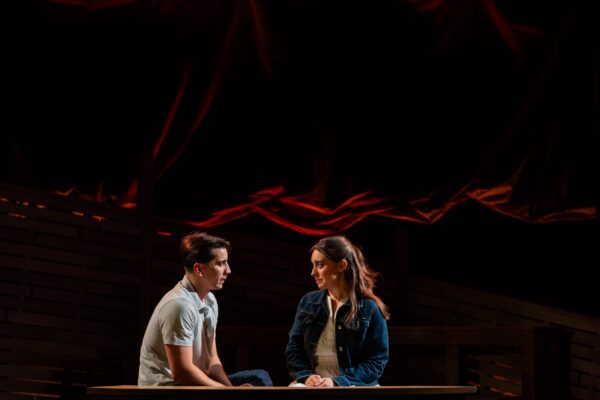
Dan Garcia and Josephine Moshiri Elwood in the Lyric Stage production of Our Town. Photo: Nile Hawver
Like us, you might wonder why Lyric Stage Company Producing Artistic Director Courtney O’Connor would decide that what we needed, in this tumultuous year, was a visit to Grover’s Corners. This is Thornton Wilder’s quaint, imaginary New Hampshire village, circa the turn of the last century, where dear Emily Webb (Josephine Moshiri Elwood) and athletic George Gibbs (Dan Garcia) are destined to fall in love. Still, beneath the surface of this nostalgic evocation of an era — when America was great — there lurks some sobering discoveries. “Far from a saccharine period piece,” O’Connor writes, “I’ve long felt Our Town is a primal scream begging us to fully see, embrace, and deeply honor the beauty and the pain in our community, our loved ones, and ourselves, in our lives in moments big and small.”
There’s precedent for this way of thinking. When the play opened in 1938, Wilder wrote, “Our Town is an attempt to find a value above price for the smallest events in our daily life.” In a troubled world on the eve of World War II, the play was a revelation and, it seems, a comfort for many. Some of the first productions outside of the US took place in Poland, Germany, Vienna, Italy, and Japan.
Beginning with the stage direction of “No curtain. No scenery,” the playwright wanted to encourage audience members and the actors to see themselves on common ground – unified by being in each others’ presence, alive at that moment. And brought together by words. Together we’d learn, as Emily does, that life is precious but fleeting, and that it should be cherished.
O’Connor and her team can’t resist the urge to bring some traditional theatrical elements to their Our Town. Scenic designer Shelley Barish has set up a stylistic wooden circle on the stage, with a ramped curve upstage and movable platforms that turn into tables and benches for all the many locations that are needed. A fenced back wall frames the stage, with a fabric backdrop upstage, crumpled at the horizon, which, when lit, resembles clouds.
Deb Sullivan’s lighting design is sculpted and warm, at times supplying a sepia tone that suggests old photos in an antique album.
The cast, which includes several faces familiar to local audiences, is generally dressed in contemporary garb. Some of Rachel Padula-Shufelt’s costume design choices are lovely, giving off a sense of timelessness. Other selections feel less well-considered.
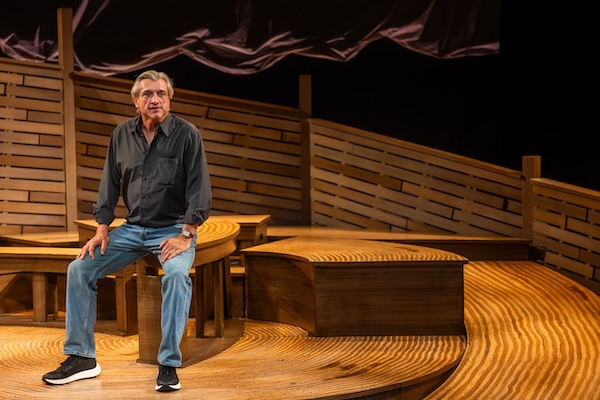
Will McGarrahan in the Lyric Stage production of Our Town. Photo: Nile Hawver
We’re not in Grover’s Corners, of course. That’s not Wilder’s intention. We’re in a theater, and the Stage Manager (Will McGarrahan) knows it. “The play is Our Town,” he says at the beginning. He casually describes the landmarks of the town – the six churches, the town hall and post office, the grocery store, Mr. Morgan’s drug store, and the homes of the Gibbs and Webb families. Two other characters also break the fourth wall to provide some insight into what seems to be a community frozen into placidity. Professor Willard (John Kuntz) shares some history of the town, and Mr. Webb (De ‘Lon Grant), the editor of the paper, gives us the “political and social report.”
Even (scripted) questions are invited. One stranger, the Tall Man (Jesse Garlick), tries to stir the pot, “Is there no one in town aware of social injustice and industrial inequality?”
“Oh yes, everybody is – something terrible. Seems like they spend most of their time talking about who’s rich and who’s poor,” Mr. Webb replies.
“Then why don’t they do something about it?,” the Tall Man retorts.
Webb’s got the answer down pat: “Well, we’re ready to listen to everybody’s suggestion as to how you can see that the diligent and sensible ‘ll rise to the top and the lazy and quarrelsome sink to the bottom. We’ll listen to anybody. Meantime, until that’s settled, we try to take care of those that can’t help themselves, and those that can we leave alone.”
The magic of Our Town lies in its simple, at times poetic, language and its laconic appreciation of existence. Life in Grover’s Corners, at least on the surface, is as reliable as the arrival of the early morning train. The town just flows, as Emily says of her Louisiana Purchase speech at school, like “silk off a spool.” The play’s depth lies in its poignant commentary on our complacency in the face of the vast wonders — and tragedies — around us.
This production is earnest, but it becomes bogged down at times in the very kind of theatrical busy work that Wilder wanted to avoid. There are efforts at miming physical activity, and these pantomimes can quickly elbow conversations aside. The space is utilized for a variety of exits and entrances, and these can also overwhelm what should be a focus on storytelling. There are plenty of interesting exchanges in the script, but O’Connor enforces a swift tempo, robbing us of a chance to eavesdrop on quicksilver but revealing conversations. Famous scenes, such as the “used furniture salesman” discussion between Mrs. Gibbs (Thomika Marie Bridwell) and Mrs. Webb (Amanda Collins), or the wonderfully short “chopping wood” exchange between Doc Gibbs (Robert Najarian) and his son George are pushed along when they should be gently nurtured.
Kathy St. George (Rebecca, Mrs. Soames, and others) is the most consistent member of the supporting players. Her recounting of the letter to Jane Crofut hits exactly the right tone. Likewise, Elwood’s Emily and Garcia’s George develop their budding relationship clearly through Act I’s starlight scene, and the charming ice cream parlor interlude in Act II might well be the highlight of the production.
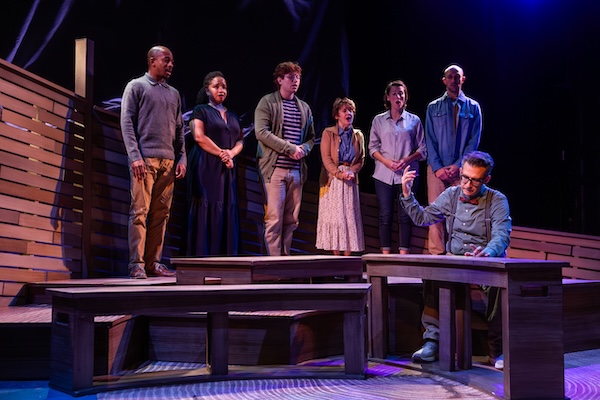
(l to r) Darren Paul, Thomika Marie Bridwell, Jacob Thomas Less, Kathy St. George, Amanda Collins, Jesse Garlick, and John Kuntz in the Lyric Stage production of Our Town. Photo: Nile Hawver
At three short acts, with one ten-minute intermission, Our Town runs just two hours. The staging would benefit from taking more time to settle into those revelatory moments of silent discomfort or surprise that make up the distinctive texture of this drama.
Yes, Our Town is a little dated. Some lines in this production have been edited out, and the reference to the made-up “Cotahatchee Tribes” and Mrs. Gibbs’ assertion that “People are meant to go through life two by two. ‘Tain’t natural to be lonesome” misses the mark when its delivered without a twinge of contemporary irony.
For the most part, however, Our Town holds up. Simon Stimson (John Kuntz) articulates Wilder’s bracing view in Act III, when he tells Emily: “That’s what it was to be alive. To move about in a cloud of ignorance; to go up and down trampling on the feelings of those…of those about you. To spend and waste time as though you had a million years. To be always at the mercy of one self-centered passion, or another.”
That speech remains an effective reminder of the emotional complications we are unwilling to confront. And at the moment, that “cloud of ignorance” has become powerful enough to blind our appreciation of democracy’s value. Given all the chaos and violence around us, isn’t it a mite too late for a subtle play like Our Town to be considered a “primal scream”? In the words of Constable Warren (Darren Paul), “I don’t know how that’s goin’ to end.”
David Greenham is an arts and culture consultant, adjunct lecturer on Drama at the University of Maine at Augusta, and is the former executive director of the Maine Arts Commission. He can be found at https://davidgreenham.com/
Tagged: Amanda Collins, Courtney O’Connor, Dan Garcia, Darren Paul, Jacob Thomas Less, Jesse Garlick, John Kuntz, Josephine Moshiri Elwood, Kathy St. George, Our Town, The Lyric Stage Company of Boston, Thomika Marie Bridwell