
Doc Talk: The Newburyport Documentary Film Festival — One of the Strongholds for the First Amendment
By Peter Keough
As other outlets for reporting and investigating the truth are persecuted or succumb to pressure, the role of independent documentary filmmaking grows more urgent and vital.
The Newburyport Documentary Film Festival. September 26 through 28
As the Trump administration defunds and diminishes agencies supportive of non-fiction filmmakers, festivals such as the Newburyport Documentary Film Festival remain a refuge for the medium. Moreover, as other outlets for reporting and investigating the truth are persecuted or succumb to pressure, the role of such filmmaking grows more urgent and vital.
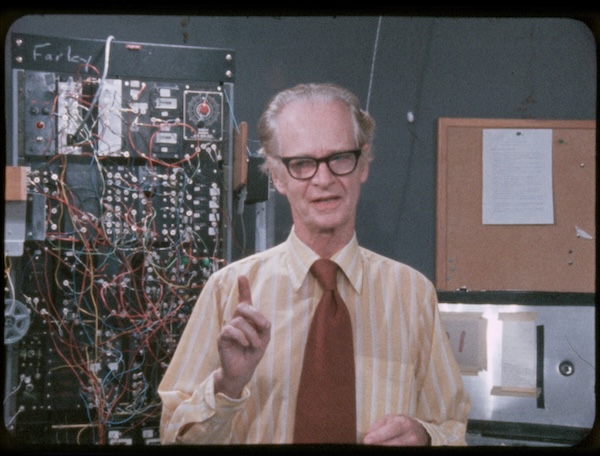
The man himself: a scene from B.F. Skinner Plays Himself. Photo: courtesy of the filmmaker
One wonders how the subject of Theodore Kennedy’s B.F. Skinner Plays Himself (2025; screens September 27 at 10 a.m. at the Screening Room) might regard the current state of democracy, culture, and social interaction. Skinner (1904-1990) had devised a theory called operant conditioning, a kind of extrapolation of Pavlov’s experiments by which external reinforcement could shape a person’s behavior without any consideration of personal volition. Kind of like A Clockwork Orange, though as indicated in his utopian novel Walden Two (published in 1948, the year before Orwell’s 1984 came out) and outlined in his more truculently titled Beyond Freedom and Dignity (1971) Skinner hoped that his system would be used not for nefarious purposes but to improve the human race and eradicate social and political ills.
Charming, imposing (such a forehead!), and an expert at self-promotion, Skinner shone in talk shows in the ’60s and ’70s with what then seemed a radical dismissal of notions about consciousness, free will, and individual autonomy (a segment on The Dick Cavett Show in which he debates Dennis Potter in full hippie regalia is a hoot). Drawing on archival footage and outtakes and clips from an unreleased 1975 documentary profile (a disgruntled Skinner pulled the plug on it), Kennedy not only critiques Skinner’s ideas but also deconstructs the documentary genre itself and its capacity for presenting objective truth.
Acknowledging that his methods could be as easily employed by a despot as by an enlightened authority, Skinner in the end was pessimistic about the future. “Those of us who can predict what is going to happen are not in a position to do anything about it,” he concludes.
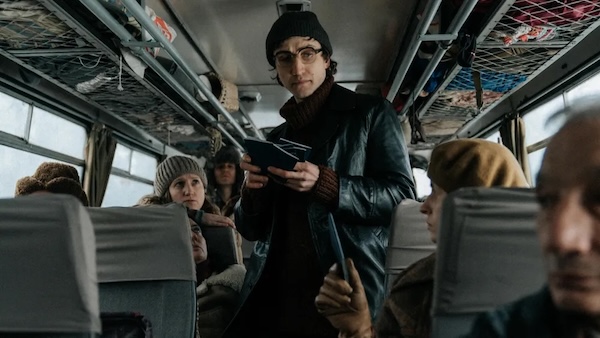
A scene from Budapest Diaries. Courtesy of Lukasz Bak
As an example of humans conditioned into evil behavior one need look no further than the turmoil recorded in Shay Fogelman’s quietly terrifying Budapest Diaries (2023; screens September 28 at 11:30 a.m. at the Firehouse Center for the Arts), a record of the events in that city in the last year of WWII as documented in journals written by Jews, their allies, and others.
For a while it seemed that Hungary, despite being an ally of the Third Reich, might be a haven of sorts from the Holocaust. Most Hungarian Jews considered themselves patriots and essential members of society. This is despite the fact that the fascist regime ruling the country had issued many anti-Semitic laws since as early as the ’20s and had engaged in a number of persecutions. But it was not until 1944 that the full brunt of the Nazi genocide came to fruition, once German troops occupied the country.
Many of the diaries reflect an early, guarded optimism, followed by a growing disbelief and horror as the full scope of the disaster became clear. These writings also reflect considerable resilience, resourcefulness, and determination in the face of unimaginable danger, terror, and wickedness. This is essential viewing at a time when such a nightmare, supposedly relegated to the past, has become all too plausible.
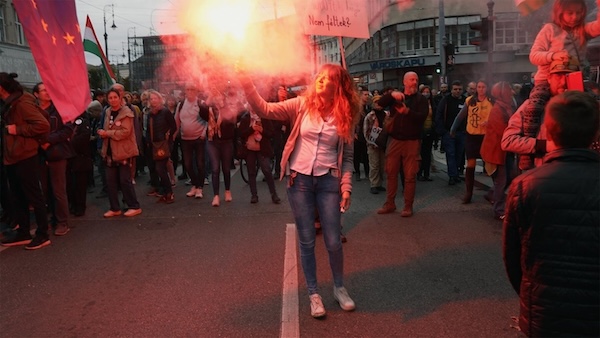
A scene from Democracy Noir. Photo: courtesy of the filmmaker
Flash forward some six or seven decades. Once again, the political situation in Hungary has taken a turn for the worse. Connie Field’s infuriating and inspiring Democracy Noir (2024; screens September 27 at1:30 p.m. at the Firehouse Center for the Arts) shares the country’s disheartening recent history in its study of President Viktor Orbán (the prototype of our own current tinpot tyrant), his ongoing fascist reign, and the frustrated but resolute resistance against him waged by three courageous women.
Unlike the American electorate, Hungarian voters did not know what they were getting into when they opted for Orbán and his supposedly left-leaning Fidesz party. They saw him as a reasonable alternative to the corrupt socialists and the wacky far right. But it did not take long for the ugly truth to emerge. In short order, Orbán took over the media, scapegoated immigrants and gay people as enemies of the people, hijacked the judicial system, and rewrote the constitution to virtually guarantee that he would be reelected every four years and remain dictator for life.
Sounds familiar, as does the lament “I just don’t want to get out of bed – what kind of country are we living in?” uttered by Tímea Szabó, an opposition parliamentarian, after Orbán’s victory in 2022. But she got out of bed and persisted, as did Babette Oroszi, a once prominent gay broadcast journalist who still manages to find outlets for her exposés of Orbán’s breathtaking corruption, and Niko Antal, a nurse who sees firsthand the regime’s toll on healthcare and leads protests in the streets.
And their efforts might not all be for naught. The once fractious opposition parties in Hungary seem to have united under the charismatic leadership of Peter Magyar and, as Orban’s fiscal irresponsibility has taken root, he looks to be in deep trouble in the next election, which is scheduled for April, 2026.
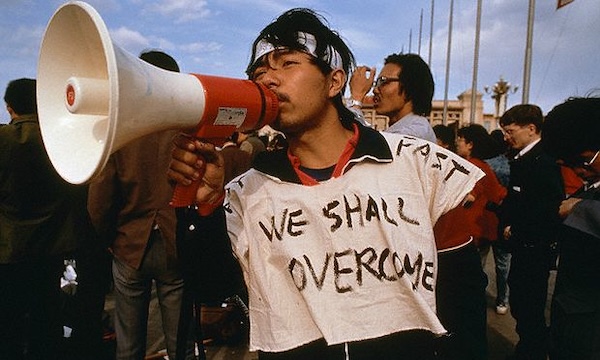
A scene from Tiananmen Tonight. Photo: courtesy of the filmmaker
As noted above, the first target of a dictatorship is the free press, and its power is celebrated in Bestor Cram and Michael Streissguth’s rousing and dismaying Tiananmen Tonight (2025; screens September 28 at 3:15 p.m. at the Screening Room). In 1989, what looked to be a liberalization of China’s hardcore rule encouraged students to gather in Beijing’s Tiananmen Square and show their support for democracy. This quixotic appeal for liberation might have fizzled out, largely unknown to the rest of the world, lost in China’s information desert, had the CBS Evening News not been struggling in the ratings. They and host Dan Rather needed a big story to restore their fortunes. All the other networks were pretty much ignoring the ongoing furor in China, so they convinced the corporate heads that this event was a winner.
It proved to be so — for CBS at any rate, and also for the movement, at least for a while, as their numbers swelled to hundreds of thousands and they were joined by workers and peasants from across the country, a development that threatened to overthrow the regime. This dissent, of course, could not stand. The government kicked out most of the CBS crew, sent in the army, and killed thousands as it obliterated the demonstration (to the present day, any mention of Tiananmen in China is met with grave consequences). Still, a small contingent of reporters, risking their lives and freedom, reported the aftermath and were able to capture, among other tragic moments, the iconic image of the lone civilian facing down, however briefly, a column of tanks.
Cram and Streissguth combine riveting archival footage and illuminating interviews with those involved, including Rather and other CBS personnel as well as student participants in the struggle. They also do not shy away from pointing out that it wasn’t idealism that motivated the network’s decision to cover the uprising but the corporate bottom line. The result was a boon for CBS, a momentary boost for the movement, and a devastating, enduring crackdown on freedom in China. Would the cause have been better served had CBS ignored it?
Not only does the festival offer a showcase for these and many other established documentarians, but it also provides a supportive venue for student filmmakers. Its Young Emerging Filmmakers Showcase (YES) competition will present a $1000 prize to the winning candidate. The finalists, whose films will be screening September 26 at 3 p.m. at the Screening Room followed by a Q & A, give one hope that the future of the medium is still bright.
They include Carlo Ang’s uplifting and harrowing “Lola,” a tribute to his grandmother who endured the brutalities and terror of the Japanese occupation of the Philippines during World War II; Chelsea Casabona and Surabhi Sundaram’s intimate and engaging “Mettle” about a blind Filipino-American young woman who trains relentlessly to be the first American female to win a gold medal in judo at the Paris Paralympics; Anna Carroll’s wry and delightful “The POMtastics” which profiles a group of 65+ Massachusetts women who have found solidarity and commitment with their popular Pom-dance team; and Anni Spacek’s fascinating and disturbing “How to Be Seen” in which young people try to create their identity through social media — and some who do not. (One wonders what B.F. Skinner might have thought of the latter film, and how his strategy of behavioral reinforcement seems to have been co-opted by the internet.)
Peter Keough writes about film and other topics and has contributed to numerous publications. He was the film editor of the Boston Phoenix from 1989 to its demise in 2013 and has edited three books on film, most recently For Kids of All Ages: The National Society of Film Critics on Children’s Movies (Rowman & Littlefield, 2019).
Tagged: "B.F. Skinner Plays Himself", "Democracy Noir", "Tiananmen Tonight", Bestor Cram and Michael Streissguth, Connie Field, Newburyport Documentary Film Festival, Shay Fogelman