
Film Festival Reviews: The Toronto International Film Festival – Storks and Arctic Drama
By David D’Arcy
Two outstanding films from this year’s Toronto International Film Festival — “The Tale of Silyan” and “Wrong Husband”
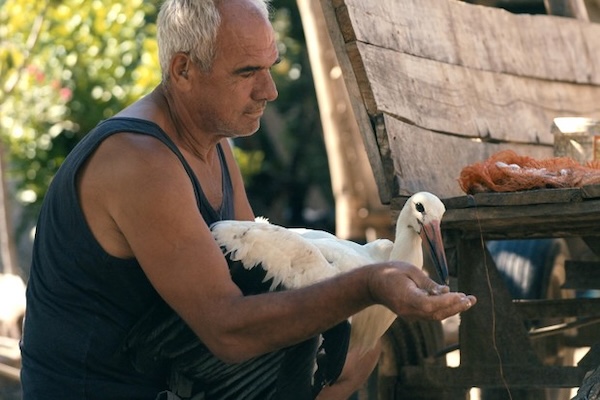
A scene from The Tale of Silyan. Photo: Toronto International Film Festival
The documentary The Tale of Silyan has the beguiling imagery of a fairy tale and the grim honesty of a sledgehammer. It was one of the best films I saw at the Toronto International Film Festival.
Director Tamara Kotevska takes you to the expansive plains of her native North Macedonia in a narrative that follows the wondrous white storks that are native to that region, the birthplace of Alexander the Great. The film’s other storyline, running parallel but intersecting, is the ordeal of a farm family that is struggling to live off the land there. The word “struggle” understates the grueling challenge.
Kotevska became a figure to watch with Honeyland, a 2019 film of radiant lyricism, nominated for two Oscars despite its minimal commercial potential.
We enter her new film with views of a rural village, where storks alight onto rooftop nests, as they have done for as long as anyone there can remember. They make noises with their huge beaks that sound as if sticks were being hit together, or like Geiger counters registering at high volume. They stretch their long necks behind their backs. In the air, they are as graceful as anything that can fly, soaring beyond the horizon. On the ground, they are ungainly and as angular as creatures imagined by the great Cuban modernist Wifredo Lam, who painted his share of birds. They also call to mind the shadowy creatures that gather around devils in early Renaissance paintings.
The storks are not angels or demons, but busy carnivores, feeding on frogs and other small animals in the fields. There’s a storybook harmony to Kotevska’s images of life in the village — as long as you’re high on the food chain. But the local farmers are suffering. They raise potatoes, melons, and other crops for meager prices. If the film’s initial images of village life have the resonances of a fairy tale, it turns out to be a dark one. Merchants tell farmers who demand higher prices that they can eat the crops themselves. It’s not a bluff. There are no tourists or weekend farmers to fill the economic gaps.
Families leave the land. We watch as Nikola, now a grandfather, sits amid mounds of unsold potatoes, which he and others dump on the roads to block traffic. In France or the Netherlands, farmers can pressure politicians to take their side. Not here. Nikola’s son and his family leave for Germany through the services of a job broker. It’s migration the old-fashioned way; southern Europeans trekking north for underpaid work. Nikola and his wife Jana settle into life back home without the younger generation, until word arrives that Germany is expensive. Jana heads out to care for her grandchild, so both parents can work.
Nikola, without his family, stays in the village. Besides dead-end farming, there are few jobs. He lands work directing garbage trucks in a squalid landfill outside of town. If that weren’t grim enough for a man who once worked on his own land, we see skeletons of storks amid piles of waste. Conservation, for eternity, by bulldozer.
The story shifts from meditations on nature to a page out of an updated Book of Job. Nikola puts his fields up for sale and retreats to his house, his last possession. He’s not the only desperate worker. Fields go up in flames; the farmers who set those fires get more from their insurance than what they can get for their crops. But Nikola has company — a limping stork, immobile after injuring a wing. The proud creature has been brought down to earth. Gradually the stork adjusts to Nikola’s efforts to feed him. Somehow – since the economy hasn’t changed for the better – the two keep each other going.
Once again, Kotevska focuses on the interdependence between the human and natural worlds, which was at the core of her glowing and sobering Honeyland. In that film, she and her co-director Ljubomir Stefanov observed a tragedy. An old beekeeper’s traditional process of producing honey from hives on the side of a mountain is compromised after a family moves to a nearby house and sells all their own honey, failing to save half their output for the bees. The new bees then raid the older hives, interrupting what had once been a delicate, cooperative process of honey-making. It’s evidence that the pursuit of unrestrained growth, even at that modest scale, can kill an enterprise rooted in ecological stability.The lesson seems obvious — yet is it ever learned?
Honeyland was remarkable for its close observation of people and insects. Kotevska’s reach in The Tale of Silyan is broader. Here she explores a landscape in all directions, including the air, as drones follow the storks (thanks to cameraman Jean Dakar). In the village community, humans and the birds that build their nests on rooftops live right on top of each other. The stork that Nikola nurtures back to health avoids a fate in the landfill, and adapts slowly to the rhythms of human activity. Nikola’s wife Jana returns from Germany to work with him on their unsold land. Is this a reassuring fable or just a fragile reprieve?
I couldn’t help but be reminded of the tender All That Breathes, a 2022 documentary by Shaunak Sen about a team of men in crowded Delhi who care for injured birds of prey. The men are Muslim, and we hear the voices of Hindu gangs hunting down Muslims on the streets outside. Fearful, the men talk of emigrating.
Nikola, who is caring for the injured stork, is in his sixties. In Honeyland, Hatidze was decades older. Perhaps wisdom comes with age. So does hope. The alternative is the landfill.
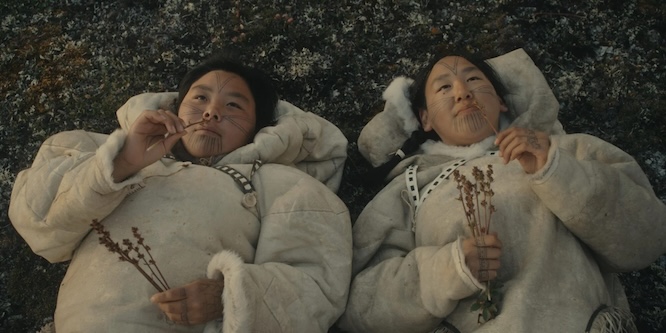
A scene from Wrong Husband. Photo: Toronto International Film Festival
Set far north of Toronto, indigenous Canadian director Zacharias Kunuk’s Uiksaringitara (“Wrong Husband”) is a drama that looks at the two forces that shape life there — nature and tradition. In a tiny arctic settlement, an arranged marriage between a young couple is broken apart. Marriage is vitally important for these people because the population is so small.
Kunuk (2001’s Atanarjuat: The Fast Runner) situates his latest work 2000 years ago in the tundra, a desert of stones that stretches outward in the 24-hour-long light of summer. The sky is majestic, with vivid patterns and colors that shift like versions of abstract paintings.
The drama heightens when a new widow marries an old man from a nearby village, taking her daughter away from a local man to whom she had been promised. Once the daughter is seen as available, suitors appear, ready to fight for a prize – a new wife. The tale’s resonances range from local Inuk legends, which include supernatural ingrediants, to the wooing of Penelope in ancient Ithaca during Odysseus’s long return from the Trojan War. Note that the Odyssey is a more recent source than the folk tales Kunuk draws from.
Inuk culture adds other elements, including shamanism. Figures return from the past in clouds of smoke to intervene as the suitors fight. The broad empty vistas ensure that the rivals in this community are stuck with each other, as far as the eye can see. The spirits at hand include a troll with a rubbery face ready to take its share of possessions and people. Add to that the paradox of a community dressed for warmth in thick hides, yet living in sparse austerity.
Another element evoking ancient Greece –the blazing sun — which gives this barren environment a grandeur that will help you ignore acting inconsistencies in a cast where all but two actors are amateurs.
David D’Arcy lives in New York. For years, he was a programmer for the Haifa International Film Festival in Israel. He writes about art for many publications, including the Art Newspaper. He produced and co-wrote the documentary Portrait of Wally (2012), about the fight over a Nazi-looted painting found at the Museum of Modern Art in Manhattan.
Tagged: "Atanarjuat: The Fast Runner", "Honeyland", "The Tale of Silyan", "Wrong Husband", Tamara Kotevska, The Toronto International Film Festival, The Toronto International Film Festival 2025