
Theater Review: “Silent Sky” Celebrates the Pioneering Women Who Charted the Heavens
By David Greenham
Once again, the innovative CST/Catalyst Collaborative@MIT project proves that there are inspiring stories of women’s contributions to science that need to be told.
Silent Sky by Lauren Gunderson. Directed by Sarah Shin. Choreography by Peter DiMuro. Scenic design by Qingan Zhang. Costume design by Leslie Held. Lighting design by Eduardo M. Ramirez, sound design and composition by Kai Bohlman, properties design by Julia Wonkka, projection design by Michi Zaya. A Catalyst Collaborative@MIT production, produced by Central Square Theater, Cambridge, through October 5.
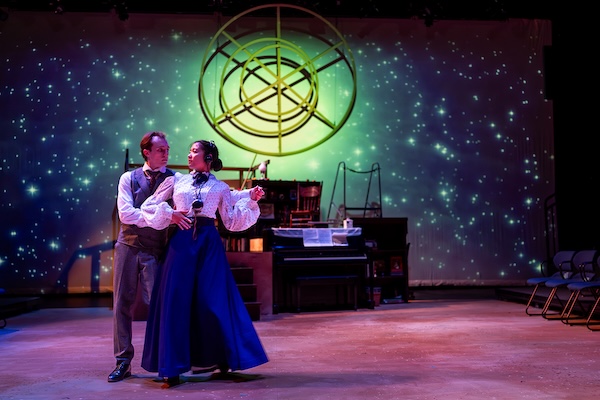
Jenny S. Lee and Max Jackson in the Catalyst Collaborative@MIT production of Silent Sky. Photo: Nile Scott Studios
At a few poignant moments in Lauren Gunderson’s lovely, lyrical, and sometimes laugh-out-loud-funny Silent Sky, Margaret Leavitt (Kandyce Whittingham) serenades her sister, Henrietta Leavitt (the wonderful Jenny S. Lee), with the popular Methodist hymn, “For the Beauty of the Earth.” It includes the verse:
For the beauty of each hour
of the day and of the night,
hill and vale, and tree and flower,
sun and moon, and stars of light;
Lord of all, to thee we raise
this our hymn of grateful praise.
The Leavitt sisters live in Ohio, where their father is a pastor and Margie plays piano for the church choir. It’s 1902, and women are supposed to find their place in the home as caregivers for their family and community.
Henri, a brilliant thinker, is having none of it. “Heaven’s up there, they say,” pointing to the sky, “clouds and pearly gates, they say.” Henri adds with steely determination, “they don’t know about astronomy, I say.” Henri convinces her father to release her dowry, so she can move to Boston and accept a job from physicist Edward Pickering, director of the Harvard College Observatory.
In Boston, Henri meets Pickering’s underling Peter Shaw (Max Jackson). She’s dumbfounded to learn that she won’t be looking through the observatory’s legendary refracting telescope; that privilege is reserved for men. Instead, she’s relegated to acting as a computer alongside Scottish-born Williamina Fleming (Lee Mikeska Gardner), and Annie Jump Cannon (Erica Cruz Hernández), an astronomer and early suffragette. “Pickering’s Harem,” they’re called, a moniker they abhor. But Annie assures Henri that doing the work of mapping the stars is critical, or, as Williamina notes, “At the moment, we’re cleaning up the universe for men and making fun of them behind their backs.”
Henri’s youth and determination rejuvenates her lab partners. They examine slides taken from the telescope and categorize the stars using a system that Cannon invented. But Henri’s anxious to dig deeper. “I have some pressing issues with science,” she declares at one point, pointing out how little we know about our place in the universe. She asks,“Who are we? Why are we here? Where are we?” She sets off on her own exploratory course, trying to discover a pattern in the changing brightness of the stars they’re identifying.
At the same time, the all-too-serious Peter Shaw has become enchanted by Henri. Much to the amusement of Williamina and Annie, Pickering’s nerdy assistant is falling in love.

Kandyce Whittingham and Jenny S. Lee in the Catalyst Collaborative@MIT production of Silent Sky. Photo: Nile Scott Studios
Playwright Gunderson does a phenomenal job of conveying the technical aspects of the scientific quest while keeping the script’s characters grounded in a compelling emotional and interpersonal narrative. The relationship between Henri, Annie, and Williamina is humorous, but their camaraderie is also rooted in a deep mutual respect. They’re a solid team taking on the face of institutionalized sexism.
Sisters Maggie and Henri share an unshakable bond that is revealed through snippets of interspersed scenes. They have their ups and downs, but their connection to each other is strong.
Jackson’s clumsy and lovelorn Peter is hilarious and, once Henri looks up from her notes and notices his affection, she matches him with her sweet innocence. Neither of them knows how to say what they feel, and how to act on those feelings — until it’s too late.
Director Sarah Shin has created a smooth ride through the two-and-a-half-hour show, with an intermission, and the time slides by thanks to an engaging story.
Qingan Zhang’s unit set, with an upstage platform and three rolling desks, ebbs and flows easily. Eduardo M. Ramirez’s beautiful lights, Kai Bohlman’s warm and ethereal sound design, and Leslie Held’s scrumptious period costumes combine to give the production a wondrous glow.
The cast is universally strong. As Williamina and Annie, Gardner and Hernández supply a stable base on which to create the life in a lab. Whittingham’s solid Margaret grounds the family side of the tale. The shining star in this staging is Jenny S. Lee. Her brilliant and determined Henri is engaging and fun, but the performance also brings out the character’s emotional depth and maturity.
Once again, the innovative CST/Catalyst Collaborative@MIT project proves that there are stories of women in science that need to be told. At a time when we, as a country, are marching backwards, supposedly to a golden age when women had fewer rights, when science and education were under attack by people so intimidated by knowledge that they sought to destroy it, Silent Sky serves as a valuable warning, a cautionary tale. Our lives and successes have been made possible by those who quested. People looked to the land, the seas, and the skies to seek answers, to discern truth rather than capitulate to dogma.
Like so many of the productions in the Catalyst Collaborative@MIT series, Silent Sky is yet another examination of the foolhardiness of our misogynistic past (and present).
The play concludes with the reading of a Walt Whitman poem, When I Heard the Learn’d Astronomer, which ends:
…I wander’d off by myself,
In the mystical moist night-air, and from time to time,
Look’d up in perfect silence at the stars.
In the context of this play, the verse suggests that wonder is not enough — we ignore science, and the understanding it provides, at our peril.
David Greenham is an arts and culture consultant, adjunct lecturer on Drama at the University of Maine at Augusta, and is the former executive director of the Maine Arts Commission. He can be found at https://davidgreenham.com/