
Film Review: “Spinal Tap II” — Aging Rockers, Fading Laughs
By Tim Jackson
This is another visit to the world of Spinal Tap. I had some good laughs, and that might be enough.
Spinal Tap II: The End Continues, directed by Rob Reiner. Screening throughout in cinemas throughout New England
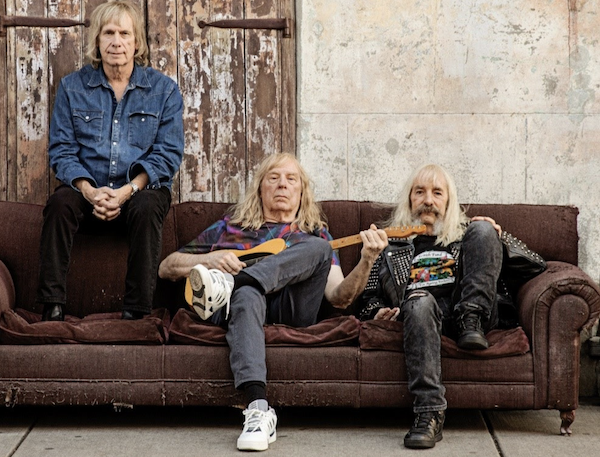
From left, Nigel Tufnel (Christopher Guest), David St. Hubbins (Michael McKean), Derek Smalls (Harry Shearer) in Spinal Tap II: The End Continues. Photo: Kyle Kaplan/Bleecker Street
Mick Jagger at 78 was quoted in the London Sunday Times saying: “Rock & Roll, or any kind of pop music honestly, isn’t supposed to be done when you’re in your 70s. I wasn’t designed for that.” It’s a lovely self-effacing comment. At age 31, he also said famously: “I’d rather be dead than playing ‘Satisfaction’ at 45”. Age brings wisdom and perspective. Not so with the band Spinal Tap nor the film of their reunion, Spinal Tap II: The End Continues, which feels a bit threadbare, like the band members themselves. Still, it is not without many guffaws and discomfiting realities, particularly for rock musicians of a certain generation.
This time around, the mythical band lurches out of the past to fulfill a forgotten contract that called for them to perform one last concert. With the help of Hope Faith (comedienne Kerry Godlimen), daughter of their former manager Ian Faith (played in the first film by the late Tony Hendra), the reunion is once again to be chronicled by the stalwart director Marty Di Bergi (Rob Reiner). His first job: to round up the graying members of the band who haven’t seen one another for 40 years.
With the height of their music careers behind them, members of the group are now comfortably ensconced in new jobs. David St. Hubbins (Michael McKean) lives in Morro Bay, California, where he plays in a Mariachi band and composes for a murder-porn podcast on a single keyboard with a computer in his cramped “recording studio”. His girlfriend, Jeanine Pettibone (June Chadwick) from the first film, has left him and is now Sister Jeanine Imaculata, who is also interviewed. Derek Smalls (Harry Shearer), sporting an oversized drooping mustache, lives in London where he owns a glue museum. He offers this nugget of wisdom about his career: “What keeps things together? Glue. What keeps people together? Glue”. He also produces occasional Goth concerts. One is called “Hell Toupee”. Finally, there’s Nigel Tufnel (Christopher Guest) who runs a cheese and guitar shop with his friend Moira Babbage (Nina Conte) in Berwick-Upon-Tweed. It is delightful to see Conte, who is also a brilliant ventriloquist and of whom I am a huge fan, in this small role. Christopher Guest executive-produced Conte’s own film, Sunlight.
Across this fictional universe walk many guest stars such as Fran Drescher and several Christopher Guest regulars. Garth Brooks and Trisha Yearwood are seen in an online clip performing ‘Big Bottom’. Paul Shaffer is back as Artie Fufkin, the hapless Midwest Polymer Records promotions man (there actually exists a long-lost radio jock named Artie Fufkin, though the name appears coincidental). Their concert promoter is Simon Howler (comedian Chris Addison), a name that echoes ‘Simon Cowell’, the judge on the American Idol franchise. Howler confesses: “My weakness is my strength, which is that I hate music. I can’t hear it and I can’t even duplicate it.”
Because so many of their drummers have died, they need someone for that cursed position. Chad Smith (Red Hot Chili Peppers) and Lars Ulrich (Metallica) claim conflicts. Questlove declines with: “I have a colonoscopy to do. Guys, look, you’re legendary, but I don’t want to die”. A drummer from the Blue Man Group comes in. The brief uncredited older woman auditioning is actually the viral sensation 74-year-old Dorothea Taylor, who is called the “Godmother of drumming.”
When Valerie Franco (drummer for Halsey, Kacy Hill, Kylie Minogue and others) sits at the set and plays, the band stops in their tracks. Franco is a powerful professional drummer. The appearance of this beautiful, spirited percussionist is no parody. Derek Smalls attempts to hit on her: “Since we’re playing together, what do you say we play together?” suggests Derek Smalls. “Oh my gosh, I’m flattered” she says. Then, in walks the beautiful Annie Gordenier. “Oh my God, speaking of playing together, this is my girlfriend”, she beams, dashing Smalls’ hopes. Rounding out the band is another excellent musician, a keyboardist named “Caucasian Bob” (session player, CJ Vanston).
The celebrity cameos include Paul McCartney and Elton John. McCartney appears during a studio rehearsal, performing the deliriously twee song “Cups and Cakes”, where he sings a quick, Beatlesque French horn line. Elton John delivers a surprising studio performance singing the lead vocal on “What the Flower People Say”. He confesses his love for the band: “I always loved that song, but I never thought I’d actually perform it.”.He also appears in their final concert to surprising results.
Like the original film, much of the dialogue comes from improvisation within scenes set up for that purpose. In improvisational comedy, the mantra is ‘always accept the offer’. In other words, go with whatever situation has been brought up and build on it. Quick wits and spontaneity are the comedians’ forte but the blade is not as sharp as it once was. These guys are by now seasoned comedians. Reiner, always dead serious, does well priming the actors with questions on which they can riff but the jokes are less organic, and more old guy shtick. There are amusing lines, as when St. Hubbins declares: “The more we retreat into music the more we retreat into our cowardice.” It’s funny, but as they once told us, not particularly clever.
The scripted bits work to varying degrees, such as the promotion item called “Tap” Water: regular tap water in a special Stonehenge bottle. My guess is such an item would actually sell, given the buildup to this film and their renewed status as a faux cult band.
Of course, it is impossible to duplicate the impact that the original film had when it was released. All the performers were younger then, their youthful naïveté and dunderheaded wisdom made for a wicked commentary on the rock & roll posturing of the day. I recall thinking at the time that the film should be required viewing for all rock and rollers who believe that their bands and music were the be-all and end-all of pop artistry. This is Spinal Tap was a reflection of those delusions of grandeur in a funhouse mirror. The film gave birth to the genre of comic faux documentaries. Christopher Guest went on to make a brilliant career of classic comedies such as Waiting for Guffman, Best in Show, and A Mighty Wind. Another example would be the 1993 rap mockumentary, Fear of a Black Hat.
Most of the popular white pop musicians of the ’60s and ’70s are now in their 70s and 80s. Jazz, blues and country legends of yore, for the most part, aged gracefully. Growing old in rock and roll, however, is uncharted territory. Jagger ages with discipline and grace. He is like a dancing stick puppet and can still pull off a show. Audiences love that Keith Richards looks like the Crypt Keeper in pirate garb; it’s part of his shtick. Like Kabuki actors, these two move from pose to pose as a way to conserve energy. Fans adored the late Ozzy Osbourne, who turned rock ‘n’ roll dotage into an art form. The ever popular Gene Simmons of KISS remains an egotistical buffoon.
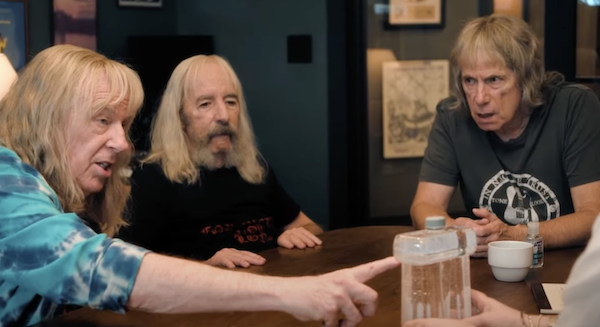
From left: David St. Hubbins (Michael McKean), Nigel Tufnel (Christopher Guest), Derek Smalls (Harry Shearer) in Spinal Tap II: The End Continues. Photo: Kyle Kaplan/Bleecker Street
Let’s face it, many heavy metal players and former rock “Gods” have been ravaged, mind and body, by their vanity and wild lifestyle. They come off as clownish. This Spinal Tap sequel comes off as a plea for rockers to age gracefully. When the comedy works, it does so precisely because these musicians have not aged gracefully. The color of their hair, in overgrown pageboy cuts, falls somewhere between gray and straw. Eyeliner does nothing to peel away the years. The band’s personal arguments and creative conflicts are as ludicrous as ever, though they lack the unique spark of their younger days.
Some unspoken beef looms over the relationship between St. Hubbins and Tufnel. During a sound check that comes to a head, St. Hubbins wanders off into the city. He ends up on a dark street watching 85-year-old blues singer Little Freddie King sing “Can’t Do Nothing Babe.” In front of real roots music, he wistfully recalls his past. It’s a rare bittersweet moment in the film. It is as though Michael McKean himself were wondering if they should be attempting this movie/concert at all.
Coasting on past fame, the band can still fill a stadium, but this is probably a non-paying audience. The “fans” know all the lyrics and in unison hundreds (as they were no doubt told to do) chant “Tap, Tap, Tap.” The concert at the Lakefront Arena, New Orleans is actually pretty good (although the actual concert was shot at Stonehenge in Wiltshire, England, in August of this year). The three actors seem to drop their idiot personas to concentrate on performing well in front of a real mob. This creates a narrative disconnect between the preceding parody and a serious finish.
These guys can play their instruments, after all, and classic songs like “Big Bottom” and “Stonehenge,” accompanied by outrageously precarious set designs, are no sillier than what is served up by many of the heavy metal bands that haul themselves out for reunion tours. If one needs proof, just see the jaw-dropping documentary Anvil: The Story of Anvil, the real-world analogue to Spinal Tap.
Anyway, this is another visit to the world of Spinal Tap; I had some good laughs, and that might be enough. Here’s a quote that’s often been attributed to E.B. White: “Analyzing humor is like dissecting a frog. Few people are interested and the frog dies of it.” I would add that, as long as bands like KISS, Alice Cooper, Mötley Crüe, Twisted Sister, and GWAR fill arenas, the joke is on us all.
Tim Jackson was an assistant professor of Digital Film and Video for 20 years. His music career in Boston began in the 1970s and includes some 20 groups, recordings, national and international tours, and contributions to film soundtracks. He studied theater and English as an undergraduate, and has also worked helter-skelter as an actor and member of SAG and AFTRA since the 1980s. He has directed three feature documentaries: Chaos and Order: Making American Theater about the American Repertory Theater; Radical Jesters, which profiles the practices of 11 interventionist artists and agit-prop performance groups; When Things Go Wrong: The Robin Lane Story. And two short films: Joan Walsh Anglund: Life in Story and Poem and The American Gurner. He is a member of the Boston Society of Film Critics. You can read more of his work on his blog.
Tagged: "Spinal Tap II: The End Continues", Christopher Guest, Harry Shearer, Michael McKean, Rob Reiner