
Book Review: From Protest to Progress — Abdul-Jabbar’s Memoir Battles Historical Amnesia
By Bill Littlefield
Given Donald Trump’s claim that American history has been “rewritten” and transformed into a “distorted narrative driven by ideology rather than truth,” We All Want To Change the World may be banned in some school libraries in America.
We All Want To Change the World: My Journey Through Social Justice Movements from the 1960’s to Today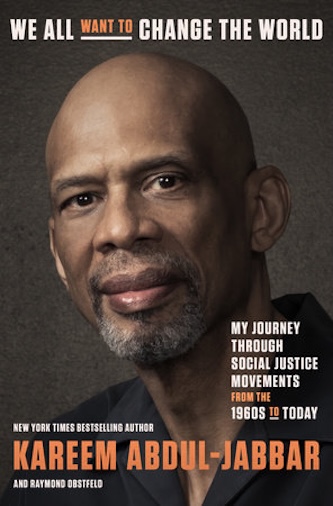 by Kareem Abdul-Jabbar and Raymond Obstfeld, Crown, 306 pages
First, a disclaimer: In my previous work life, I interviewed lots of pro athletes. Kareem Abdul-Jabbar, whom I also heard speak several times, seemed to me more thoughtful, receptive to questions, and articulate than any of the rest of them. I came to his most recent book, We All Want To Change the World, expecting to like it.
In several previous books, Kareem has chronicled the achievements of Black men and women in various fields. He has also written about his own career as an exceptionally successful basketball player, and about his relationship with his former college coach, John Wooden. In the new book, he’s more ambitious. He discusses the development of his consciousness through an examination of various events that have influenced him over the past sixty-five years. He reminds his readers of precisely the events and developments that the current presidential administration would like them to forget. One of his goals, as he writes, is to answer this question: “Have I at least tried to make this country a better, more humane, more compassionate, freer place?” He believes he has. I think he’s right.
The author is aware of the risks he’s running. As he writes early in the book,
I’ve been getting death threats since I played at UCLA — so, for more than fifty-five years…Sometimes it was because I was Black, sometimes because I was a Muslim, sometimes because of a political cause I supported, sometimes because of a social cause I championed, sometimes because of a criticism I had made of a political or cultural figure. Over the years, I’ve become an all-you-can-hate buffet, one that will satisfy even the pickiest hater.
The political events and developments responsible for the growth of Kareem Abdul-Jabbar into an influential activist range from the murders of individuals (beginning with stories he heard about the murder of Emmett Till and extending to the murder of George Floyd and beyond) to courageous acts by, among others, Rosa Parks and John Lewis, and the outrages committed by Donald Trump, who has made his affection for various racists and fascists clear. But Kareem writes that his “involvement with social protests” really began after he met Dr. Martin Luther King in 1964. A few days later, he was caught up in a riot in Harlem when he got off the subway near a record store where he wanted to buy some jazz recordings. Those two events taught the seventeen-year-old Kareem that “hope and fear are necessary to motivate real change.”
This is a book that celebrates progress and cries out for more of it, and the author does not limit himself to matters of race. He also salutes the events and movements that have advanced the causes of feminism, gay rights, and transgender rights. And, with precision and power, he writes about threats, past and present, to these developments. His “journey through social justice movements from the 1960’s to today” provides readers with the essential history necessary to understand not only much of what has happened in this country over the past seventy years, but what must happen if the progress Kareem acknowledges is not to be lost. The book is not for children specifically, but it is notable for its accessibility to readers of all ages.
A big part of Kareem’s message is the perniciousness of the current effort to erase or sanitize the history of this country, the attempt to insist that we blindly celebrate everything “American” as glorious. The MAGA goal is dishonest and fraudulent, even deadly. The danger of erasing past realities is obvious. Calculated failure to understand that progress has been costly and bloody and complicated ignores the profound difficulties faced by folks dedicated to that change and the value of what was accomplished. At one point, Kareem warns:
After all the beatings, the murders, the sacrifices, the assassinations, the protesting, the rioting, the legislation; after millions have taken to the streets; after a Black president; after Oprah – after all that, we’ve returned to Go…The past five years have seen a rejuvenation in the Jim Crow spirit. Individual states have been passing laws to suppress teaching Black history and to sanitize the parts they do teach.
Given Trump’s claim that American history has been “rewritten” and transformed into a “distorted narrative driven by ideology rather than truth,” We All Want To Change the World may be banned in some school libraries in America. Members of various school boards might object to Kareem’s allegiance to accuracy. Let us hope such witless and dangerous knee-jerk opposition will encourage many, many people to read his book.
Bill Littlefield volunteers with the Emerson Prison Initiative. His most recent book is Who Taught That Mouse To Write? (Writing Mouse Press)
Bill,
I agree with most of this article. And it is good to see you write about something other than prison reform! Your many years researching sports’ quirks, idiosyncrasies, and oddities give you a wealth of information that you should share more. Hopefully, in the future, you will.