
Film Review: “The Long Walk” — A Vicious But Timely Parable
By Tim Jackson
Audiences prefer that political messages be buried under heaps of horror, but this film may be extreme enough to alert some viewers to look beneath the bloody spectacle.
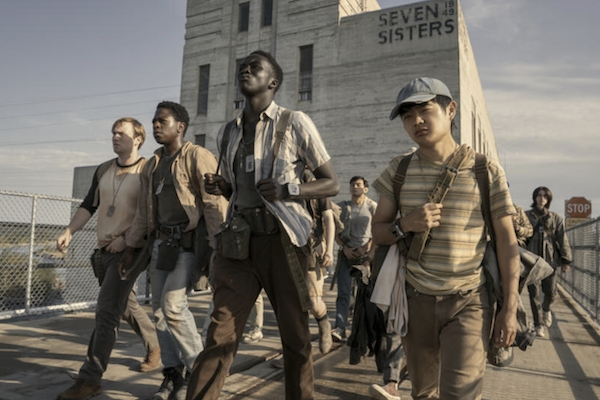
A scene from The Long Walk.
In The Long Walk, a group of young men chosen by a national lottery take up the challenge to walk until only one of them is left alive. The last man walking will win whatever he wishes, including great wealth. Sparse spectators line the long route of the march as a camera watches the group. There is no finish line. The end depends solely on the endurance of the last one standing. A cheering crowd awaits. But how do they know the final location? It is also unclear to what degree the participants are aware of the fact that those who fail will be shot on the spot. The film’s questionable “ducks in a barrel” premise is based on the first novel Stephen King wrote, in the late ’60s, while he was still a student at the University of Maine. The book was eventually published in 1979 under King’s pen name, Richard Bachman. The no-way-out scenario must have been appealing to director Francis Lawrence, who has helmed such cinematic future visions as I Am Legend and the four Hunger Games films. He knows how to pack a dystopian punch.
To say that watching the film is exhausting may be redundant, but discomfort is obviously the point. Why this murderous competition exists is left for us to imagine. The allegory strains credibility, but it works as a metaphor for mindless sacrifice to tyrannical power. One critic called the novel “a bleak science-fictional mirror of contemporary America,” which suggests that the story is a critique of America’s involvement in the Vietnam War. It was a time when young men were sacrificed like cannon fodder to an illegal war.
Before Bachman was revealed to be Stephen King, the novel was dismissed as nothing more than minor pulp fiction. It then gained acceptance as one of the author’s first Richard Bachman novels. The thin premise reflects the fledgling writer’s youth, but it works reasonably well as a film. The real appeal of The Long Walk lies in its graphic horror thriller elements. This is an example of intense, visceral filmmaking — the killings are depicted unflinchingly.
In 1971, Punishment Park, a pseudo-documentary, shot in verité style by British filmmaker Peter Watkins, depicted war dissenters who were given a choice. Jail time or a chance to earn their freedom by crossing 50 miles to reach an American flag — while being pursued by National Guardsmen. The rationale for the contest was a piece of faux legislation, supposedly the idea of Richard Nixon, called the 1970 Internal Security Act. (I have had international students ask me if this was real legislation.).Watkins’ intent was to excoriate America’s efforts to squelch dissent during the Vietnam War. The fantastical context of The Long Walk takes this idea further: here the government has become so corrupt that human sacrifice has been turned into a form of entertainment. This is how a totalitarian government would make “patriotic” use of reality television.
The Long Walk has no use for complicated backgrounds for its standardized characters. Cooper Hoffman leads the fine cast as Ray Garraty, a sensitive young man whose weeping mother is distraught after he joins the contest. She and his father are the only parents visible in the film. A brief cameo, played by Josh Hamilton in a flashback, reveals how the father’s death motivated Garraty to compete in the Long Walk. That Hoffman’s father, the actor Philip Seymour Hoffman, died tragically, makes the casting ironic and poignant; Hoffman excels in this emotionally and physically challenging role. Equally good is David Jonsson as Peter McVries (Alien: Romulus), with whom Ray will bond. McVries is more abrasive and cynical, but the two predictably learn to respect one another’s attitudes toward life and fate. They recall Sidney Poitier and Tony Curtis shackled together in The Defiant Ones (1958) — but with rapport rather than division.
The other walkers are unsurprising, stereotypical characters, but they are a well-cast group of lesser-known young performers. Tut Nyuot, a British actor with South Sudanese roots, ably represents decency in the face of irrational sacrifice. Young Ben Wang as Hank is determined to make it through to the end with youthful resilience and determination. The four are like a grim version of the quartet in the 1986 film adaptation of King’s Stand by Me.
Charlie Plummer is Gary Barkovitch, whose onomatopoeic name suggests a bad dog. Abrasive and skeptical, he will inevitably have to come to terms with his own negativity. Another character, Collie Parker, serves as a gesture toward American diversity. Joshua Odjick, a model-handsome Canadian actor of Algonquin-Anishinaabe-Cree heritage, is compelling as a stalwart man who faces unbeatable odds with laconic stoicism. He is the polar opposite of the mouthy and obnoxious Stebbins, played by Garrett Wareing. Of course, a group like this needs at least one frail walker, and that’s Thomas Curkeit, played by young Roman Griffin Davis (JoJo Rabbit).
Dialogue and character do not run deep in The Long Walk. It is the potential carnage that maintains suspense. Followed by military tanks and soldiers with rifles, young men walk day and night without rest, eating, drinking, pissing, and shitting as they walk. After three warnings, they are shot dead on the spot if they slow down to under 3 miles per hour or drop. Mark Hamill is cartoonish as a barking Major who periodically hectors the group from his tank and who, for extra sinister effect, never removes his aviator shades.
The surreal fable shares some similarities with Shirley Jackson’s “The Lottery,” another nightmarish tale of institutionalized madness, published in 1948, in which one citizen of a small community is regularly chosen to be stoned to death. Ari Aster’s film Midsommar (2019) is a more recent horror story where rituals of violence can unite a community. The Long Walk another vicious parable. I can’t say that I enjoyed the film, and perhaps that is the point. As I write this, an advertisement is popping up on my computer featuring Secretary of Homeland Security Kristi Noem; she’s in a slickly produced advertisement encouraging “illegal” immigrants to “self deport.”
Audiences prefer that political messages be buried under heaps of horror, but this film may be extreme enough to alert some viewers to look beneath the bloody spectacle. The Long Walk is a warning to communities not to be silent during hate-filled times. Silence is cruelty, silence is oppression. SILENCE = DEATH.
Tim Jackson was an assistant professor of Digital Film and Video for 20 years. His music career in Boston began in the 1970s and includes some 20 groups, recordings, national and international tours, and contributions to film soundtracks. He studied theater and English as an undergraduate, and has also worked helter-skelter as an actor and member of SAG and AFTRA since the 1980s. He has directed three feature documentaries: Chaos and Order: Making American Theater about the American Repertory Theater; Radical Jesters, which profiles the practices of 11 interventionist artists and agit-prop performance groups; When Things Go Wrong: The Robin Lane Story. And two short films: Joan Walsh Anglund: Life in Story and Poem and The American Gurner. He is a member of the Boston Society of Film Critics. You can read more of his work on his blog.