
Doc Talk: Camden International Film Festival — Dreams Good, Bad, and Impossible
By Peter Keough
Several films in this year’s festival explore the nature of dreams and the people who are driven by them.
Camden International Film Festival. September 11-14. Camden, Rockland, ME. Various locations.
Unlike Hollywood studios that regard dreams as tawdry fantasies that pander to audiences’ basest impulses and most banal aspirations, documentarians tend to be more analytical about such things. This is the case at the Camden International Film Festival, which is screening several films that explore the nature of dreams and the dreamers who are driven by them.
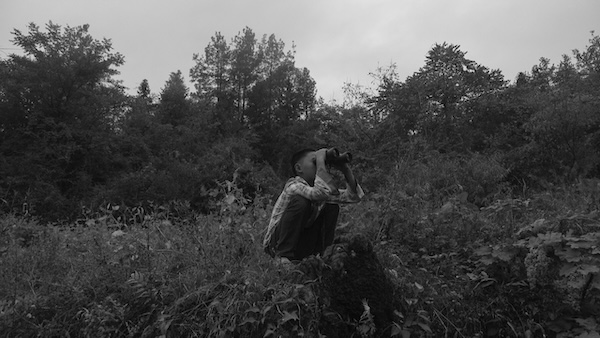
A scene from Deming Chen’s documentary Always. Photo: Camden Film Festival
In Deming Chen’s luminous and melancholy 从来 (Always) (2025; screens Sept. 12 at 1:30 p.m. at the Camden Opera House – Auditorium), Youbin Gong, an eight-year-old schoolboy in a hardscrabble village in China’s rural, mountainous Hunan province, dreams of being a poet.
Or perhaps, more accurately, he has poetic dreams – Wordsworthian reveries while walking across the woods, pastures, and riverbanks of his idyllic surroundings, watching birds or tending the fields or minding the family’s sad little bull. He turns these observations into poems that satisfy assignments given by his surprisingly enlightened teacher, whose class takes place in a one room schoolhouse. Chen then shares these poems in Chinese text on the screen and in recitations on the soundtrack.
They are gemlike and epiphanic, like Japanese haikus in their brevity and precision of image and like Zen koans in their arresting insight into life’s absurdity. They reflect an old soul, bemused and delighted but undeceived by the world’s transient beauty.
Gong’s family – his grandparents and his one-armed, feckless father (his mother abandoned him when he was an infant) – also has dreams, for the boy but also for the family’s prosperity. But his father has been unsuccessful in his investments in livestock, as crooks and animal diseases and his own incapacities (his mother later reflects, no wonder his wife left him) have sabotaged most of his ambitions.
Their investment in Gong’s future also flounders. A social worker visits them and promises to try to get the boy some resources to further his obvious talents. But he is no longer heard from, and it looks like Gong will suffer the same fate as his father and grandparents: a life of hard work and no reward.
Chen avoids overt editorializing. Any commentary is subtle, conveyed ironically. Grandmother notes that the bearded social worker who considers Gong’s case looks like Karl Marx; as it turns out, he is as reliable as the Communist prophet in fulfilling his rosy promises. A striking image of ants struggling to carry off the carcass of a moth hundreds of times bigger than themselves is intercut with a sequence in which Gong’s grandparents ineptly wrestle with an overloaded wheelbarrow. The insects seem to have the better deal.
And, in a film about dreamers, Chen’s style is luminously dreamlike. The first part of the film is shot in an opalescent monochrome in the squarish Academy 4:3 aspect ratio and the landscapes and interiors radiate with a visionary immanence. But when Chen returns five years later to record the fate of the now adolescent poet, the images are in widescreen and color, still shimmering and sublime but shrouded in gloom and foreboding.
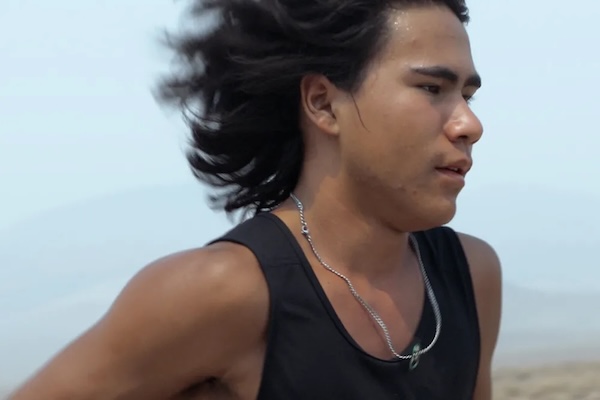
A scene from the documentary Remaining Native. Photo: Camden Film Festival
In the opening sequence of Paige Bethmann’s compelling and inspiring Remaining Native (2025; screens September 11 at 3:45 at the Strand Theatre, Rockland), Ku Stevens is racing relentlessly through the desert. In voiceover he relates his dreams of running – for his life.
A 17-year-old Native American Paiute living in a small, parched rural Nevada community, he stopped participating in tribal dances (glimpsed in home videos) to pursue his passion for cross-country running. A gifted athlete, he soon dominated the sport at the local level, but his dream of being accepted to the track mecca of the University of Oregon seemed to be only a remote possibility — unless he could compete in more prominent events. Unlike his father, who earned degrees and returned to the reservation to share his skills with his people, Ku wanted to escape the isolation and limitations of this community and experience the world outside.
The desire to escape is one Ku shares with his great-grandfather, who as an eight-year-old had been torn from his family and placed in a religious boarding school that sought to divest him of his Native American identity. Unwilling to let this happen, he repeatedly broke free and fled across the 50 miles of desert terrain until he finally succeeded in making it back home, where he would become a revered member of the community. Ku reflects on his predecessor’s ordeal in voiceover commentary, illustrated by archival images, as he trains for the meet that will determine his future.
At first Bethmann indulges in the conventional structure of a countdown to a crucial contest, but that device is complicated once a news report from Canada details the discovery of hundreds of unmarked graves at an Indian school (these events are examined in Julian Brave NoiseCat and Emily Kassie’s harrowing 2024 documentary Sugarcane). Subsequent investigations would reveal similar burials in US Indian schools, including the one that kidnapped Ku’s great -grandfather. This revelation will alter Ku’s goals and the film’s focus, ending in another kind of race, its triumph later clouded by Trump’s cancellation of funds set aside for recording the systematic abuses that took place at indigenous boarding schools.
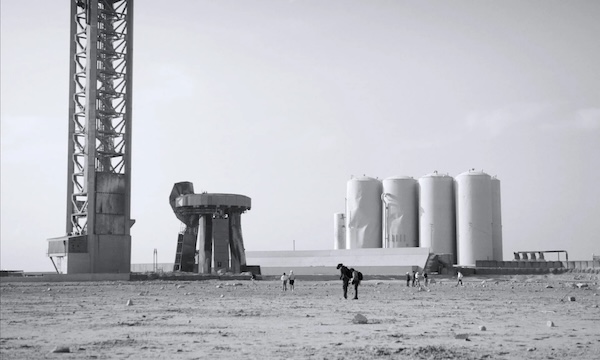
A scene from Julien Elie’s documentary Shifting Baselines. Photo: Camden Film Festival
No need to worry about lost funding for the dreamers in Julien Elie’s absurd and nightmarish Shifting Baselines (2025; screens Sept. 12 at 6:30 p.m. at the Strand Theatre, Rockland). Tawdry visionary Elon Musk has set up “Starbase,” his Space-X fiefdom, in Boca Chica, Texas, near the coast, next to the Mexican border, and in the midst of environmentally endangered habitats.
Devotees of the “Occupy Mars” movement flock there and Elie evokes early films of Erroll Morris like Vernon, Florida (1981) in her interviews with the characters. Smitten by the genius of their hero, they share his determination to relocate the human race to the Red Planet to escape the encroaching disaster engendered by oligarchs such as himself (one of the few remaining local residents comments, “I don’t know who’s going to Mars but I doubt if it’s those people”).
In tents and campers they line the beaches awaiting the next launch. The rockets tower over the salt flats and the drab company bungalows like giant, winged, silver phalluses. It is a dystopian, monochrome hellscape, reminiscent of some ’50s sci-fi movie. The “Mars or bust” fan brigade are undismayed when the launch is delayed and are not even fazed when it launches, soars into the sky, and blows up.
There are those who are not convinced, such as the environmentalist reduced to tears after witnessing the ruined habitat of endangered seabirds destroyed by the site. Or the scientists dismayed by the peril of space pollution posed by Musk’s proliferating, disposable infestation of satellites for his Starlink system.
Other recent documentaries have examined the obsession of billionaires to build spacecraft to escape the global mess created by their own rapacious excesses, including Rudolph Herzog’s skeptical Last Exit: Space (2022), in which his father Werner Herzog imagines Mars colonists “hunker[ed] down in radiation-proof bunkers enjoying drinks of recycled urine,” or Elizabeth Chai Vasarhelyi and Jimmy Chin’s more positive — but ultimately critical — Return to Space (2022). Elie’s film revisits the quest and reveals it in its deranged, surreal, lemming-like glory.
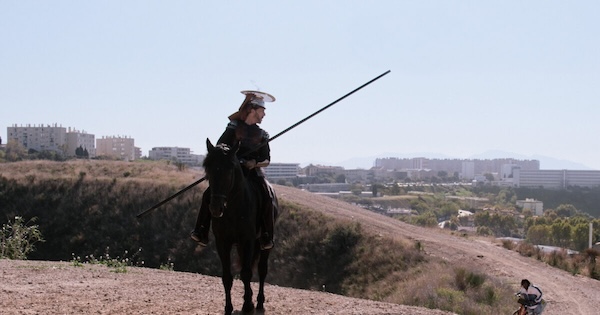
A scene from Gaspard Hirschi’s I am Night at Noonday. Photo: Camden Film Festival
Now we come to one of the most famous dreamers of all, Don Quixote, who in Gaspard Hirschi’s uneven but at times inspired I am Night at Noonday (2025; screens September 12 at 3:45 p.m. at the Strand Theatre). The figure is more Brechtian perhaps than quixotic here, more of a triste figura than the warbling picaro of the stage and movie production. Portrayed by suitably gaunt theater director, Manolo Bez, he wears the traditional DIY armor of cast-off welding mask, colander, and the like. He also bears a formidable-looking lance and rides a striking black charger. His Sancho Panza is a roly-poly pizza delivery guy on a moped; they meet in one of the film’s more amusing moments as the soon-to-be Sancho, demanding payment for his pizza, chases the circling knight on horseback.
That levity continues throughout, delivered with occasionally strained irony, as Don Q tours the gated communities of Marseilles, engages with cops whom he romanticizes into giants, confronts gangs of tormenting children who he sees as evil dwarves. A bemused bourgeois woman invites the wanna-be knight into her chateau — she becomes his Dulcinea. But his mission is to help the disenfranchised, the poor, and orphans and widows, which means the mood darkens when this crusader comes across a group of African refugees at a squatter settlement. Their tales of horror, torture, rape, and cruelty defy any chivalric fantasizing — an impossible dream confronts an intractable nightmare.
Peter Keough writes about film and other topics and has contributed to numerous publications. He was the film editor of the Boston Phoenix from 1989 to its demise in 2013 and has edited three books on film, most recently For Kids of All Ages: The National Society of Film Critics on Children’s Movies (Rowman & Littlefield, 2019).
Tagged: "I am Night at Noonday", "Remaining Native", "Shifting Baselines", "从来", Camden International Film Festival, Deming Chen, Gaspard Hirschi, Julien Elie