
Theater Review: “Deep Blue Sound” — The Everyday Tragedy of Inaction
By David Greenham
It’s likely, the playwright suggests, that Americans are incapable of getting out of their own way long enough to cooperate in ways that do anything about the challenges that we face as a society and a country, let alone the world.
Deep Blue Sound by Abe Koogler. Directed by Dave Register. Scenic design by Daniel Prosky, lighting design by SeifAllah Salotto-Cristobal, sound design by Seth Asa Sengel, costume design by Anya Criden-Clark, prop design by Adam Corriveau. Produced by the Portland Theater Festival and staged at the Baxter School for the Deaf on Mackworth Island, Falmouth, Maine, through September 14.
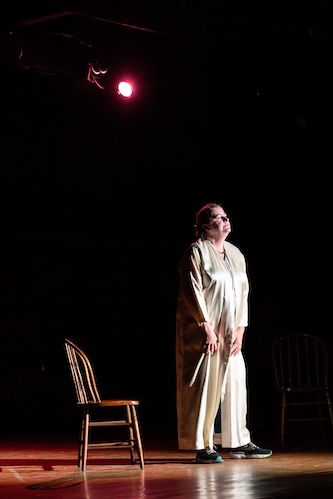
Moira Driscoll in Portland Theater Festival ‘s production of Deep Blue Sound. Photo: courtesy of PTF
These challenging times for the US and the world cry out for collaboration, cooperation, and teamwork. For years we’ve been told that the climate crisis is here, and that it will continue to change our lives and life on the planet in profound and disturbing ways. The grievous misdeeds of the current administration are generating protests nearly every weekend — on the left and the right — about a wobbling national trajectory. We all seem to agree: Something must be done! But nothing seems to happen.
Abe Koogler’s Drama Desk-nominated Deep Blue Sound is a response to this stalemate. The plot focuses on the residents of an unnamed island community in Washington’s Puget Sound. There’s Ella (Moira Driscoll), one of the island’s matriarchs, who is dying of cancer and has secretly scheduled her own final day. Her daughter Ali (Kathleen Lewis) has abandoned her quest to become a successful graphic designer in New York; she has returned home to support her mother during these final days. Annie (Courtny Cook), the popular director of the Humane Society, is interested in making the most of her year in the ceremonial post as the mayor of the town. Hardscrabble island native Mary (Sally Wood) works at being cynical and independent. Her ex-husband, Chris (Conor Riordan Martin), is a charming man-child determined to win Mary and their daughter back. Joy Mead (Kim Gordon) is the editor of the local paper. Leslie (Molly Bryant Roberts) is a horse groomer hoping to find romance via a pen pal. John (Dustin Tucker) is a quiet outsider and gardener who sells his flowers at Seattle’s Pike Place Market. Finally, there is the homeless Gary (Paul Haley), a figure of restlessness: he wanders the community carrying his chain saw, always ready to work on trees that need cutting.
All of these people agree that something must be done about a local crisis. The orca whales who used to gather each year in the waters close to the island have not shown up. The islanders loved to watch the creatures splash and play and, sometimes, jump. But this year they are MIA. The whales have not shown up, and “it’s unacceptable!”
The drama is structured through a series of short scenes featuring one, two, or three people. Koogler presents nuanced glimpses into the maddening behavior of characters who — like most of us — are apprehensive about the changes taking place in the world around us, but struggle to make them a priority over the events in their daily lives. The prosaic dominates all.
Deep Blue Sound is an unusual play because it manages to comment on the action at the same time that it presents the emotional arc of its characters. This is not a conventional narrative with a beginning, middle and end. It’s more of a painted canvas filled with splashes of color, fragments of stories that at times don’t reach a conclusion. The drama grabs you and then lets you go, apparently at the playwright’s whim.
This is not to say that the bewilderment doesn’t come with amusement. The silly and weird island stories that weave in and out of the narrative provide plenty of fun. For example, Edna St. Vincent Millay was an early settler on the island. No, not THAT Edna St. Vincent Millay. A different one. There’s a wolf sanctuary on the island that’s run by a strange woman named Star. No one really knows too much about the operation. They might not really be wolves, but the animals come from all over the world. Bob Hartman was an important island fixture. When he died, his dog ate him. Well, most of him. Bob was conservative and an asshole, the residents agree: “Two things that may or may not be related.”
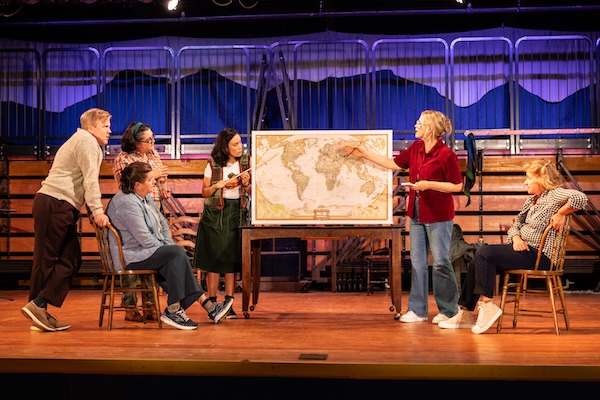
A scene featuring the cast of Portland Theater Festival’s Deep Blue Sound. Photo: courtesy of PTF
At its core, though, Deep Blue Sound reflects on the everyday complications in the lives of ordinary people – the quest for happiness, unrequited loves, the failure to communicate our feelings, the desire for something better, and the wish to be at peace. But that vision falls short of what we are called to do in this time of climate/political crisis.
Portland Theater Festival found an island for its performances: the gymnasium stage at Mackworth Island, just north of Portland. It’s home to the Baxter School for the Deaf. Set designer Daniel Prosky transformed the space, using sails to create a fabric-enclosed seating area. The raised stage is mostly open: it resembles a community meeting hall.
When the group of islanders assembles, it’s motivated by the problem of the missing whales. What should they do? They never get close to agreeing on a solution. When someone finally suggests that residents get a boat and go out on the water and look for the whales, Annie, the mayor, immediately ridicules the idea, dismissing it as the dumbest suggestion yet.
There’s an engaging, and revelatory, scene between friends John and Mary, who discuss the history of our past climate-related alarms as they inspect the limited stock of sunglasses at the local store. When was the ‘save the whales’ campaign? And what happened with that hole in the ozone layer? It was supposed to be dangerous? Was that fixed?
Joy Mead reaches out to a former lover who is a famous climate scientist in Germany. She learns that sea mammals are in trouble all over the world. It’s a distressing problem that’s way bigger than a few missing whales in Puget Sound. He points out that scientists have been warning us about this extinction for years and years. Joy, the newspaper editor, hears this and shouts, “Well, they should have been more insistent!”
The 90-minute Portland Theater Festival production is adroitly acted, but it only provides glimpses of the depth of character interactions that have become PTF’s trademark over their five years of producing eclectic and challenging works. But that makes sense here because, when it comes right down to it, the stories of the characters are beside Koogler’s point.
The playwright is serving up a critique that we are understandably reluctant to consider. These characters are too enmeshed in the clutter and chatter of their everyday lives. It’s likely, he suggests, that Americans are incapable of getting out of their own way long enough to cooperate in ways that do anything about the challenges that we face as a society and a country, let alone the world. These islanders can’t even find a unified way to deal with the plight of their beloved whales. And that’s the tragic takeaway. Any hope for our kids and grandkids depends on us working together and taking informed but extreme actions now. And it is not looking good.
David Greenham is an arts and culture consultant, adjunct lecturer on Drama at the University of Maine at Augusta, and is the former executive director of the Maine Arts Commission. He can be found at https://davidgreenham.com/