
Musician Interview: Pianist Marcus Roberts — How AI can Support Artists
By Steve Provizer
Pianist Marcus Roberts is aware of the artistic community’s criticism of AI, but maintains an attitude of optimism tempered by realism.
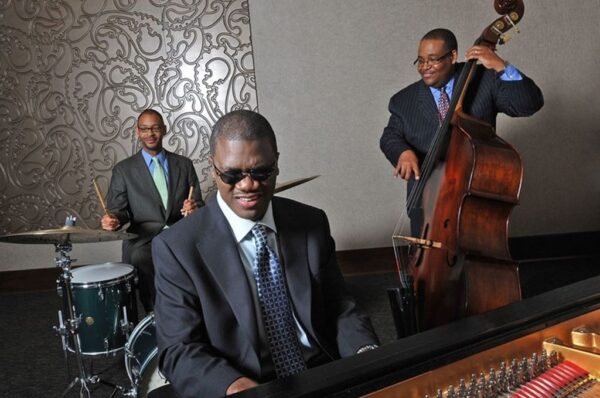
Marcus Roberts and his trio (drummer Jason Marsalis and bassist Rodney Jordan). Photo: courtesy of the artist
I have been no friend of AI, as you can see here and here. I’ve had some positive things to say about the potential use of AI in medicine and science, but I’ve found its effects on the arts to be particularly egregious: AI is fed by Large Language Models that gobble up work without recompense; AI-composed songs flood streaming services; and the technology threatens to erode the incomes and ultimately to displace and replace artists, musicians, and writers.
However, in a recent conversation with pianist Marcus Roberts, the way in which AI can positively serve artists was made powerfully clear. Roberts is blind, and the benefits of technology, including AI, have greatly expanded his creative options.
If you don’t know Roberts’s work, he’s a top tier jazz pianist and composer. He initially came into the spotlight at age 21 when asked to join the band of Wynton Marsalis, with whom he continued to play for about seven years. His first piano concerto, Spirit of the Blues: Piano Concerto in C Minor was commissioned by The Savannah Music Festival and performed by the Atlanta Symphony Orchestra. He has performed as a soloist in symphony orchestras with Marin Alsop and Seiji Ozawa.
In 2012, Roberts founded The Modern Jazz Generation, a touring and recording group with 12 musicians and an expansive musical repertoire. This impressive eclecticism reflects Roberts’s own — his playing draws on the complete history of jazz piano, in a way reminiscent of Jaki Byard. He’s on the faculty at Florida State University and has served as associate artistic director for the Savannah Music Festival and director of the annual Swing Central high school band competition.
Clearly, this is not a man who has let his blindness impede his travels through the world. His parents instilled in him to reject self-pity and assert independence. At age 85 his mother, also blind, continues to run her own household.
Roberts told me that he has been utilizing technology since he learned Braille as a young boy. He noted that the first system Louis Braille devised was actually for music, not for words. Braille was an organist and wanted access to scores. Roberts went to Florida School for the Deaf and the Blind in St. Augustine, Florida, and was the go-to guy to test new technologies, such as the Optacon, which can read raised print letters. He also took up ham radio and learned Morse Code.
 Roberts bought all the newest recording machines as they were made available. When he attended Florida State University he bought a Sony WDM6 recorder and taped all his classes. At home, he wrote out all the lectures in Braille and — despite not buying one textbook — he came out with a 3.8 GPA.
Then, when CD players were released, he said “I was all over that.… Transcribing solos became a lot easier.” (He told me a story about vibist Milt Jackson telling him that he could hear Charlie Parker, go home, and play his solos back from memory).
In 1997, performing with Seiji Ozawa, Roberts had a conversation with a blind violin player who told the pianist about a machine called the Braille Lite 40. “It changed my life,” Roberts recalls. “I could write things down. I felt literate again…. It has a Braille keyboard and a display and you could read and scroll on it, you could access documents, check email, and use a calendar. It allowed us to store a huge amount of data on a small machine. Now 25 years later, the one I have is the Braille Sense 6 Mini by the company HIMS. You can download apps on it, use Excel spreadsheets, do podcasting, use ChatGPT.” Roberts helps the technology evolve by serving on a Beta committee that gives feedback to the company.
Roberts manages recording and editing with the assistance of his studio’s DANTE recording setup, where audio can be routed or panned anywhere. Once all the wires are in place, you can use software to send signals anywhere. There are all kinds of plug-ins available. The blind community came up with one called OSARA, which allows blind people to access information from meters and faders. Another plug-in enables Roberts to converse on Zoom and bring high audio content into the meeting.
In fact, Roberts says he doesn’t need a sighted engineer to run a recording or editing session. In a way, everything the pianist does advocates for the blind community. But Roberts is concerned about the fact that the literacy rate of blind children is only 10%. This is something he says the sighted community would never put up with. “People are very comfortable deciding what your capacity is to know things, or learn things,” Roberts explained. “It’s how people look at disability in this country, as something to be afraid of. Instead of viewing it as an obstacle in the sense that somebody might be an alcoholic, have a gambling problem or other illnesses that you can’t see that they struggle with every day.”
Roberts recently received a grant from the Doris Duke Performing Arts Technology Lab and he is using it to focus on a particular issue: “My big thing is to figure out a way to reduce latency online. That’s what we’ve been working on.…If you have musicians in different cities, how can they play together without the problem of latency.” He has a team of programmers trying to come up with an inexpensive step-by-step process to get latency below 40 milliseconds, the maximum lag you can have to avoid problems.
Roberts is aware of the criticism of AI, but maintains an attitude of optimism tempered by realism: “I think music has to come from the body, from us. The danger with AI is if it gets to the point where it replaces people, what are we doing? If we devalue the value of human discovery, we’re in trouble. Don’t forget, Chat GPT doesn’t know anything…. If they do get to General AI, thousands of times smarter than us, the first thing it’s gonna determine is ‘we don’t need you.’ I think they need to slow down with that. What if the hammer decides it’s gonna hammer you.”
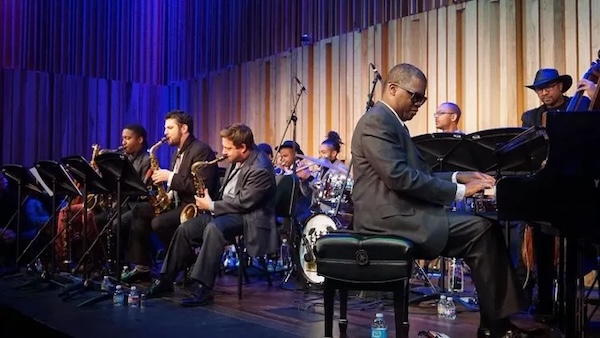
Marcus Roberts and his 11-piece band The Modern Jazz Generation performing in 2022. Photo: courtesy of the artist
Will working with AI change Roberts’s music? His response:
Technology makes it a more even playing field. I think it only changes my music because hopefully it will be easier to do, it’ll be cheaper to rehearse and record and will allow us to explore more music more quickly…. Technology is always just an automated process. If we lose the manual process, technology does us no good. You can use a cheap AI tool to find weird parts of a frequency and clean up or isolate tracks. But it still comes down to what comes out of the microphone, so we can have all these tools, but the ability to play is still gonna be important. I’m a piano player. I practice. I want to become better at manually playing the piano. People need to base their use of AI on helping them learn and understand more so they can do better work.
I still believe in unity. Jazz music has taught us that for me to sound good, I gotta make other people sound good…. It forces us, even if we’re in a disagreeable state emotionally towards each other, the music forces us to get over that-at least for the next hour…
Roberts shows that AI can be mobilized positively, but the race to implementation inevitably circumscribes the constructive possibilities. One artist may be helped; many others will be harmed. Considering the issue in a moral/aesthetic context, rather than admiring AI as wealth-creation, needs to happen more often. Roberts models how this much-needed conversation can take place: “As Dr. King said, you want people’s moral compass to always be ahead of the technology. And if the technology transcends your moral compass, that’s when bad things happen.”
Steve Provizer writes on a range of subjects, most often the arts. He is a musician and blogs about jazz here.
Tagged: AI, Doris Duke Performing Arts Technology Lab, Marcus Roberts