
Concert Review: Boston Landmarks Orchestra Closes Its Season with Its First Ever Performance of Mahler’s First Symphony
By Aaron Keebaugh
The Boston Landmarks Orchestra offered a rousing valediction for a summer season drawing to a close.
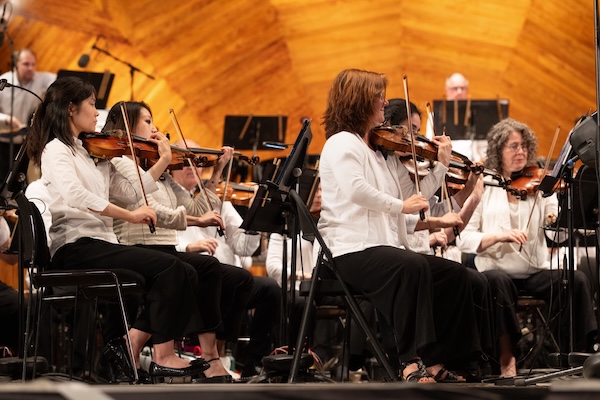
The string section of the Boston Landmarks Orchestra in action. Photo: Michael Dwyer
Many of Boston’s orchestras program the music of Gustav Mahler so frequently that it is rare to go a full season without hearing one of the composer’s world-embracing canvases in sound. But, despite the familiarity, some performances still bring surprises. The city’s finest Mahler typically comes from the Boston Symphony Orchestra and Boston Philharmonic, each featuring conductors who interpret this music in vastly different ways.
Last Wednesday at the DCR Hatch Shell, conductor Christopher Wilkins and the Boston Landmarks Orchestra joined that august company by performing Mahler’s Symphony No. 1 for the first time in the ensemble’s 25-year history. The symphony’s sunlit textures and rousing fanfares concluded the summer season in the same way these musicians rang it in: with bold colors.
Though the First Symphony is the shortest of his nine symphonies, Mahler crafted it on a large scale. Spanning nearly an hour, the score combines disparate elements that, meshed together, pose challenges for any conductor. The ingredients include klezmer tunes, funeral marches, military bugle calls, and quotations from the composer’s Songs of a Wayfarer. Some conductors choose to lean into the music’s abrupt shifts in mood, and that brings varying results. The most successful performances knit together Mahler’s eclectic mix with a clear vision of the overall seismic tension and teleological force of the work.
Christopher Wilkins’s vivid performance fell into the latter category. His bold gestures set the air spinning with a vibrancy that was felt palpably throughout, from the spare opening octave and the gradually flowering melodies to bursts of brass fanfares. His well-judged tempos permitted the music to languish as much as storm forward. The opening phrases hung in the air like mist. Woodwinds and strings allowed for the strains of “Ging heut’ Morgen über’s Feld” to blossom beautifully.
But this was no naive romp through the tulips. At times, the sections of the orchestra collided, and the explosions were seismic. In the robust passages, the brass cut through the string tremolos with bold assurance. The Ländler lilted, and Wilkins’s generous rubatos encouraged the lines of the Trio to rise and fall like turbulent waves. The central theme of the third movement, with its klezmer overtones, lurched forward with restive glee.
In the finale, Wilkins’s brisk tempos generated rapt intensity. The orchestral sound grew into an inspiring blaze, with the brass taking on a raspy edge. The brightly simmering approach paid off with a final burst of energy. Mahler’s symphonies are multidimensional worlds: this musical voyage explored both the noble and the bawdy through an adroit balance of tasteful irreverence and warm reflection.
In tandem with the Mahler, Ravel’s Second Suite from Daphnis et Chloé basked in lush serenity as well as spirits wild enough for a party. Composed in 1912 for the Ballets Russes, this score appears soft and sumptuous on the surface — yet it packs a punch.
Wilkins invoked the music’s natural beauties through surging bass lines and delicate washes of orchestral color. Winds rippled with zesty effervescence. The flute solo in the Pantomime sounded as clear as spring water. The brass collaborated with full, rosy tones that conjured up images of an Arcadian wilderness. Everything broke loose in the Danse générale, which swelled to a raucous bacchanal.
The concert opened with Zhou Tian’s The Mighty River Runs Eastward. This brief score is the fourth movement of Broken Ink, which commemorates the cultural heritage of the composer’s hometown of Hangzhou in China. An ode to nature as well as history, the music takes its inspiration from Song Dynasty poetry. The Mighty River Runs Eastward interweaves a meditation on the Battle of Red Cliffs during the Three Kingdoms period with a boat journey down the Yangtze.
From the opening percussive barrage to a rush of scattered wind figures, The Mighty River seems tailor made to be a vibrant curtain-raiser. The music was a perfect fit for an outdoor celebration, serving as a rousing valediction for a summer season drawing to its close.
Aaron Keebaugh has been a classical music critic in Boston since 2012. His work has been featured in the Musical Times, Corymbus, Boston Classical Review, Early Music America, and BBC Radio 3. A musicologist, he teaches at North Shore Community College in both Danvers and Lynn.
Tagged: Boston Landmarks Orchestra, Christopher Wilkins