
Concert Review: Boston Landmarks Orchestra Explores Revolutions in Sound
By Aaron Keebaugh
The point was made: this was not merely a revolt, but a revolution in sound.
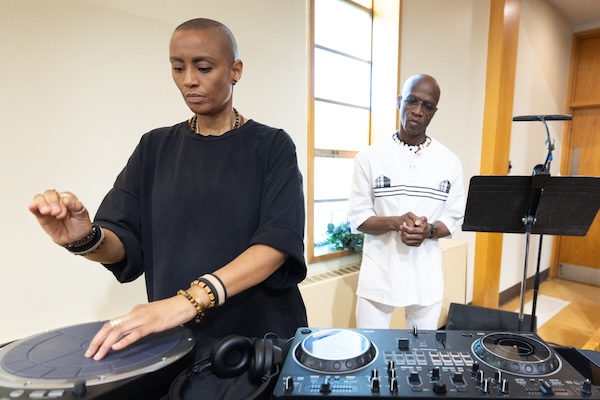
“Sound chemist” Val Jeanty and Jean Dany Joachim performing with the Boston Landmarks Orchestra in Roxbury. Photo: Michael Dwyer
“It is a big revolt,” King Louis XVI exclaimed after the fall of the Bastille in 1789.
“No Sir,” answered François de la Rochefoucauld, “a big revolution.”
The events that followed shook France to its very foundations and went on to set Europe and the Atlantic world ablaze with a passion for radical political change. In the Americas, nowhere were the winds of revolution blowing more strongly than in Saint-Domingue where, following more than a century of violent oppression, enslaved Blacks rose up against their cruel white masters. That revolution led to the first Black republic in the western hemisphere. Since then, Haiti has stood as a nation forged in the fires ignited by the French ideals of liberty, equality, and fraternity.
The French and Haitian revolutions were the sites of bloody struggle, and memories of their shared conflicts and values live in musical works that pair rousing fervor with intimations of lingering dissatisfaction. Among like-minded composers, Beethoven famously etched in sound his hopes for a better future driven by fraternal relationships and lofty idealism. The allure of those sentiments continues to ring true in our own troubled century, when new voices have emerged to cry out with fury at the persistence of global injustice and inequality. Val Jeanty, a Haitian-born American composer — and self-described “sound chemist” — wrestles with the contradiction between things as they are and what many hope they could become. Paired alongside Beethoven’s “Eroica” Symphony, her music resonates with the same explosive power. At least that is the conclusion I came to at Twelfth Baptist Church in Roxbury last Thursday, where conductor Christopher Wilkins and the Boston Landmarks Orchestra evoked the musical fires of revolutionary spirit via music by Beethoven and Jeanty, among others.
Jeanty’s sonic art is a heady mix of the old and the new. She weaves together music from the African-Haitian tradition, drawing on electronics to craft throbbing blocks of sound, which she calls “Afro-Electronica.” One example played on Thursday was Faces, an electronic sampling of speeches that call for the utter destruction of slavery and racism. Over the sounds of scattered pulses and haunted scratches could be heard shrieks, soaring cries for liberation. This made for an ironic pairing that symbolizes, at least to my ears, the generational trauma brought on by slavery and the rise of an undying opposition.
Faces served as the centerpiece of a Haitian-themed suite that was bookended by Occide Jeanty’s Quand nos Aïeux brisèrent leur entraves, once the Haitian national anthem, and the traditional song Kote Moun Yo (Where are the People). Occide Jeanty was Val Jeanty’s great uncle, and his rousing march is accompanied by a poem about the lush vistas of contemporary Haiti. That piece transitioned seamlessly into Faces, which gave way to Kote Moun Yo, which broke out like a mantra, a reminder that oppressive systems can’t always hold.
Thursday’s performance handled all Jeanty’s demands with vibrant colors. Vocalist Solaya’s voice glowed like an aura around Jeanty’s electronic soundscape. Guest percussionists underscored the infectious energy of the music’s rhythms. Wilkins led the orchestra in an accompaniment that only further amplified the assembly’s verve and grit.
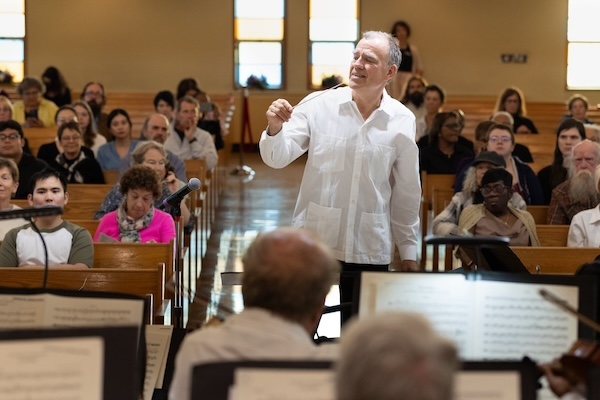
Christopher Wilkins conducting the Boston Landmarks Orchestra in Roxbury. Photo: Michael Dwyer
Memories of revolutionary yearnings remain strong in Beethoven’s Symphony No. 3, “Eroica,” which filled out the program’s second half. Completed in 1804, months after Napoleon declared himself Emperor, the “Eroica” eschews imperial glory in favor of the fiery beliefs in common justice that the composer believed would unite all people.
Wilkins led a fleet performance driven by quick tempos and judicious cuts to the first movement’s exposition repeat. That approach meant that the second movement’s funeral march lacked much of its customary grandeur and gravity, but the other movements made up for it with the crackle of an immediacy that felt like an electric shock. The conductor’s insistence on momentum helped the music build to satisfying heights. On top of that, along the way he drew out details in the piece that are often overlooked, such as the rising horn arpeggios in the Allegro con brio. The piquant oboe, flute, and clarinet solos also emerged from the texture, sounding brightly before falling away. The Scherzo percolated, the horns contributing particularly rousing cries in the Trio. Everything built to a din in the finale, which brought the audience to its feet.
The concert opened with Beethoven’s Coriolan Overture and Romance No. 1 in G, Op. 40, which turned the spotlight on violinist Adrian Anantawan.
Critics and historians alike have referenced the Romance as Beethoven’s brightest example of “absolute melody.” And Anantawan made each line sing fervently. His weighty tone, imbued with a touch of grain, accented each line with a rustic flair, set off by pristine double and triple stops.
In the Coriolan Overture, Wilkins again revelled in nuance. Accents struck like thunderclaps, setting the stage for the wild play between darkness and light. Tension bubbled along the lively surface with compelling ferocity. The point was made: this was not merely a revolt, but a revolution in sound.
Aaron Keebaugh has been a classical music critic in Boston since 2012. His work has been featured in the Musical Times, Corymbus, Boston Classical Review, Early Music America, and BBC Radio 3. A musicologist, he teaches at North Shore Community College in both Danvers and Lynn.
Tagged: Adrian Anantawan, Boston Landmarks Orchestra, Christopher Wilkins