
Film Review: Killing Time with Talk — Olivier Assayas’s “Suspended Time”
By David D’Arcy
If life among these four characters risks being so monotonous over the course of an hour and 45 minutes, just imagine what it must have been like to endure months of lockdown before a vaccine became available.
Suspended Time, directed by Olivier Assayas.
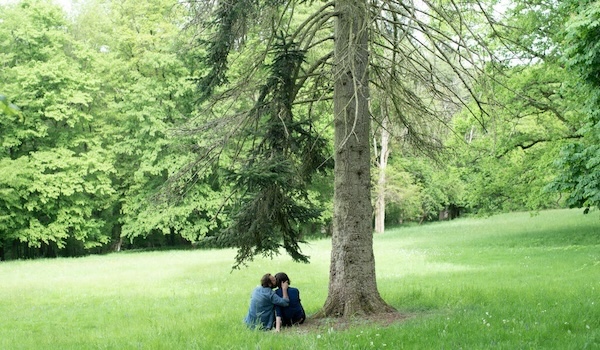
A scene from Suspended Time. Photo: Film at Lincoln Center
Everyone has Covid stories, including Olivier Assayas, who made some of his into Suspended Time, an evocation of everydayness dramatized in the lives of a quartet of characters during the early stages of the pandemic.
Suspended Time (Hors du Temps, or “Outside of Time” in French) watches two couples in middle-age, bohemian enough in behavior to seem younger, as they wait Covid out, trying to tolerate each other in a comfortable house located in the valley of the Chevreuse, southwest of Paris. It’s a life that is privileged enough. Their only real discomforts come from the chafing of the two brothers under strict public health rules. Think of Jean-Paul Sartre’s play No Exit, a version of Hell in which three characters are stuck in one room for eternity. At least in that existential drama, the characters had to die to get there. In Suspended Time, the only casualty turns out to be an expensive saucepan, delivered by Amazon, which is burned after someone decrees that the strawberries in it should not be stirred.
The film premiered at the Berlin International Film Festival in February 2024, well after Covid had subsided as a risk for most of us. It is opening in the US at a time when far greater risks are facing us all — in the form of a health autocrat who doesn’t believe in the vaccine that made most of us safe from Covid. The delay in the opening of the film here is anything but shrewd marketing. At this time, our memories of the torturous Covid lockdown are about as marketable as a Joe Biden highlight reel.
There is a bit of a sitcom quality to Suspended Time. Bearded and paunchy Paul Berger (Vincent Macaigne) is a neurotic, self-involved film journalist and filmmaker (an Assayas stand-in), obsessed with following all the emergency rules. He’s stuck in his family’s country house with his brother Etienne (Micha Lescot), a music journalist with the styled untamed hair to prove it. Etienne follows his own rules as they suit him, which in his case means that when he whisks batter for crepes he ends up violating a regulation as he eats them. Thus the kitchen becomes the terrain where the brothers clash. Meanwhile, Paul seems to be receiving a package from Amazon a day. Etienne scolds him for supporting a corporation that abuses its workers and threatens small businesses with extinction.
Stripping off his clothes and then dutifully washing them after he picks up groceries, Paul faults Etienne for purposefully violating Covid protocols. At one point, their respective girlfriends, Morgane (Nine d’Urso) and Carole (Nora Hamzawi), appear. They are also sheltering in the house, and tensions subside as Paul and Etienne rhapsodize about old times. No drunken fistfights spike the mealtime drama.
Another character, the auteur himself, comes in a voice-over by Paul (it is the voice of Assayas himself), which is filled with film allusions. The tiny hamlet where the quartet are staying was once rural: it is now filled with weekend homes (pavillons). This is not a trip into the authenticity of la France profonde. Paul knows none of the new weekenders, but he is familiar with the trees and meadows from his childhood, and the rudimentary tennis court where he hits the ball back and forth with Morgane. Their Covid refuge (or prison) is lushly verdant as seen through the camera of Eric Gautier (Irma Vep, Motorcycle Diaries, Into the Wild), whose deft reaction shots bring life — and even some laughs — to isolated existences sustained by talk. Gautier ensures that this talkathon of a home movie doesn’t look like one.
Suspended Time has its charming moments. Paul is a likable neurotic who has to deal with a phone-in therapist and drive-by visits with his precocious daughter, whom he shares with his peevish ex, played by Maud Wyler. As young Britt, the adorable Magdalena Lafont knows how to wring whatever she wants out of her father. She’s a delight, but there are plenty of characters like this on YouTube.
Perhaps Assayas is suggesting one serious point, though obliquely. If life among these four risks being so monotonous over the course of an hour and 45 minutes, imagine what it must have been like to endure months of lockdown, before a vaccine became available. Assayas’s fans, as some positive reviews suggest, are welcoming this tepid twist on the memoir genre.
But, if you’re confident that the vaccines which eventually controlled Covid put an end to most Covid movies, don’t be.
At the US Department of Health and Human Services, recognized authorities in epidemiology have been fired, while new managers question warnings about excessive sun exposure (why worry about cancer?), and vaccines that worked miraculously have lost government support. Here are all the makings of a bona fide horror movie: “The Return of Covid – a True Story.”
Don’t expect that film to be dull. Plenty of now-jobless government employees may be begging for work as extras.
We can also expect more from Assayas, and soon. His latest, The Wizard of the Kremlin, based on the 2022 hit novel by Giuliano da Empoli (Arts Fuse commentary), stars Jude Law as an ambitious KGB agent called the Tsar and Paul Dano as his media guru — who spills the beans. Once again, the timing of the film’s release might not be the best for a Putin prequel. On top of that, the film, in English, adapted from a novel about Russia written in French by a Swiss Italian, has been attacked as too favorable to its war criminal protagonist. Don’t be surprised if Assayas’s movie is eclipsed by its subject.
David D’Arcy lives in New York. For years, he was a programmer for the Haifa International Film Festival in Israel. He writes about art for many publications, including the Art Newspaper. He produced and co-wrote the documentary Portrait of Wally (2012), about the fight over a Nazi-looted painting found at the Museum of Modern Art in Manhattan.