
Concert Review: The Mercury Orchestra Goes Down Memory Lane
By Aaron Keebaugh
The Mercury Orchestra explored nostalgia, via performances of rare Finzi and familiar Respighi compositions.
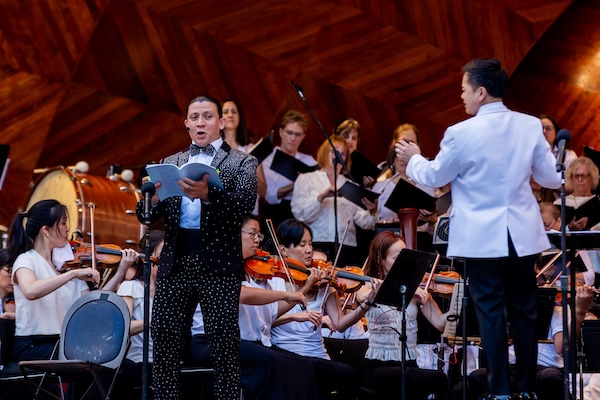
Tenor David Rivera Bozón performing with the Mercury Orchestra, conducted by Channing Yu. Photo: Taylor Rossi
“We will grieve not, rather find/ Strength in what remains behind.”
So wrote William Wordsworth near the end of his Ode: Intimations of Immortality from Recollections of Early Childhood, a poem about the gradual disappearance of youthful wonder and excitement. The lyric ends on a hopeful, rather than melancholic, note. While our initial experiences of the beauties of flowers, trees, and all that is good and green may fade, memories remain strong in old age. Reflection, he says, encourages deeper connections with those surviving. And memories can engender joy.
That powerful note of optimism may have led English composer Gerald Finzi to set Wordsworth’s ode to music. But while the poet expressed hope, Finzi emphasized resignation. His Intimations of Immortality, scored for tenor, chorus, and orchestra, poses questions about past happiness and the inevitable loss that follows. In a rare performance at the DCR Hatch Shell on Wednesday, conductor Channing Yu, the Mercury Orchestra, and New World Chorale dramatized the work’s dark undercurrent: memories may linger, but joy is fleeting.
Intimations of Immortality was one of the most significant scores to come from the pen of a composer who maintained a lifelong affinity for expressing the interiority envisioned by poets like Wordsworth, Christina Rossetti, and Thomas Hardy. Setting Wordsworth’s ode was no simple task. Finzi worked on the piece for 16 years, completing it just in time for its premiere in September 1950. By then, the popularity of the English choral tradition had waned. Large-scale works by Hubert Parry, Charles Villiers Stanford, and even Ralph Vaughan Williams felt like old-world relics compared with the thorny new canvases of Benjamin Britten.
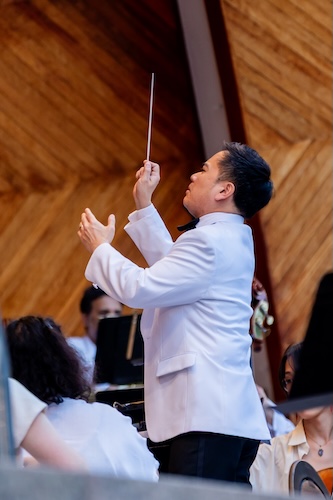
Channing Yu conducting the Mercury Orchestra. Photo: Taylor Rossi
Yet Finzi’s Intimations of Immortality resonates with subtle power, fusing the deep mysteries evoked by Gustav Holst’s Hymn of Jesus with the glittering orchestral colors of William Walton’s Belshazzar’s Feast. Finzi’s style mostly closely resembles that of Vaughan Williams. His harmonies hover in the air like clouds, creating a hazy stasis. Yet there is a strong narrative arc, driven by the indelible imagery of Wordsworth’s verse. The chorus carries much of the text; the tenor takes on the role of narrator, describing and reflecting on the themes of early wonder and late nostalgia. The orchestra bathes it all in gentle shades of light and shadow, with frequent bursts of exuberance popping up.
But the emotional fireworks fade by the end. Rather than lean into Wordsworth’s optimism, the music yearns for flickers of illumination — it feels like the last gasp of Romantic aspiration. This curious melancholy may reflect the composer’s personal tribulations. Finzi’s childhood was troubled; he lost his father and three siblings at a young age. Whether the deaths were on his mind as he composed Intimations of Immortality remains unknown. But I hear a world-weary gravity creeping into the final bars. Enduring joy, the music suggests, lies just out of reach.
Conductor Channing Yu used broad strokes to convey this compelling tension. The opening unfolded in dark tones that gave way to sudden cries of woodwinds and brass. Tenor David Rivera Bozón captured the extremes between Wordsworth’s warmth and Finzi’s frosty desolation. His clarion voice was as fierce and moving as that of a country preacher. But he adroitly softened his high notes with arresting intimacy to reveal the pain of loss. The sound of the New World Chorale, prepared by Holly MacEwen Krafka, was spotty during the delicate moments, but they erupted with splendor when the music surged.
And some of those moments were rousingly moving. “Sing a joyous song” teetered in gleeful romps. “We will grieve not” glowed with whispered assurance. The concluding prayer of thanksgiving, underscored by groaning basses and muted brass, captured apt notes of complicating dispossession.
The second half of the program featured the orchestra performing Ottorino Respighi’s Pines of Rome. Completed in 1924, this colorful score takes listeners on a vivid tour through the Roman past and present. Like Wordsworth, Respighi revels in the joys of childhood. The opening “Pines of the Villa Borghese” depicts children playing joyfully in the gardens. But, rather than ruminating on loss, the ensuing movements reach back to past glories, first by way of catacombs and the Janiculum, then by way of images of a Roman legion marching down the Appian Way.
If Yu’s plodding tempo didn’t quite allow the lines of “Villa Borghese” to sparkle fully, he proved to be a careful guide to the weight and liquidity of the remaining movements. Winds and strings in the “Pines on the Janiculum Hill” rippled like water from a fountain. “Pines of the Appian Way” built steadily to triumphant heights. Along the way, solo clarinetist Raymond Lam, offstage trumpeter Karen Martin, oboist Veronica Kenney, and cellist Aster Zhang added the details that make up this portrait of historic grandeur. Memories of the past may never have lost their pain for Finzi. But for Respighi, they were the very stuff on which legends are made.
Aaron Keebaugh has been a classical music critic in Boston since 2012. His work has been featured in the Musical Times, Corymbus, Boston Classical Review, Early Music America, and BBC Radio 3. A musicologist, he teaches at North Shore Community College in both Danvers and Lynn.
Tagged: Channing Yu, David Rivera Bozón, Mercury Orchestra
David Rivera is a great young tenor, who sings with his heart, touching the audience heart and soul… Great job David…keep going…the best Is jet to come ..