
Book Review: “A Day Like Any Other: The Life of James Schuyler” — A Hymn to Life
By Michael Londra
As befits a prolific and distinguished poet, renowned for his visionary instincts and signature compositional technique, Nathan Kernan has produced an account of James Schuyler that is as morally serious as his subject.
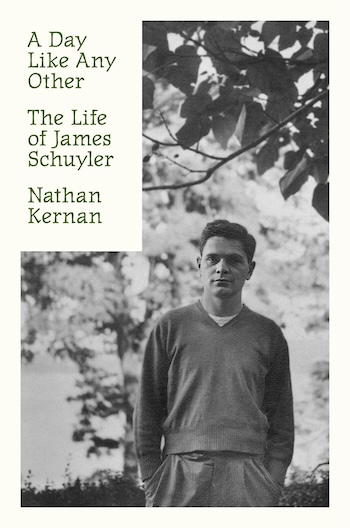
A Day Like Any Other: The Life of James Schuyler by Nathan Kernan. Farrar Straus Giroux, 512 pp, $40
 Oscar Wilde quipped that biography “lends to death a new terror.” James Joyce agreed, ridiculing biographers in Finnegans Wake as “biografiends.” It is ironic that fate teamed them with Richard Ellmann. His James Joyce and Oscar Wilde established the Oxford University professor as the preeminent literary biographer of his era.
Joyce and Wilde’s dread of “biografiends,” however, was not entirely misplaced. The genre is replete with sensationalists. One culprit might be James Atlas. A protégé of Ellmann at Oxford, Atlas authored Delmore Schwartz: The Life of an American Poet — a narrative that foregrounds “Crazy Delmore” mythmaking. Instead of rejuvenating interest in Schwartz’s poetry, Atlas dismissed him as a “failure,” undermining his legacy. As a result, Schwartz’s achievement remains neglected, his mentorship of the New York School of Poets largely unexamined. The fact is, Schwartz inspired John Ashbery to apply to Harvard, taught Kenneth Koch there, and handed Frank O’Hara his professional poetic debut in Partisan Review. Unlike Atlas, Brad Gooch’s City Poet: The Life and Times of Frank O’Hara assesses O’Hara’s life and work objectively. Indeed, the New York School has fared well in the biography department. Alongside Gooch, there is Karin Roffman’s The Songs We Know Best: John Ashbery’s Early Life, and David Lehman’s The Last Avant-Garde: The Making of the New York School of Poets. These chronicles excite readers to discover the poems that sparked the biographies in the first place.
Likewise, Nathan Kernan’s A Day Like Any Other: The Life of James Schuyler, the first book-length treatment of one of last century’s most enigmatic literary artists. In his lifetime, James Schuyler (1923-1991) published five major poetry collections, two novels, and collaborated on a third with John Ashbery. Recipient of the Pulitzer Prize for Poetry in 1981, Schuyler was a Guggenheim Fellow, and a member of the American Academy of Poets. After his death, caches of diaries, letters, and journals were published to critical acclaim.
As befits a prolific and distinguished poet, renowned for his visionary instincts and signature compositional technique, Kernan has produced an account as morally serious as his subject. The biographer tells it plain. Scrutinizing every facet of Schuyler’s life — sexual, psychological, financial, emotional — he unearths the truth without voyeuristically luxuriating in melodrama. Still, calling Schuyler “Jimmy,” as Kernan does, requires getting used to. Perhaps it brings us closer to Schuyler. But the repetition can be jarring, occasionally disturbing the spell of an otherwise elegant narrative.
Kernan’s title derives from the last line in Schuyler’s poem “February:”
I can’t get over
how it all works together…
It’s the shape of the tulip.
It’s the water in the drinking glass the tulips are in.
It’s a day like any other.
Known for poetry that imbues the mundane with transcendence, Schuyler’s reputation rests on his ability to elevate quotidian minutiae into radiant universality. In “February,” he achieves this spiritual transformation by readjusting our perceptions. By the time we get to the end of the poem, it is apparent that everything in the world “works together,” miraculously. The phrase “a day like any other” loses its casual meaning of boring routine. Instead, it is infused with a sense of wonder. Each day is a day like any other — suffused with luminous marvels. Kernan meets the challenge of parsing the work’s complex philosophical ideas and attitudes, illuminating how “lively details, anecdotes, and sense impressions” combine to energize Schuyler’s process: “With ‘February,’ Jimmy comes to a conscious recognition of the poetic territory that was his … free verse put to the service of careful and fluent observation in real time.”
Tackling Schuyler’s life, Kernan is similarly insightful. Born in Chicago, the writer’s parents divorced when he was six. In seventh grade, he met Bernie, “his first real … queer soulmate,” who “helped [Schuyler] to be relatively comfortable with his homosexuality as he began to recognize it in himself.” Contrary to his colleagues in the New York School, Schuyler did not go to glamorous Harvard. After bailing on West Virginia’s very blah Bethany College, he joined the Allied effort, enlisting in the Navy in 1942. Twelve months later he went AWOL. Held in military prison, Schuyler was released only after signing a document proclaiming “I hereby admit that I am a homosexual and of no use to the U.S. Naval Service.” Schuyler then secured digs in Manhattan, where he met W.H. Auden, who needed someone to type up his poems. Accepting, Schuyler joined Auden and his partner Chester Kallman in Italy for four years, enjoying “poetry, opera, cooking, and sex, not necessarily in that order.”
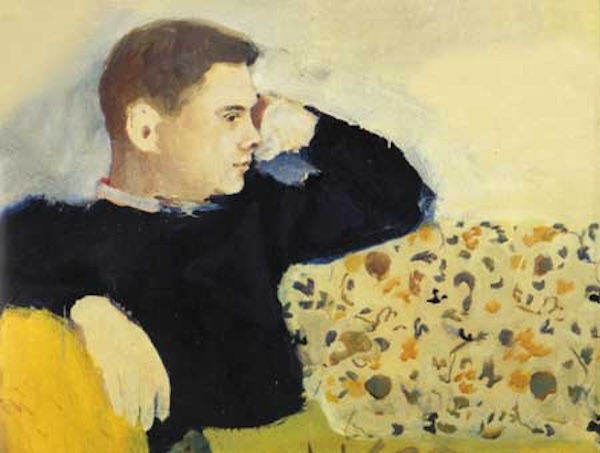
James Schuyler, painted by Fairfield Porter
Returning to Manhattan in 1951, Schuyler scored an invite to a party for Larry Rivers, where he was introduced to Frank O’Hara and John Ashbery. Enchanted by O’Hara’s exuberance, Schuyler gushed that O’Hara’s conversation was “full of invisible italics.” Kernan notes how it was O’Hara and Ashbery’s comradely blessing that gave Schuyler the confidence to finish his first poem, written after Schuyler’s initial hospitalization for “schizoaffective disorder.” In fact, as the writer’s mental health issues worsened, he became increasingly dependent on his friends for money and accommodation. Kernan quotes Kynaston McShine: “[Schuyler] had a real talent for being taken care of, and finding people to take care of him.” Kernan adds that the poet “idealized family life,” cultivating “stable surrogate families to attach himself to in one way or another,” such as painter Fairfield Porter’s. Schuyler ensconced himself within the Porter household from 1961 to 1973. Porter’s wife Anne characterized that time as “Jimmy came for the weekend and stayed for eleven years.” Porter was in love with Schuyler, painting portraits of him over and over again. Eventually, he was asked to leave. Schuyler’s response, “I’ll think about it,” augured his presence for an additional three years. Departing at last, Schuyler holed up at the Chelsea Hotel. Addicted to drugs and alcohol and suffering manic episodes, Schuyler was robbed by a series of personal assistants (including a young Eileen Myles, who paid him back) who filched cash and secretly sold his manuscripts. In 1985, Schuyler became sober and received medication that reduced his mental suffering. Three years later, Schuyler gave a legendary public reading at Soho’s Dia Art Foundation. About that occasion, Schuyler said, “I was a fucking sensation.” He died in 1991.
Ten years after his New York Poet confreres all made their bones, the late-blooming Schuyler produced his first masterpiece, Freely Espousing, at 45. The ensuing years saw the defining collections The Crystal Lithium, Hymn to Life, The Morning of the Poem, and A Few Days. These volumes testify to Schuyler’s heroism in the midst of instability and uncertainty. Far from the product of a “biografiend,” Kernan’s excellent A Day Like Any Other: The Life of James Schuyler compels us to delve further into James Schuyler’s oeuvre. Revisiting his verses is inevitably rewarding, such as this one from “Hymn to Life,” Schuyler’s long song of time, sexuality, and mortality. Only poetry refutes death: “When I / was born, death kissed me. I kissed it back.”
Michael Londra talks New York writers in the indie doc Only the Dead Know Brooklyn (dir. Barbara Glasser, 2022), available on YouTube. His Arts Fuse review “Life in a State of Sparkle—The Writings of David Shapiro” was selected for the Best American Poetry blog. His other reviews, poetry, and fiction appear or soon will in DarkWinter Literary Magazine, Restless Messengers, Asian Review of Books, The Fortnightly Review, Cha: An Asian Literary Journal, and The Blue Mountain Review, among others. He contributed six essays and the introduction to New Studies in Delmore Schwartz, out next year from MadHat Press; and authored forthcoming Delmore&Lou: A Novel of Delmore Schwartz and Lou Reed. He lives in Manhattan.
Tagged: "A Day Like Any Other: The Life of James Schuyler", James Schuyler
This does everything a good review should do: sheds light on the book under consideration and its subject. It puts Jimmy Schuyler on my radar.
I look forward to reading your take on Delmore Schwartz.
Really thoughtful and probing. I wanted to read Schuyler again.