
Television Review: “Chief of War” — Remembrance of Hawaii’s Past
By Sarah Osman
Hopefully, Hollywood will take note of this impressive dramatic accomplishment, and more Indigenous stories will follow.
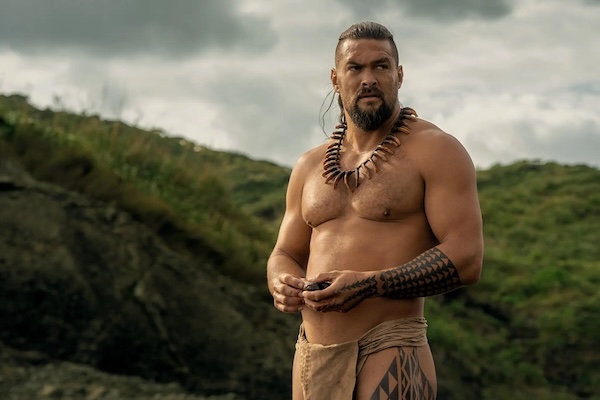
Jason Momoa in Chief of War, set in 18th-century Hawaii. Photo: Apple TV+
Despite being a part of the fifty states, Hawaiian history often remains shrouded in mystery. If you grew up on the mainland, you probably learned little about the past of the islands. And even if you grew up in Hawaii, your knowledge depends on how you were taught and from what perspective. (Of course, this same issue afflicts how US history is being taught in America.) But, thanks to the efforts of none other than Jason Momoa, Hawaiian history is finally receiving its due—at least in terms of historical TV dramas.
Chief of War is a pet project of Momoa’s, one he’s been trying to make for years. First, he had to star as Khal Drogo in Game of Thrones and as Aquaman before Hollywood would consider the idea of a Hawaiian epic. Now that he’s considered a star, Momoa was given the green light to co-write and co-create the series, with Thomas Pa’a Sibbitt. Note how this series came about. As much as Hollywood loves to tout its interest in diversity, you have to be a diverse star to get anyone with any real power to listen to you.
The fact is, it’s about damn time that Chief of War was made. Beautifully shot, emotionally charged, and featuring the talents of Native Hawaiian actors, Chief of War proves why stories like it need to be told.
Set at the turn of the 18th century, Chief of War follows Ka’iana (Momoa), a Native Hawaiian warrior who is introduced to us as he is wrestling a shark. Clearly, this is not a man to be messed with. Ka’iana is enjoying life in exile on Kauai with his family, but he’s soon summoned to the Kingdom of Maui. The leader, Kahekili (Temuera Morrison), asks Ka’iana to return to service in his army to defend the people against the Kingdom of Oahu. Ka’iana agrees but, in the ensuing melee, quickly concludes that Kahekili is a tyrant, hellbent on destroying all other royal bloodlines. Ka’iana ends up separated from his people and aboard a ship filled with colonial explorers (Important factoid: the series takes place after Captain Cook, who met his end in Hawaii). Meanwhile, Ka’iana’s wife, two brothers, and sister-in-law flee to Hawaii. Ka’iana eventually returns, armed with muskets and ammunition, and the battles continue. The series’ overarching story dramatizes the unification of the Hawaiian islands, but multiple plot lines interweave together to probe issues raised by gender roles, racism, and political intrigue.
Momoa and Pa’a Sibbitt’s narrative immerses you in Polynesian culture as well as the beauty of the Hawaiian islands. The physical detailing is exacting, ranging from the construction of villages to the appearance of weapons and ceremonial wear. Characters speak both Hawaiian and English (Hawaiian to each other, English to white folks).
And, while the series heavily focuses on war planning and battles, the focus is thankfully broader. I was drawn to Kaʻahumanu (Luciane Buchanan), who is being forced to marry Kamehameha (Kaina Makua), the son of Hawaii’s dying king. Unlike what has become the standard stereotype of a strong female character, Ka’ahumanu feels three-dimensional. She befriends a “pale-face” and asks him to teach her about his travels, but she never falls for him. And she treats him as her inferior. Yes her relationship with Kamehameha is understandably strained, but she doesn’t come across as a damsel in distress. She deals with her anger by throwing knives at a tree (who among us hasn’t wanted to do that?). The other female characters in the series aren’t pushed to the sideline; they are used to reveal the sins of the patriarchy in Hawaiian history.
Chief of War isn’t perfect. At times there’s a lot of exposition, and some of the battle scenes drag on and on. The series may have also benefited from being released all at once, rather than an installment, week by week. But no war epic is perfect — after all, war itself is inherently messy and grotesque.
The series shouldn’t have taken Momoa and Pa’a Sibbitt years to make. Hopefully, Hollywood will take note of this accomplishment, and more Indigenous stories will follow.
Sarah Mina Osman is based in Los Angeles. In addition to the Arts Fuse, her writing can be found in The Huffington Post, Success Magazine, Matador Network, HelloGiggles, Business Insider, and WatchMojo. She has an MFA in Creative Writing from the University of North Carolina Wilmington and is working on her first novel. She has a deep appreciation for sloths and tacos. You can keep up with her on Instagram @SarahMinaOsman and at Bluesky @sarahminaosman.bsky.social.