
Doc Talk: “Architecton” — Ozymandias Revisited
By Peter Keough
Deconstructing construction in Architecton
Architecton. Directed by Victor Kossakovsky. At the Loews Boston Common, the Kendall Square Cinema, the Somerville Theatre, and the suburbs.
A scene from Architecton. Photo: A24
Russian documentarian Victor Kossakovsky has turned his playful, poetic, and often profound gaze from the world of water in Aquarela (2018) to the animal kingdom in Gunda (2020), and now to the cold, inert realm of concrete and stone in his most recent film, the disappointing, portentously titled Architecton. Unsurprisingly, perhaps, the subject does not bring out the whimsy, ebullience, and wit found in his earlier efforts. On top of that, his previous two films made their points without much explanation. This one ends with an awkward, bromidic, and unilluminating dialogue between Kossakovsky and the architect Michele De Lucchi.
Nonetheless, the imagery, shot by frequent collaborator Ben Bernhard, remains astounding, if repetitive. As in his previous films, Kossakovsky is a master of the slow reveal. The film opens with a breathtaking drone shot of a huge building with a gap blasted out of its middle, making it look like an inverted arch. Backed by Evgueni Galperine’s ominous soundtrack, the drone passes more ruins, gazing at the exposed innards of apartment blocks, demolished buildings filled with pitiful abandoned TVs, bookcases, beds, and clothing of the former inhabitants. There are no people in the rubble-filled streets. Where is this? When a blasted building appears hung with a huge banner reading “Kick Russia out of the UN,” it becomes clear that it is one of the many cities razed by Russia in Ukraine.
A daring image for a filmmaker based in St. Petersburg to include but, perhaps understandably, this is as specific a statement as the film makes. More images of savage demolition follow, from ancient sites to a city ravaged by the recent earthquake in Turkey. In a striking shot in the latter, a car has been squashed by a giant, collapsed concrete building. The only life stirring in the uniform drabness of the wreckage is the busy, bright-colored, insect-like earthmovers and backhoes clearing the debris.
What is Kossakovsky driving at by juxtaposing these images? The meaning seems vague, if not banal, or even insidious. Is he saying that the destruction of Ukrainian cities should be seen in the context of the rise and fall of civilizations throughout history? Or is it part of the arbitrary violence of natural cataclysms? In the long run, is this just more of the same old, same old? Unfortunately, the Ukrainian victims in those razed cities don’t have the luxury of such an Olympian perspective. Nor is nature the force that has destroyed them — it is Russia. Though the images are stunning, even sublime, the message is muddled, if not perverse.
A scene from Architecton. Photo: A24
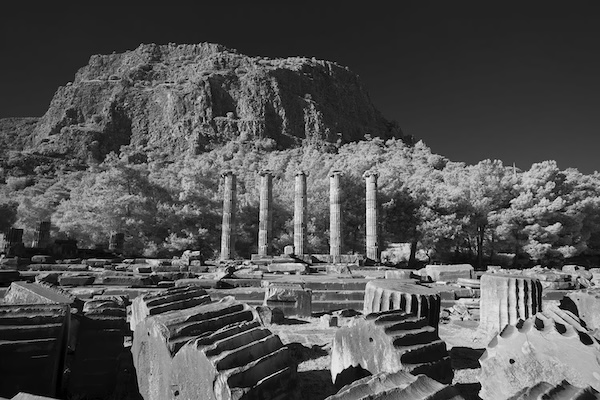
More appealing and poetic is De Lucchi’s exploration of the ancient ruins in Baalbek, Lebanon and other sites. In these sequences, Kossakovsky shows his talent for visual wit, with switches in scale achieved by editing and the disclosures made by a tracking shot, zoom, or pan. In a scene reminiscent of the quarry section of The Brutalist (2024), De Lucchi approaches and strokes the surface of a toppled oblong column as the camera moves and reveals the full enormity of the monolith. He wonders: how did these ancients achieve this? And why are we no longer capable of such immortal architecture?
Less impressive is an ongoing, intermittent project by De Lucchi and his helpers. At first it is unclear what they are doing as they measure out a circle in the garden of his estate and then fill in the perimeter with painstakingly chosen rocks. In the process, they unearth a weathered disc that looks like an old CD. De Lucchi speculates that it is a mystically serendipitous discovery and puts it in a place of honor in the center of the circle. When the circle is finished, it is declared magical. No human being is allowed inside, only dogs and horses.
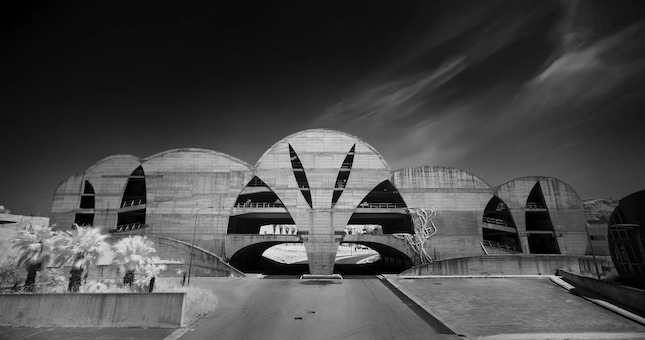
In the concluding conversation between the filmmaker and his subject, the latter is asked whether he expects future generations of his family to keep his magic circle intact. De Lucchi seems to think so, and then expresses his guilt about having himself designed a giant, ugly, concrete block of a building in Milan which probably will be torn down in about 40 years (or perhaps sooner, if the Russians deign to bomb it).
Concrete (the manufacture of which is shown in sometimes spectacular, sometimes laborious detail), the two conclude, is the downfall of architecture and perhaps civilization (as is mentioned in the film’s epilogue, concrete is, next to water, the most widely used substance on earth). Only by imitating ancient builders — and returning to the pure element of stone — can time-defying, life-affirming structures be achieved. That might come as a surprise to the Romans, who used concrete in such still-standing architectural masterpieces as the Pantheon, the Colosseum, and the aqueducts.
Peter Keough writes about film and other topics and has contributed to numerous publications. He was the film editor of the Boston Phoenix from 1989 to its demise in 2013 and has edited three books on film, most recently For Kids of All Ages: The National Society of Film Critics on Children’s Movies (Rowman & Littlefield, 2019).