
Concert Review: John Williams’ Piano Concerto Pays Homage to Jazz Legends
By Aaron Keebaugh
John Williams’s concert music may be intended to enrich and edify, but there’s always room for a little fandom, particularly on occasions like this. At 93, and after a lifetime of firsts, the composer deserves every accolade.
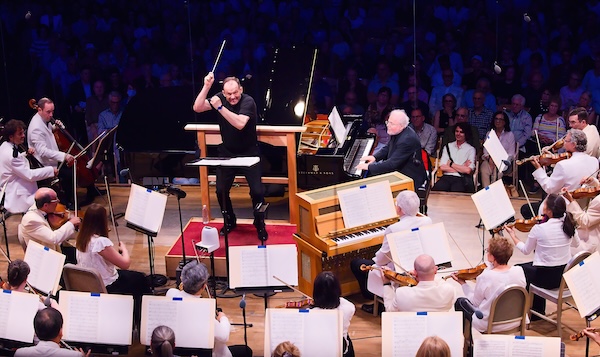
Andris Nelsons conducting the premiere of John Williams’s Piano Concerto with Emanuel Ax at Tanglewood. Photo: Hilary Scott
John Williams so revered the playing of four different pianists that he composed a concerto that resonated with their distinct styles. Though not entirely musical portraits of jazz and classical keyboard wizards, the music encapsulates Williams’s memories of listening to Art Tatum, Bill Evans, and Oscar Peterson. The fourth pianist, Emanuel Ax, served not only as the concerto’s dedicatee, but was the vital force who brought the score to life with the Boston Symphony Orchestra at Tanglewood’s Koussevitzky Shed this past weekend. Andris Nelsons led the way in the concerto’s world premiere.
Drawing on dark colors, Williams’s Concerto for Piano and Orchestra imitates the sounds of three different jazz stylists who could work marvels with 88 keys. Three soft but stately chords open the concerto. They represent memories of Tatum’s distinct approach to harmony—he often let chords fall freely before adding phrases that build to blistering cadenzas. As the concerto soloist mimics these flights of fancy, the orchestra hovers in the background like a harmonic haze.
Despite the inspirations, there’s little in the way of actual jazz in Williams’s score, only abstractions via the arpeggios, octave leaps, and clustered chords that characterized Tatum’s and the other pianists’ approaches to the instrument. The second movement recalls Bill Evans visually, much as sonically. A solo viola evokes images of a silent but serious man. The music is just as poignant. Ax worked his way between string and wind lines that hung in the air like mist. His phrases occasionally rose above the fog, emitting just enough improvisational flair before sinking back into the texture. The effect was a balanced give and take—the soloist was as much an accompanist to the orchestra as the other way around.
Tension returns in the third movement, which brims with the driving riffs associated with Oscar Peterson’s performances. The lines churn unabated, stumble momentarily on knots of harmony, and then resolve in deft flourishes. Through it all, Ax managed to be both cool and fiery. Nelsons coaxed sounds from the orchestra that were as felt as they were heard. The result was an auspicious pairing fit for one of Williams’ finest concert creations—the music was contemplative but never predictable. The piece consistently pushes against listeners’ expectations. When the music supplied the kinds of gestures and sweep Williams is known for, it could do so with unapologetic fervor.
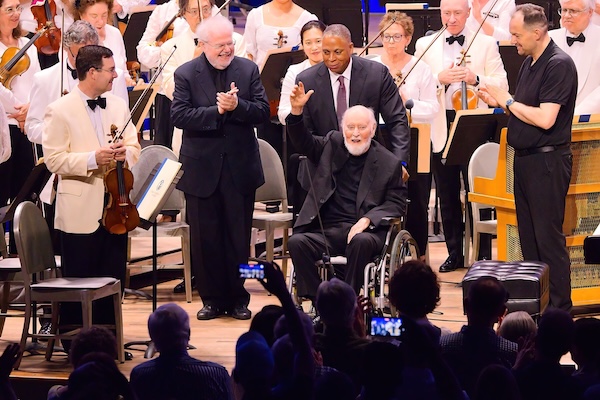
Applause for composer John Williams at Tanglewood. Photo: Gabriel Scott
The audience rewarded the performance with a standing ovation that grew into a roar when Williams appeared via wheelchair to take his bows. His concert music may be intended to enrich and edify, but there’s always room for a little fandom, particularly on occasions like this. At 93, and after a lifetime of firsts, Williams deserves every accolade.
The second half of the concert was dedicated to Gustav Mahler’s Symphony No. 1.
Few composers of the late nineteenth century embraced everything he heard quite like Mahler. His First Symphony, composed between 1887 and 1888, runs the gamut between slow mystery and outright exuberance. Ländlers, klezmer tunes, and funeral marches collide with quotations from the composer’s Lieder eines fahrenden Gesellen. But, in the right hands, the sum of its various parts can yield compelling results.
Time will still tell if Nelsons will be one of those conductors who can convey all the subtle interactions between inward strife and outward joy. To be fair, his approach to the piece has matured considerably. He has traditionally favored an overly detailed approach; last weekend, his performance leaned into underlining the dramatic contrasts, and that strategy was mostly successful.
The most serious problem emerged in the third movement. While the opening dialogue between double bass, bassoon, and tuba flickered like starlight, Nelsons suddenly opened the throttle during the klezmer-like passages, a gung-ho effect that verged on the grotesque. The composer’s gloomy wit was pushed aside. Instead, the music came off as an exercise in snark — it was more reminiscent of Shostakovich than Mahler.
That said, the best aspects of this performance revealed Nelsons’s penchant for big-picture payoff. The conductor smoothly guided the orchestra through the wayward transformations in mood during the opening movement, a few flubbed wind entrances apart. To his credit, Nelsons kept a careful eye on the music’s innate lyricism. His call for subtle rubato enabled the quotations of “Ging heut’ Morgen über’s Feld” to have the lift of a Swiss air. The ensuing melodies flowered beautifully in solo trumpet and strings.
The Ländler bounded with noble grandeur. Here, too, Nelsons worked in bold colors, stretching the Trio’s soaring lines without undue exaggeration.
The finale was a powerful musical journey from tragedy to triumph. The BSO brass supplied sonic warmth and light in equal measure, bringing the performance to a rousing–and aptly Mahlerian–conclusion.
Aaron Keebaugh has been a classical music critic in Boston since 2012. His work has been featured in the Musical Times, Corymbus, Boston Classical Review, Early Music America, and BBC Radio 3. A musicologist, he teaches at North Shore Community College in both Danvers and Lynn.
Tagged: Andris Nelsons, Boston Symphony Orchestra